 Add to Chrome
 Add to Firefox
 Add to Edge
A Cross-Architecture Audit of Direction-Based Inference-Time Defences in Vision-Language Models
Jul 30, 2026
Inference time defences against vision language model jailbreaks often subtract a calibrated direction from the residual stream at a chosen decoder layer. We compare five defence candidates across 15 model and layer cells from four architectural families under a magnitude controlled protocol that matches the intervention size for each prompt and pairs every direction with a random control of the same norm. The candidates are the mean image conditioning shift, a CMRM style refusal direction, a ShiftDC style attack specific residual, a prompt instruction to ignore the image, and a random control. No single candidate dominates on both refusal recovery and utility preservation. The image conditioning shift leads on LLaVA 1.5 and Pixtral 12B and is the only candidate whose utility loss remains at the measurement noise floor in every family. The prompt instruction leads on Qwen2.5 VL, while the attack specific residual leads on Qwen2 VL 2B. The image conditioning direction is direction specific in 13 of 15 cells, but strongly architecture specific and nontransferable across the only dimension compatible pair, LLaVA 1.5 13B and Pixtral 12B. We also connect text only and multimodal refusal geometry. The CMRM direction has positive cosine alignment with the image conditioning shift in all 15 cells, with mean 0.35, range 0.17 to 0.65, 15 to 25 times the random vector null, and a sign test p value of about 3e-5. These results show that the two recipes recover partially overlapping geometry and that direction based defences should be calibrated separately for each language decoder family.

An integrated process for design and control of lunar robotics using AI and simulation
Sep 15, 2025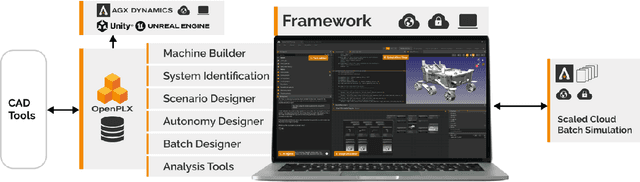
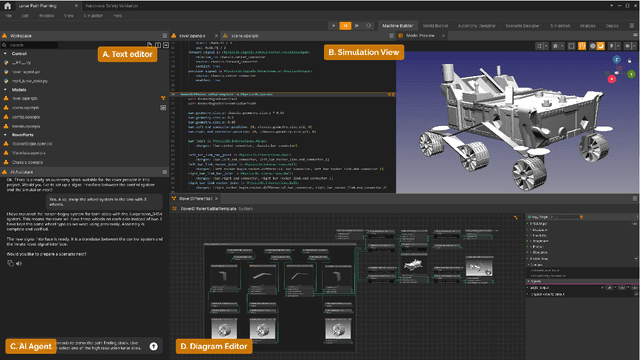
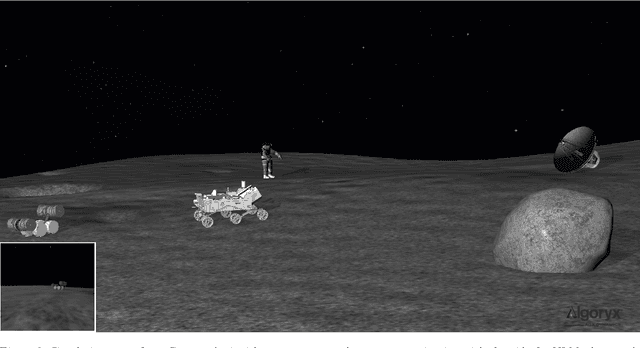
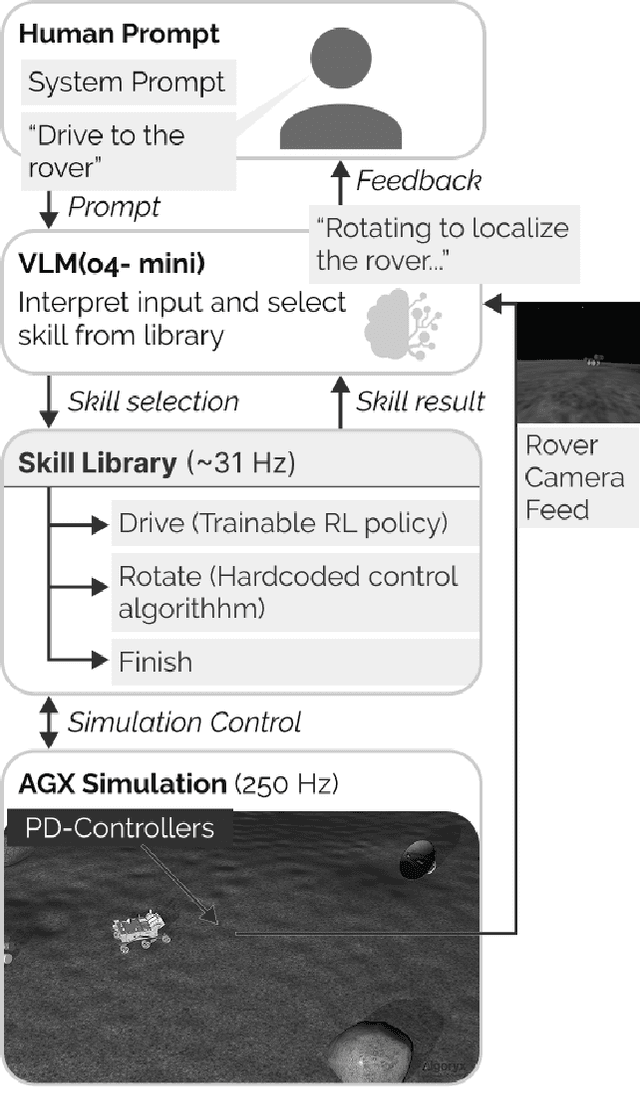
We envision an integrated process for developing lunar construction equipment, where physical design and control are explored in parallel. In this paper, we describe a technical framework that supports this process. It relies on OpenPLX, a readable/writable declarative language that links CAD-models and autonomous systems to high-fidelity, real-time 3D simulations of contacting multibody dynamics, machine regolith interaction forces, and non-ideal sensors. To demonstrate its capabilities, we present two case studies, including an autonomous lunar rover that combines a vision-language model for navigation with a reinforcement learning-based control policy for locomotion.