 Add to Chrome
 Add to Firefox
 Add to Edge
Messier: A High-Resolution Corpus for Cross-Benchmark Agent Evaluation
Jul 28, 2026
Evaluating AI agents in interactive environments is hindered by fragmented tasks, scaffolds, verifiers, and scoring rules. Existing efforts focus on narrow settings, remain limited in scale, or require costly reruns, leaving much of the empirical record incomparable. We introduce Messier, a unified corpus of 957,253 records that span 30 benchmarks, 714 agents, 11,891 tasks, and 74,205 verifiers. Messier consolidates public benchmark scores and supplements them with five-agent runs across six underrepresented professional and scientific domains, including a recent legal benchmark. Each record is standardized by model, scaffold, environment, task, verifier, and aggregation rule, with SOC/NAICS classifications for occupational and industry analysis. Using this corpus, we show frontier progress is uneven across benchmark types, with "function calling" saturated, "programming" improving the fastest, and "enterprise workflows" remaining the most challenging. Furthermore, counterfactual rescoring shows that strict all-pass aggregation in multi-verifier tasks can obscure progress and artificially alter agent rankings. From these standardized records, we derive capability scales that align with Epoch's Evaluation Capability Index rankings at Spearman \r{ho} = 0.81 and can be specialized by domain, occupation, action space, or verifier type. Messier provides a foundational, reusable infrastructure for agent capability scaling, benchmark auditing, and fine-grained analysis of evaluation failures.

HashEvict: A Pre-Attention KV Cache Eviction Strategy using Locality-Sensitive Hashing
Dec 24, 2024

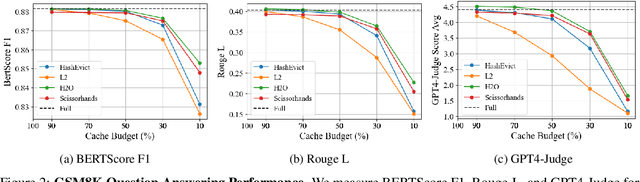
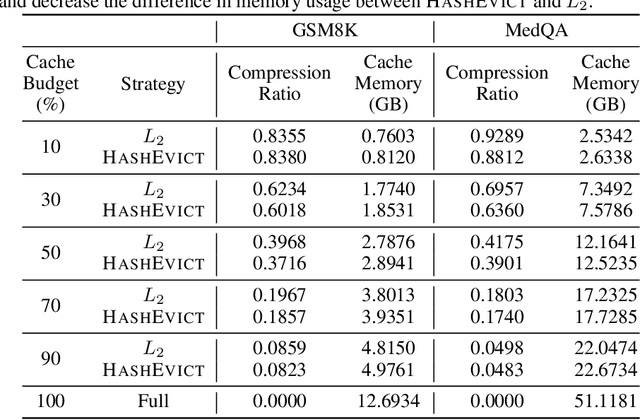
Transformer-based large language models (LLMs) use the key-value (KV) cache to significantly accelerate inference by storing the key and value embeddings of past tokens. However, this cache consumes significant GPU memory. In this work, we introduce HashEvict, an algorithm that uses locality-sensitive hashing (LSH) to compress the KV cache. HashEvict quickly locates tokens in the cache that are cosine dissimilar to the current query token. This is achieved by computing the Hamming distance between binarized Gaussian projections of the current token query and cached token keys, with a projection length much smaller than the embedding dimension. We maintain a lightweight binary structure in GPU memory to facilitate these calculations. Unlike existing compression strategies that compute attention to determine token retention, HashEvict makes these decisions pre-attention, thereby reducing computational costs. Additionally, HashEvict is dynamic - at every decoding step, the key and value of the current token replace the embeddings of a token expected to produce the lowest attention score. We demonstrate that HashEvict can compress the KV cache by 30%-70% while maintaining high performance across reasoning, multiple-choice, long-context retrieval and summarization tasks.