 Add to Chrome
 Add to Firefox
 Add to Edge
Modality vs. Morphology: A Framework for Time Series Classification for Biological Signals
May 18, 2026
Time series classification (TSC) of biological signals has progressed from handcrafted, modality-specific approaches to deep architectures capable of representing the diverse waveform structures of underlying physiological processes (i.e., morphology). This review introduces a unified morphology--modality framework that connects waveform structure to a methodological design, revealing how spikes, bursts, oscillations, slow drift, and hierarchical rhythms inform model design. By analyzing electroencephalography, electromyography, electrocardiography, photoplethysmography, and ocular modalities (electrooculography, pupillometry, eye-tracking), the review demonstrates how morphology determines preprocessing and modeling strategies. Integrating evidence across these biological signals, the framework reveals that morphology, not model class, most strongly determines performance and interpretability. This provides insight into why deep models succeed when their inductive biases align with underlying waveform dynamics. This review also identifies future work including morphological data augmentation and evaluation metrics to improve generalization. Together, these insights position morphology-aware modeling as a unifying principle for developing generalizable, interpretable, and physiologically meaningful TSC models across biological signals.

CLAMP: Majorized Plug-and-Play for Coherent 3D LIDAR Imaging
Jun 19, 2024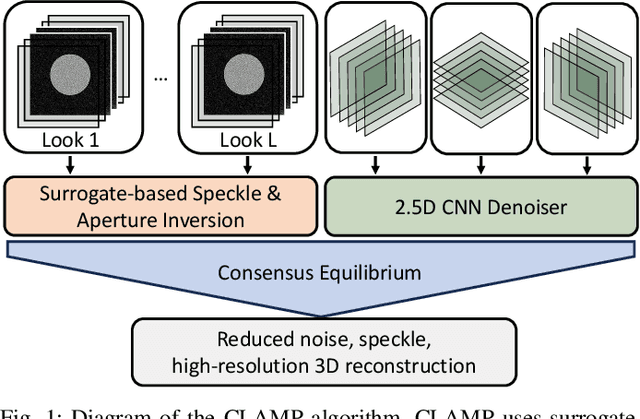
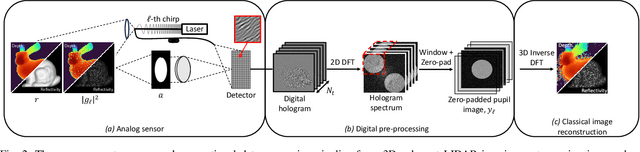
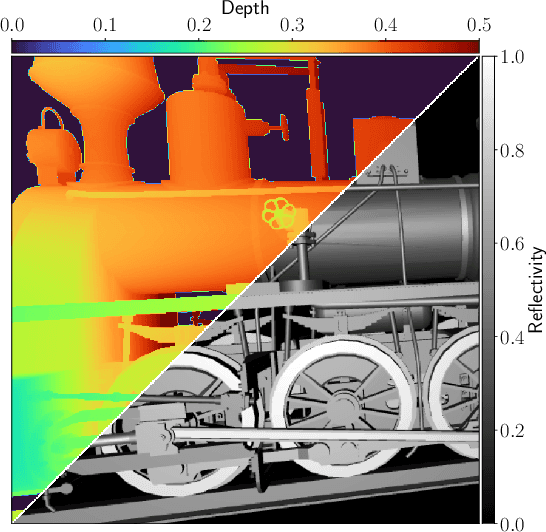
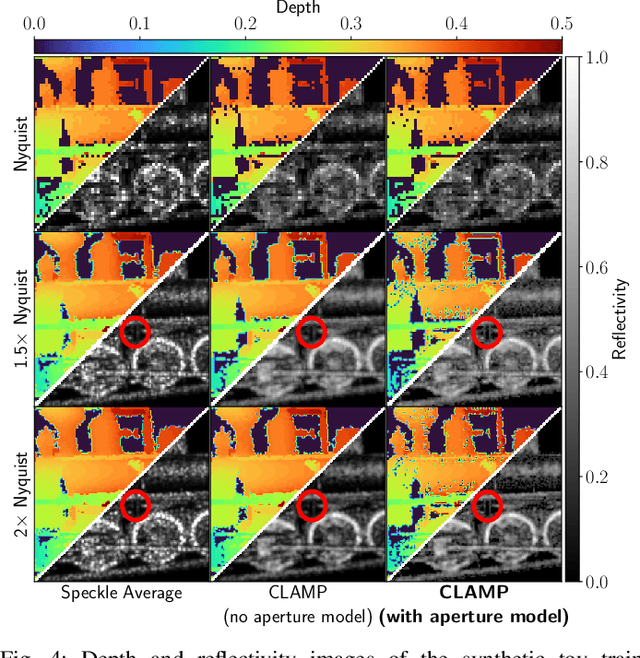
Coherent LIDAR uses a chirped laser pulse for 3D imaging of distant targets. However, existing coherent LIDAR image reconstruction methods do not account for the system's aperture, resulting in sub-optimal resolution. Moreover, these methods use majorization-minimization for computational efficiency, but do so without a theoretical treatment of convergence. In this paper, we present Coherent LIDAR Aperture Modeled Plug-and-Play (CLAMP) for multi-look coherent LIDAR image reconstruction. CLAMP uses multi-agent consensus equilibrium (a form of PnP) to combine a neural network denoiser with an accurate physics-based forward model. CLAMP introduces an FFT-based method to account for the effects of the aperture and uses majorization of the forward model for computational efficiency. We also formalize the use of majorization-minimization in consensus optimization problems and prove convergence to the exact consensus equilibrium solution. Finally, we apply CLAMP to synthetic and measured data to demonstrate its effectiveness in producing high-resolution, speckle-free, 3D imagery.