 Add to Chrome
 Add to Firefox
 Add to Edge
Efficient Computing for Medical Image Acquisition and Reconstruction
Jul 14, 2026
Medical imaging systems such as CT, MRI, PET, and SPECT do not directly acquire images. Instead, they measure physical signals that encode anatomical or physiological information, and image reconstruction recovers the underlying image by solving an inverse problem. Although these imaging modalities are governed by different imaging physics, they share a common computational framework that naturally connects medical physics, linear algebra, probability, numerical optimization, and efficient computing. As medical imaging systems acquire increasingly large and higher-dimensional datasets, image reconstruction has become one of the primary computational bottlenecks in modern medical imaging. Advanced reconstruction methods, including analytical reconstruction, iterative optimization, and statistical model-based reconstruction, substantially improve image quality while reducing radiation dose or scan time, but at significantly increased computational cost. Efficient computing has therefore become essential for achieving clinically practical reconstruction times. This chapter presents a unified computational perspective on medical image acquisition and reconstruction across CT, MRI, PET, and SPECT. It first reviews the imaging physics and data acquisition process for each modality and derives a generalized mathematical framework for image reconstruction. Building on this framework, the chapter discusses analytical, iterative, and statistical reconstruction methods together with their computational characteristics. Finally, it examines efficient computing considerations, including optimization algorithms, physics-aware forward operators, memory-efficient implementations, and parallel computing strategies. Together, these topics demonstrate how the integration of imaging physics, mathematical modeling, and efficient computing enables accurate and scalable medical image reconstruction.

Modality vs. Morphology: A Framework for Time Series Classification for Biological Signals
May 18, 2026Time series classification (TSC) of biological signals has progressed from handcrafted, modality-specific approaches to deep architectures capable of representing the diverse waveform structures of underlying physiological processes (i.e., morphology). This review introduces a unified morphology--modality framework that connects waveform structure to a methodological design, revealing how spikes, bursts, oscillations, slow drift, and hierarchical rhythms inform model design. By analyzing electroencephalography, electromyography, electrocardiography, photoplethysmography, and ocular modalities (electrooculography, pupillometry, eye-tracking), the review demonstrates how morphology determines preprocessing and modeling strategies. Integrating evidence across these biological signals, the framework reveals that morphology, not model class, most strongly determines performance and interpretability. This provides insight into why deep models succeed when their inductive biases align with underlying waveform dynamics. This review also identifies future work including morphological data augmentation and evaluation metrics to improve generalization. Together, these insights position morphology-aware modeling as a unifying principle for developing generalizable, interpretable, and physiologically meaningful TSC models across biological signals.
The Double-Edged Sword of Data-Driven Super-Resolution: Adversarial Super-Resolution Models
Feb 06, 2026Data-driven super-resolution (SR) methods are often integrated into imaging pipelines as preprocessing steps to improve downstream tasks such as classification and detection. However, these SR models introduce a previously unexplored attack surface into imaging pipelines. In this paper, we present AdvSR, a framework demonstrating that adversarial behavior can be embedded directly into SR model weights during training, requiring no access to inputs at inference time. Unlike prior attacks that perturb inputs or rely on backdoor triggers, AdvSR operates entirely at the model level. By jointly optimizing for reconstruction quality and targeted adversarial outcomes, AdvSR produces models that appear benign under standard image quality metrics while inducing downstream misclassification. We evaluate AdvSR on three SR architectures (SRCNN, EDSR, SwinIR) paired with a YOLOv11 classifier and demonstrate that AdvSR models can achieve high attack success rates with minimal quality degradation. These findings highlight a new model-level threat for imaging pipelines, with implications for how practitioners source and validate models in safety-critical applications.
ResSR: A Residual Approach to Super-Resolving Multispectral Images
Aug 23, 2024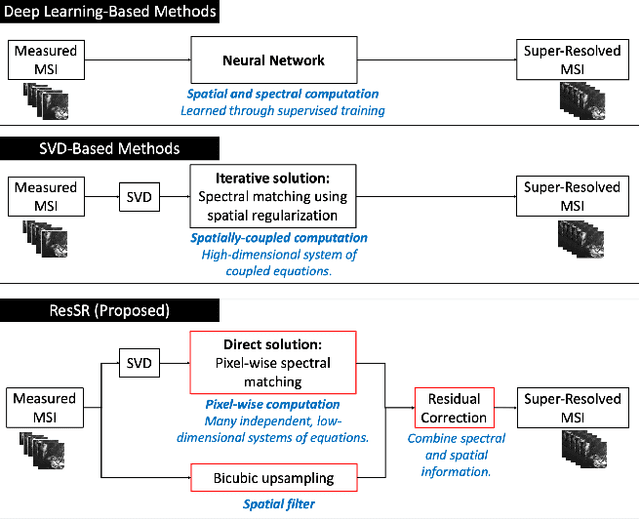


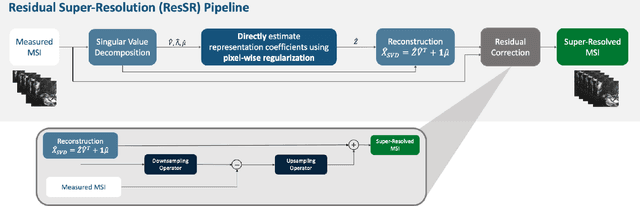
Multispectral imaging sensors typically have wavelength-dependent resolution, which reduces the ability to distinguish small features in some spectral bands. Existing super-resolution methods upsample a multispectral image (MSI) to achieve a common resolution across all bands but are typically sensor-specific, computationally expensive, and may assume invariant image statistics across multiple length scales. In this paper, we introduce ResSR, an efficient and modular residual-based method for super-resolving the lower-resolution bands of a multispectral image. ResSR uses singular value decomposition (SVD) to identify correlations across spectral bands and then applies a residual correction process that corrects only the high-spatial frequency components of the upsampled bands. The SVD formulation improves the conditioning and simplifies the super-resolution problem, and the residual method retains accurate low-spatial frequencies from the measured data while incorporating high-spatial frequency detail from the SVD solution. While ResSR is formulated as the solution to an optimization problem, we derive an approximate closed-form solution that is fast and accurate. We formulate ResSR for any number of distinct resolutions, enabling easy application to any MSI. In a series of experiments on simulated and measured Sentinel-2 MSIs, ResSR is shown to produce image quality comparable to or better than alternative algorithms. However, it is computationally faster and can run on larger images, making it useful for processing large data sets.