 Add to Chrome
 Add to Firefox
 Add to Edge
Training single-electron and single-photon stochastic physical neural networks
Apr 12, 2026
The computational demands of deep learning motivate the investigation of alternative approaches to computation. One alternative is physical neural networks~(PNNs), in which learning and inference are performed directly via physical processes. Stochastic PNNs arise when the underlying neurons are realized by the dynamics of a stochastic activation switch. Here we propose novel electronic and photonic stochastic neurons. The electronic realization is implemented by single-electron tunneling through a quantum dot. The photonic realization is implemented via a single-photon source driving one of two modes coupled via a controllable beam-splitter-like interaction. In the electronic case, the charge state of the quantum dot forms the basis for the stochastic neuron, whereas in the photonic case the occupation of the undriven mode serves as the basis for the stochastic neuron. Training of stochastic PNNs is performed with models of stochastic neurons, as well as with coherently-driven, single-photon detector stochastic neurons previously introduced. Several training strategies for MNIST handwritten digit classification have been investigated using single-hidden-layer stochastic PNNs, including varying the number of trials in each layer to control forward pass stochasticity and employing either true probability or empirical outputs in the backward pass to evaluate their influence on gradient estimation. We show that when empirical outputs are used in the backward pass, the network achieves more than 97\% test accuracy with few trials per layer. Despite the simplicity of the model architecture, high test accuracy is maintained in the presence of a high degree of noise and model uncertainty. The results demonstrate the potential of embracing stochastic PNNs for deep learning.

Efficient Quantum Feature Extraction for CNN-based Learning
Jan 07, 2022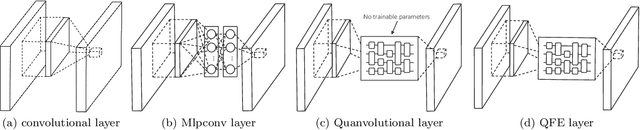
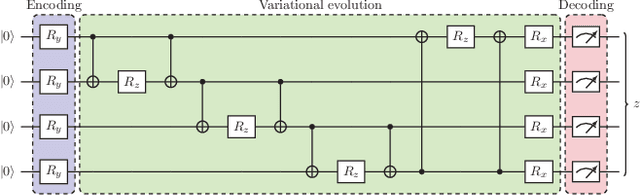
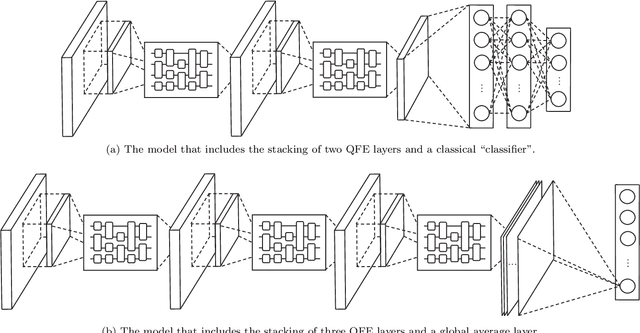
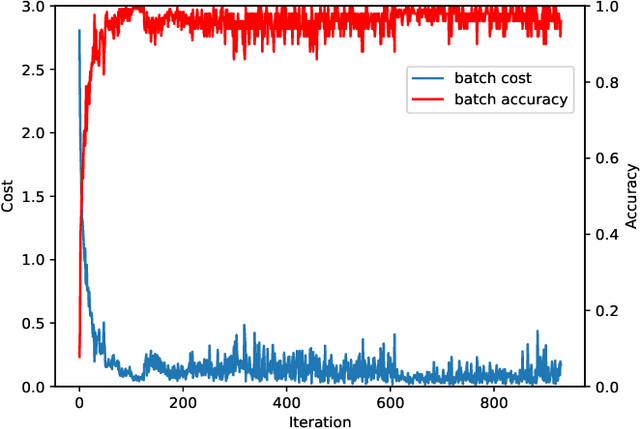
Recent work has begun to explore the potential of parametrized quantum circuits (PQCs) as general function approximators. In this work, we propose a quantum-classical deep network structure to enhance classical CNN model discriminability. The convolutional layer uses linear filters to scan the input data. Moreover, we build PQC, which is a more potent function approximator, with more complex structures to capture the features within the receptive field. The feature maps are obtained by sliding the PQCs over the input in a similar way as CNN. We also give a training algorithm for the proposed model. The hybrid models used in our design are validated by numerical simulation. We demonstrate the reasonable classification performances on MNIST and we compare the performances with models in different settings. The results disclose that the model with ansatz in high expressibility achieves lower cost and higher accuracy.