 Add to Chrome
 Add to Firefox
 Add to Edge
SUNTA: Hierarchical Video Prediction with Surprise-based Chunking
Jul 02, 2026
Hierarchical state-space models (HSSMs) offer a promising approach to long-horizon prediction by segmenting sequences into temporal chunks. However, their performance hinges on how chunk boundaries are determined. While prior HSSMs typically rely on fixed-length chunking or similarity-based boundary detection, these methods often misalign with the intrinsic temporal structure of the data. We argue that chunking should instead be driven by prediction errors, which more directly indicate when longer-range context becomes necessary. Nevertheless, integrating surprise-based chunking into HSSMs introduces critical challenges, including hierarchical collapse during end-to-end training and the absence of surprise signals during open-loop prediction. To address these issues, we propose Surprise-based Nested Temporal Abstraction (SUNTA), a method that employs a decoupled training strategy to preserve surprise signals and uses internal inconsistency as a top-down surprise metric to determine chunk boundaries within imagined rollouts. Experiments on video prediction tasks in 2D and 3D environments demonstrate that SUNTA outperforms baselines, uniquely maintaining accurate predictions over 250 timesteps, whereas all baselines degrade within the first 10 timesteps.

ADOPT: Modified Adam Can Converge with Any $β_2$ with the Optimal Rate
Nov 05, 2024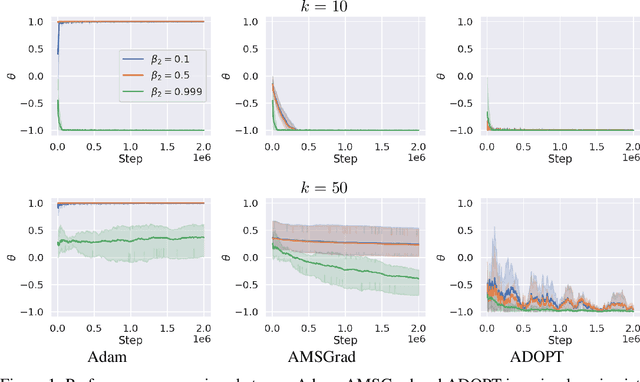
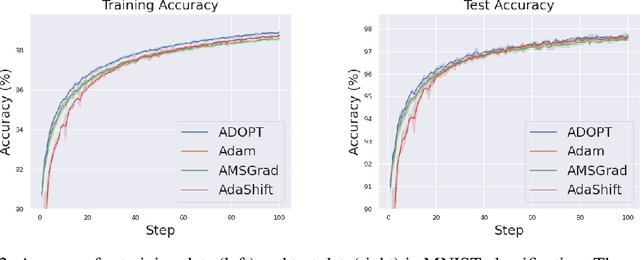


Adam is one of the most popular optimization algorithms in deep learning. However, it is known that Adam does not converge in theory unless choosing a hyperparameter, i.e., $\beta_2$, in a problem-dependent manner. There have been many attempts to fix the non-convergence (e.g., AMSGrad), but they require an impractical assumption that the gradient noise is uniformly bounded. In this paper, we propose a new adaptive gradient method named ADOPT, which achieves the optimal convergence rate of $\mathcal{O} ( 1 / \sqrt{T} )$ with any choice of $\beta_2$ without depending on the bounded noise assumption. ADOPT addresses the non-convergence issue of Adam by removing the current gradient from the second moment estimate and changing the order of the momentum update and the normalization by the second moment estimate. We also conduct intensive numerical experiments, and verify that our ADOPT achieves superior results compared to Adam and its variants across a wide range of tasks, including image classification, generative modeling, natural language processing, and deep reinforcement learning. The implementation is available at https://github.com/iShohei220/adopt.