 Add to Chrome
 Add to Firefox
 Add to Edge
Optimal Rates for Differentially Private Hypothesis Testing with E-values
May 27, 2026
E-values have attracted considerable interest in recent years as flexible tools for enabling anytime-valid and adaptive data analysis. Hypothesis testing is at the core of many of these applications, which can often involve private or sensitive data. In this work, we answer a simple but important question: given two distributions $\mathbb{P}$ and $\mathbb{Q}$, what is the maximum achievable e-power when testing $X\sim \mathbb{P}^n$ against $X\sim\mathbb{Q}^n$ with e-values that satisfy $\varepsilon$-differential privacy? We characterize the optimal rate for this problem and provide an algorithm which matches it exactly. In the sequential setting, when observations arrive one-by-one and the analyst chooses when to halt, we give matching upper and lower bounds on the stopping times of any private e-process. Numerical experiments confirm the practicality of our algorithms, which require less data than the recently proposed DP-SPRT across a range of sequential testing problems and privacy levels.

UDAMA: Unsupervised Domain Adaptation through Multi-discriminator Adversarial Training with Noisy Labels Improves Cardio-fitness Prediction
Jul 31, 2023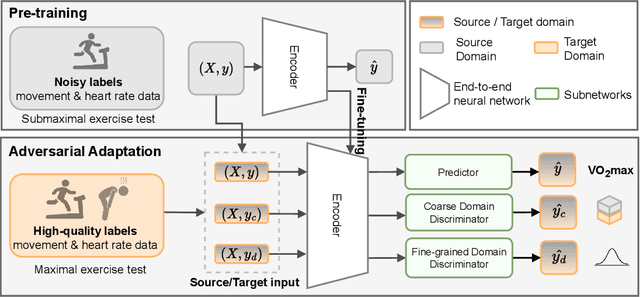
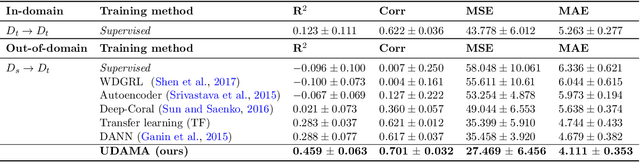
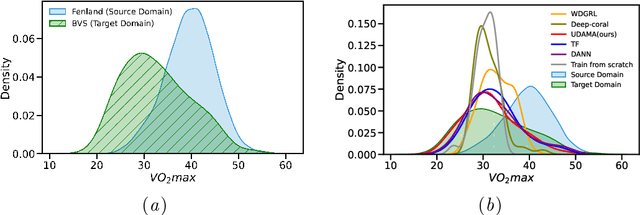

Deep learning models have shown great promise in various healthcare monitoring applications. However, most healthcare datasets with high-quality (gold-standard) labels are small-scale, as directly collecting ground truth is often costly and time-consuming. As a result, models developed and validated on small-scale datasets often suffer from overfitting and do not generalize well to unseen scenarios. At the same time, large amounts of imprecise (silver-standard) labeled data, annotated by approximate methods with the help of modern wearables and in the absence of ground truth validation, are starting to emerge. However, due to measurement differences, this data displays significant label distribution shifts, which motivates the use of domain adaptation. To this end, we introduce UDAMA, a method with two key components: Unsupervised Domain Adaptation and Multidiscriminator Adversarial Training, where we pre-train on the silver-standard data and employ adversarial adaptation with the gold-standard data along with two domain discriminators. In particular, we showcase the practical potential of UDAMA by applying it to Cardio-respiratory fitness (CRF) prediction. CRF is a crucial determinant of metabolic disease and mortality, and it presents labels with various levels of noise (goldand silver-standard), making it challenging to establish an accurate prediction model. Our results show promising performance by alleviating distribution shifts in various label shift settings. Additionally, by using data from two free-living cohort studies (Fenland and BBVS), we show that UDAMA consistently outperforms up to 12% compared to competitive transfer learning and state-of-the-art domain adaptation models, paving the way for leveraging noisy labeled data to improve fitness estimation at scale.