 Add to Chrome
 Add to Firefox
 Add to Edge
LazyHMC: Hamiltonian Monte Carlo Simulation for Lazy, Infinite Dimensional Probabilistic Programs
Aug 09, 2026
Hamiltonian Monte Carlo (HMC) is a successful generic inference method in probabilistic programming, but in its ordinary formulation it needs gradients and finite-dimensional parameter spaces. In Haskell, lazy evaluation lets probabilistic programs express stochastic processes and other non-parametric Bayesian models over implicit infinite-dimensional spaces. This paper develops new formulations of gradient-based HMC for this infinite-dimensional setting, via lazy evaluation. For automatic differentiation, we provide an analysis based on a new notion of "piecewise analytic under cylindrical analytic partition" (PACAP), to show that even if a program is infinite-dimensional and defined lazily, the gradient of the likelihood function is finitely supported. For the Monte Carlo method itself, we develop several HMC variants and a No-U-Turn Sampler that operate over the infinite-dimensional parameter space but are still productive because of lazy evaluation. Experiments cover Gaussian mixture clustering, random walks, and piecewise-constant regression with Poisson-process changepoints.
* 41 pages

Search Combinators
Mar 06, 2012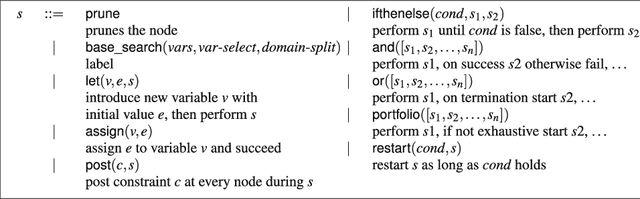
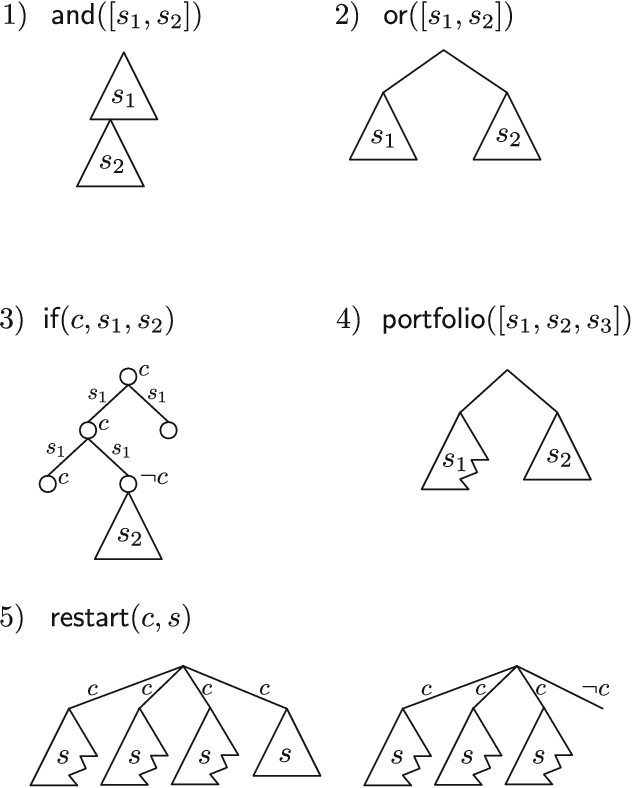
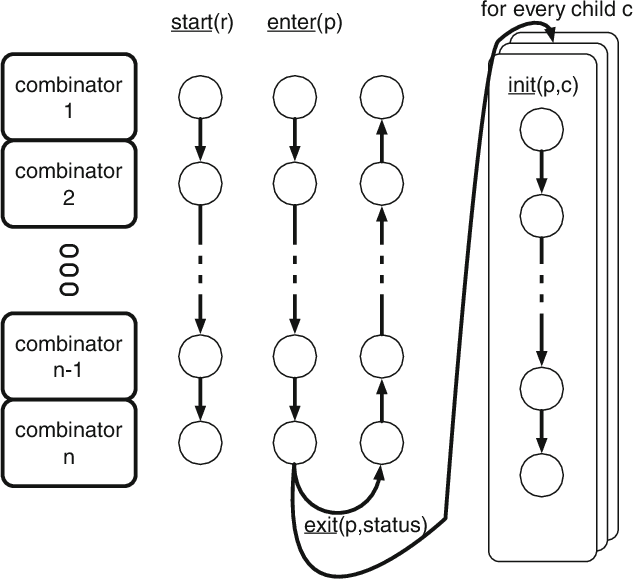
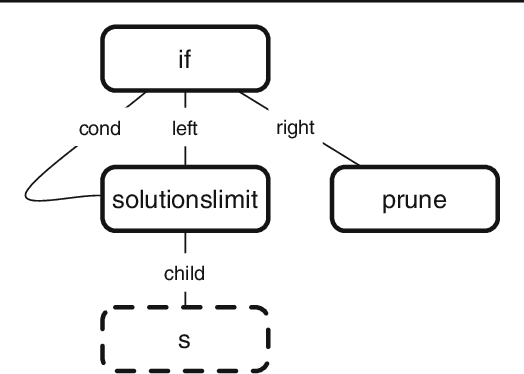
The ability to model search in a constraint solver can be an essential asset for solving combinatorial problems. However, existing infrastructure for defining search heuristics is often inadequate. Either modeling capabilities are extremely limited or users are faced with a general-purpose programming language whose features are not tailored towards writing search heuristics. As a result, major improvements in performance may remain unexplored. This article introduces search combinators, a lightweight and solver-independent method that bridges the gap between a conceptually simple modeling language for search (high-level, functional and naturally compositional) and an efficient implementation (low-level, imperative and highly non-modular). By allowing the user to define application-tailored search strategies from a small set of primitives, search combinators effectively provide a rich domain-specific language (DSL) for modeling search to the user. Remarkably, this DSL comes at a low implementation cost to the developer of a constraint solver. The article discusses two modular implementation approaches and shows, by empirical evaluation, that search combinators can be implemented without overhead compared to a native, direct implementation in a constraint solver.