 Add to Chrome
 Add to Firefox
 Add to Edge
Jolia: Concept-Level Vision-Language Alignment for 3D CT Contrastive Learning
Jun 24, 2026
Vision-language contrastive pretraining has become the dominant recipe for 3D medical foundation models, leveraging the large volumes of paired scans and reports produced in clinical practice. However, medical images usually span dozens of organs, and radiological reports are much longer than typical natural image captions and are composed of multiple structured sections. CLIP-style pretraining compresses this structure by encoding each modality into a single global token, at the risk of losing important details. We introduce ConQuer (Concept Queries), an image-text pretraining method that augments CLIP's global alignment with a set of localized alignments, one per concept. ConQuer splits the report into concept-specific sections and learns cross-attention queries that pool the matching image features without using any segmentation mask or spatial supervision. Contrastive learning is then applied independently for each concept. Concepts can be any unit of semantic localization; here, they are anatomical regions, one query per organ or gross body region. As a byproduct, each query learns attention maps focused on its concept, providing built-in spatial interpretability. We use ConQuer to train Jolia, a 3D CT foundation model on chest and abdominal CT. Jolia consistently outperforms a CLIP baseline on findings classification, report generation, and cross-center transfer, and sets a new state of the art across multiple public benchmarks. Jolia's weights are available at https://huggingface.co/raidium/Jolia

RadSAM: Segmenting 3D radiological images with a 2D promptable model
Apr 29, 2025
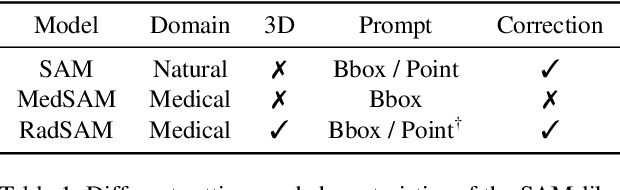
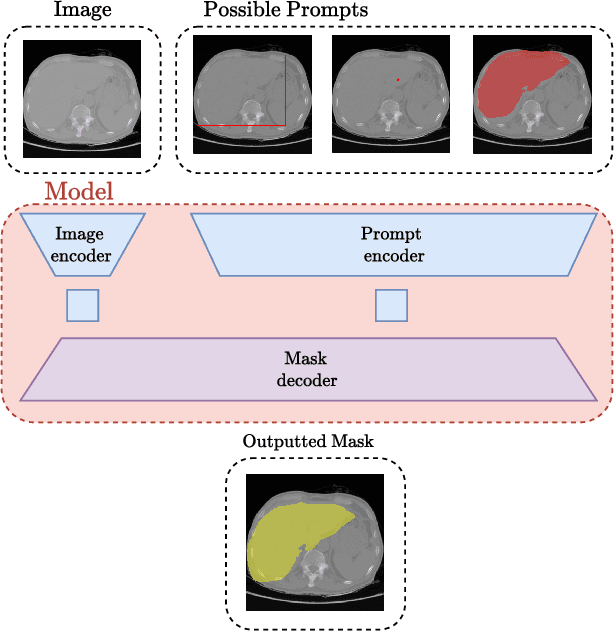
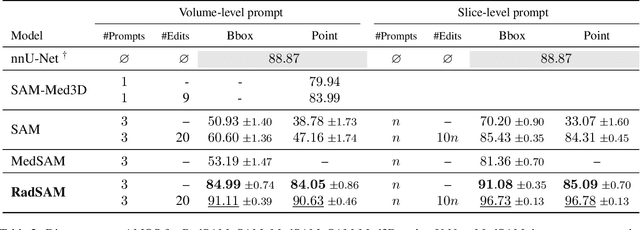
Medical image segmentation is a crucial and time-consuming task in clinical care, where mask precision is extremely important. The Segment Anything Model (SAM) offers a promising approach, as it provides an interactive interface based on visual prompting and edition to refine an initial segmentation. This model has strong generalization capabilities, does not rely on predefined classes, and adapts to diverse objects; however, it is pre-trained on natural images and lacks the ability to process medical data effectively. In addition, this model is built for 2D images, whereas a whole medical domain is based on 3D images, such as CT and MRI. Recent adaptations of SAM for medical imaging are based on 2D models, thus requiring one prompt per slice to segment 3D objects, making the segmentation process tedious. They also lack important features such as editing. To bridge this gap, we propose RadSAM, a novel method for segmenting 3D objects with a 2D model from a single prompt. In practice, we train a 2D model using noisy masks as initial prompts, in addition to bounding boxes and points. We then use this novel prompt type with an iterative inference pipeline to reconstruct the 3D mask slice-by-slice. We introduce a benchmark to evaluate the model's ability to segment 3D objects in CT images from a single prompt and evaluate the models' out-of-domain transfer and edition capabilities. We demonstrate the effectiveness of our approach against state-of-the-art models on this benchmark using the AMOS abdominal organ segmentation dataset.