 Add to Chrome
 Add to Firefox
 Add to Edge
Curia-MAE: Multi-Modal Multi-Anatomy MAE Pre-Training for 3D Medical Image Segmentation
Aug 07, 2026
Radiology foundation models learn transferable representations that can be adapted to new tasks by training only small layers on top of a frozen encoder. Dense prediction tasks such as 3D segmentation are, however, underrepresented in their evaluation, and, with the encoder kept frozen, pre-trained models still fall short of nnU-Net, the state-of-the-art reference trained from scratch. To close this gap we extend convolutional MAE pre-training with a robust reconstruction objective, a feature regularizer, and a local-global similarity objective. Using this method, we propose Curia-MAE, a multi-modal, multi-anatomy MAE model pre-trained on 300,000 CT and MRI images covering a large number of anatomical sites. On eight anatomy- and lesion-focused segmentation benchmarks, Curia-MAE improves frozen-encoder performance over a strong MAE baseline, while remaining competitive under full finetuning and superior on lesion tasks, where labeled data is scarce. These results indicate that a single frozen encoder can be reused across diverse segmentation tasks, reducing the cost of adapting and deploying such models in clinical workflows. Curia-MAE pre-trained model weights are made publicly available at https://huggingface.co/raidium/Curia-MAE.

Jolia: Concept-Level Vision-Language Alignment for 3D CT Contrastive Learning
Jun 24, 2026Vision-language contrastive pretraining has become the dominant recipe for 3D medical foundation models, leveraging the large volumes of paired scans and reports produced in clinical practice. However, medical images usually span dozens of organs, and radiological reports are much longer than typical natural image captions and are composed of multiple structured sections. CLIP-style pretraining compresses this structure by encoding each modality into a single global token, at the risk of losing important details. We introduce ConQuer (Concept Queries), an image-text pretraining method that augments CLIP's global alignment with a set of localized alignments, one per concept. ConQuer splits the report into concept-specific sections and learns cross-attention queries that pool the matching image features without using any segmentation mask or spatial supervision. Contrastive learning is then applied independently for each concept. Concepts can be any unit of semantic localization; here, they are anatomical regions, one query per organ or gross body region. As a byproduct, each query learns attention maps focused on its concept, providing built-in spatial interpretability. We use ConQuer to train Jolia, a 3D CT foundation model on chest and abdominal CT. Jolia consistently outperforms a CLIP baseline on findings classification, report generation, and cross-center transfer, and sets a new state of the art across multiple public benchmarks. Jolia's weights are available at https://huggingface.co/raidium/Jolia
RAPS-3D: Efficient interactive segmentation for 3D radiological imaging
Jul 10, 2025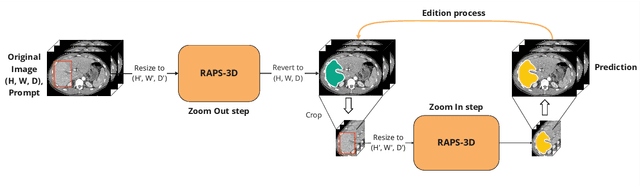
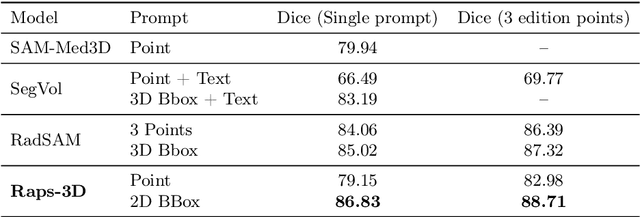
Promptable segmentation, introduced by the Segment Anything Model (SAM), is a promising approach for medical imaging, as it enables clinicians to guide and refine model predictions interactively. However, SAM's architecture is designed for 2D images and does not extend naturally to 3D volumetric data such as CT or MRI scans. Adapting 2D models to 3D typically involves autoregressive strategies, where predictions are propagated slice by slice, resulting in increased inference complexity. Processing large 3D volumes also requires significant computational resources, often leading existing 3D methods to also adopt complex strategies like sliding-window inference to manage memory usage, at the cost of longer inference times and greater implementation complexity. In this paper, we present a simplified 3D promptable segmentation method, inspired by SegVol, designed to reduce inference time and eliminate prompt management complexities associated with sliding windows while achieving state-of-the-art performance.