 Add to Chrome
 Add to Firefox
 Add to Edge
Deceased Organ Matching in Australia
Oct 18, 2017
Despite efforts to increase the supply of organs from living donors, most kidney transplants performed in Australia still come from deceased donors. The age of these donated organs has increased substantially in recent decades as the rate of fatal accidents on roads has fallen. The Organ and Tissue Authority in Australia is therefore looking to design a new mechanism that better matches the age of the organ to the age of the patient. I discuss the design, axiomatics and performance of several candidate mechanisms that respect the special online nature of this fair division problem.

Strategyproof Peer Selection using Randomization, Partitioning, and Apportionment
Sep 29, 2017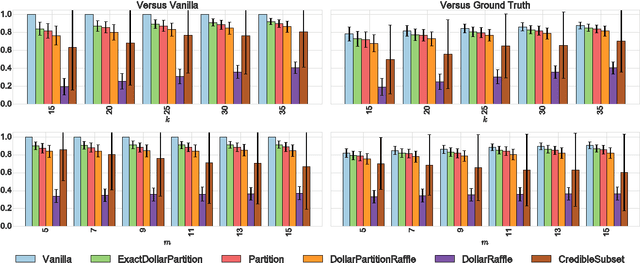
Peer review, evaluation, and selection is a fundamental aspect of modern science. Funding bodies the world over employ experts to review and select the best proposals of those submitted for funding. The problem of peer selection, however, is much more general: a professional society may want to give a subset of its members awards based on the opinions of all members; an instructor for a MOOC or online course may want to crowdsource grading; or a marketing company may select ideas from group brainstorming sessions based on peer evaluation. We make three fundamental contributions to the study of procedures or mechanisms for peer selection, a specific type of group decision-making problem, studied in computer science, economics, and political science. First, we propose a novel mechanism that is strategyproof, i.e., agents cannot benefit by reporting insincere valuations. Second, we demonstrate the effectiveness of our mechanism by a comprehensive simulation-based comparison with a suite of mechanisms found in the literature. Finally, our mechanism employs a randomized rounding technique that is of independent interest, as it solves the apportionment problem that arises in various settings where discrete resources such as parliamentary representation slots need to be divided proportionally.
Expert and Non-Expert Opinion about Technological Unemployment
Jun 21, 2017
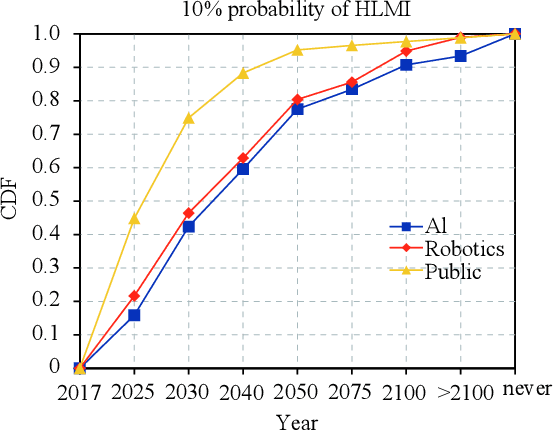
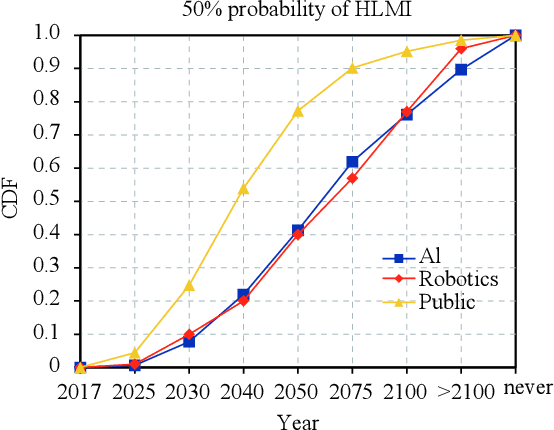
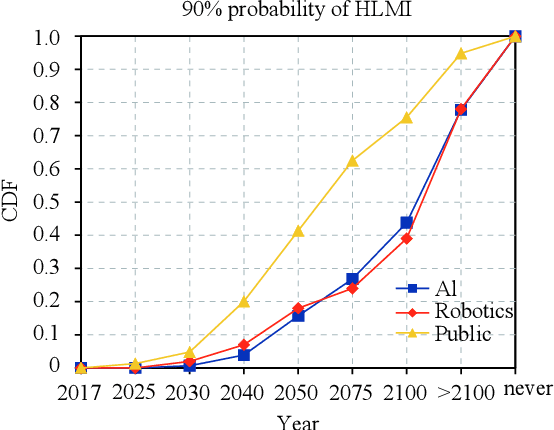
There is significant concern that technological advances, especially in Robotics and Artificial Intelligence (AI), could lead to high levels of unemployment in the coming decades. Studies have estimated that around half of all current jobs are at risk of automation. To look into this issue in more depth, we surveyed experts in Robotics and AI about the risk, and compared their views with those of non-experts. Whilst the experts predicted a significant number of occupations were at risk of automation in the next two decades, they were more cautious than people outside the field in predicting occupations at risk. Their predictions were consistent with their estimates for when computers might be expected to reach human level performance across a wide range of skills. These estimates were typically decades later than those of the non-experts. Technological barriers may therefore provide society with more time to prepare for an automated future than the public fear. In addition, public expectations may need to be dampened about the speed of progress to be expected in Robotics and AI.
The Conference Paper Assignment Problem: Using Order Weighted Averages to Assign Indivisible Goods
May 19, 2017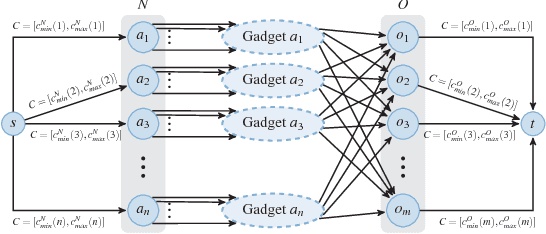
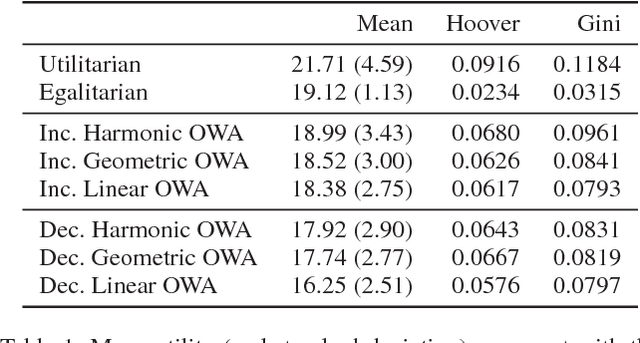
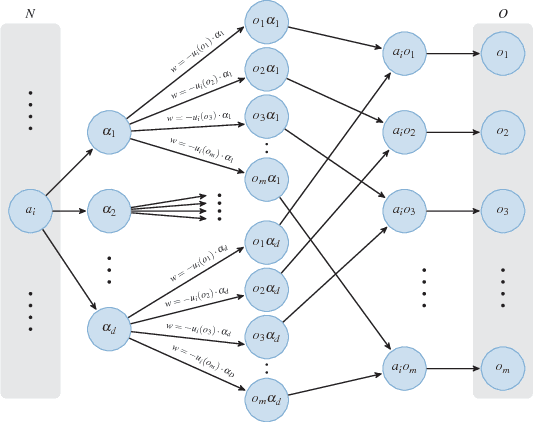
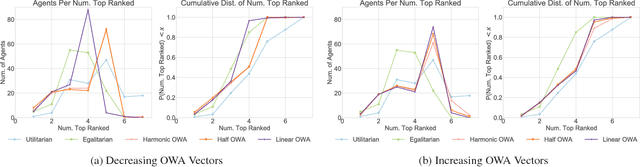
Motivated by the common academic problem of allocating papers to referees for conference reviewing we propose a novel mechanism for solving the assignment problem when we have a two sided matching problem with preferences from one side (the agents/reviewers) over the other side (the objects/papers) and both sides have capacity constraints. The assignment problem is a fundamental problem in both computer science and economics with application in many areas including task and resource allocation. We draw inspiration from multi-criteria decision making and voting and use order weighted averages (OWAs) to propose a novel and flexible class of algorithms for the assignment problem. We show an algorithm for finding a $\Sigma$-OWA assignment in polynomial time, in contrast to the NP-hardness of finding an egalitarian assignment. Inspired by this setting we observe an interesting connection between our model and the classic proportional multi-winner election problem in social choice.
Ethical Considerations in Artificial Intelligence Courses
Jan 26, 2017The recent surge in interest in ethics in artificial intelligence may leave many educators wondering how to address moral, ethical, and philosophical issues in their AI courses. As instructors we want to develop curriculum that not only prepares students to be artificial intelligence practitioners, but also to understand the moral, ethical, and philosophical impacts that artificial intelligence will have on society. In this article we provide practical case studies and links to resources for use by AI educators. We also provide concrete suggestions on how to integrate AI ethics into a general artificial intelligence course and how to teach a stand-alone artificial intelligence ethics course.
Empirical Evaluation of Real World Tournaments
Aug 03, 2016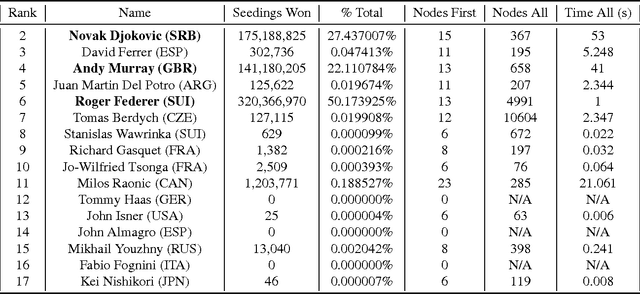
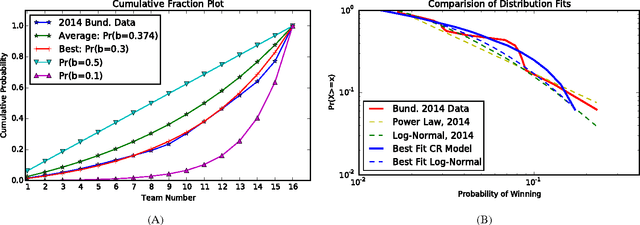
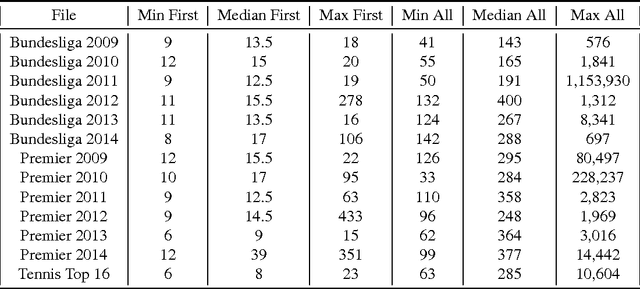
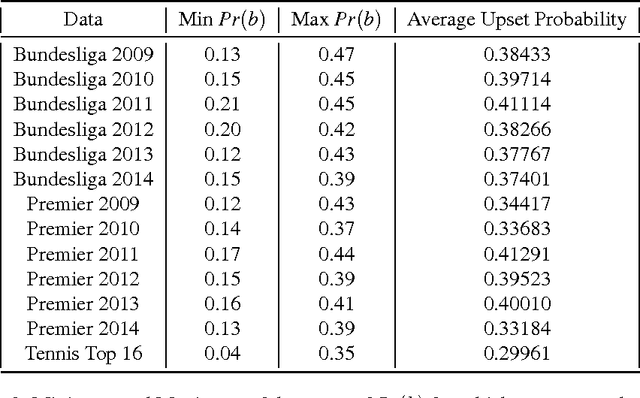
Computational Social Choice (ComSoc) is a rapidly developing field at the intersection of computer science, economics, social choice, and political science. The study of tournaments is fundamental to ComSoc and many results have been published about tournament solution sets and reasoning in tournaments. Theoretical results in ComSoc tend to be worst case and tell us little about performance in practice. To this end we detail some experiments on tournaments using real wold data from soccer and tennis. We make three main contributions to the understanding of tournaments using real world data from English Premier League, the German Bundesliga, and the ATP World Tour: (1) we find that the NP-hard question of finding a seeding for which a given team can win a tournament is easily solvable in real world instances, (2) using detailed and principled methodology from statistical physics we show that our real world data obeys a log-normal distribution; and (3) leveraging our log-normal distribution result and using robust statistical methods, we show that the popular Condorcet Random (CR) tournament model does not generate realistic tournament data.
Interdependent Scheduling Games
May 31, 2016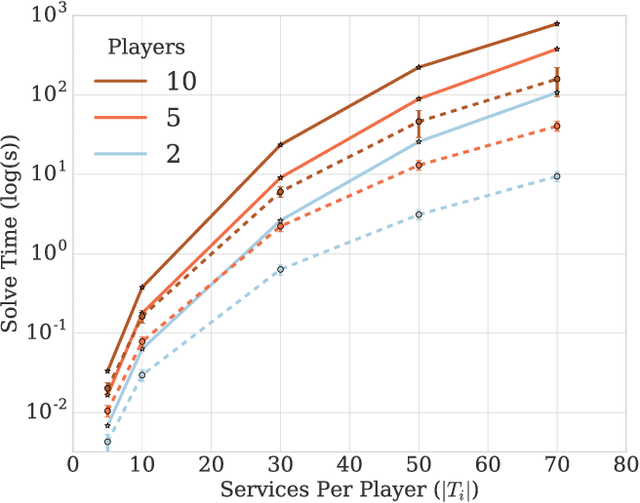
We propose a model of interdependent scheduling games in which each player controls a set of services that they schedule independently. A player is free to schedule his own services at any time; however, each of these services only begins to accrue reward for the player when all predecessor services, which may or may not be controlled by the same player, have been activated. This model, where players have interdependent services, is motivated by the problems faced in planning and coordinating large-scale infrastructures, e.g., restoring electricity and gas to residents after a natural disaster or providing medical care in a crisis when different agencies are responsible for the delivery of staff, equipment, and medicine. We undertake a game-theoretic analysis of this setting and in particular consider the issues of welfare maximization, computing best responses, Nash dynamics, and existence and computation of Nash equilibria.
The Singularity May Never Be Near
Feb 20, 2016There is both much optimism and pessimism around artificial intelligence (AI) today. The optimists are investing millions of dollars, and even in some cases billions of dollars into AI. The pessimists, on the other hand, predict that AI will end many things: jobs, warfare, and even the human race. Both the optimists and the pessimists often appeal to the idea of a technological singularity, a point in time where machine intelligence starts to run away, and a new, more intelligent species starts to inhabit the earth. If the optimists are right, this will be a moment that fundamentally changes our economy and our society. If the pessimists are right, this will be a moment that also fundamentally changes our economy and our society. It is therefore very worthwhile spending some time deciding if either of them might be right.
Welfare of Sequential Allocation Mechanisms for Indivisible Goods
Nov 26, 2015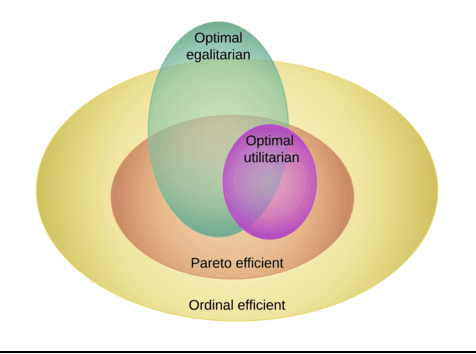
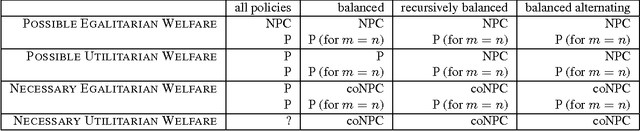
Sequential allocation is a simple and attractive mechanism for the allocation of indivisible goods. Agents take turns, according to a policy, to pick items. Sequential allocation is guaranteed to return an allocation which is efficient but may not have an optimal social welfare. We consider therefore the relation between welfare and efficiency. We study the (computational) questions of what welfare is possible or necessary depending on the choice of policy. We also consider a novel control problem in which the chair chooses a policy to improve social welfare.
Turing's Red Flag
Oct 30, 2015Sometime in the future we will have to deal with the impact of AI's being mistaken for humans. For this reason, I propose that any autonomous system should be designed so that it is unlikely to be mistaken for anything besides an autonomous sysem, and should identify itself at the start of any interaction with another agent.