 Add to Chrome
 Add to Firefox
 Add to Edge
Learning Diagnostic Reasoning for Decision Support in Toxicology
Mar 31, 2026
Acute poly-substance intoxication requires rapid, life-saving decisions under substantial uncertainty, as clinicians must rely on incomplete ingestion details and nonspecific symptoms. Effective diagnostic reasoning in this chaotic environment requires fusing unstructured, non-medical narratives (e.g. paramedic scene descriptions and unreliable patient self-reports or known histories), with structured medical data like vital signs. While Large Language Models (LLMs) show potential for processing such heterogeneous inputs, they struggle in this setting, often underperforming simple baselines that rely solely on patient histories. To address this, we present DeToxR (Decision-support for Toxicology with Reasoning), the first adaptation of Reinforcement Learning (RL) to emergency toxicology. We design a robust data-fusion engine for multi-label prediction across 14 substance classes based on an LLM finetuned with Group Relative Policy Optimization (GRPO). We optimize the model's reasoning directly using a clinical performance reward. By formulating a multi-label agreement metric as the reward signal, the model is explicitly penalized for missing co-ingested substances and hallucinating absent poisons. Our model significantly outperforms its unadapted base LLM counterpart and supervised baselines. Furthermore, in a clinical validation study, the model indicates a clinical advantage by outperforming an expert toxicologist in identifying the correct poisons (Micro-F1: 0.644 vs. 0.473). These results demonstrate the potential of RL-aligned LLMs to synthesize unstructured pre-clinical narratives and structured medical data for decision support in high-stakes environments.

Decision Support for Intoxication Prediction Using Graph Convolutional Networks
May 02, 2020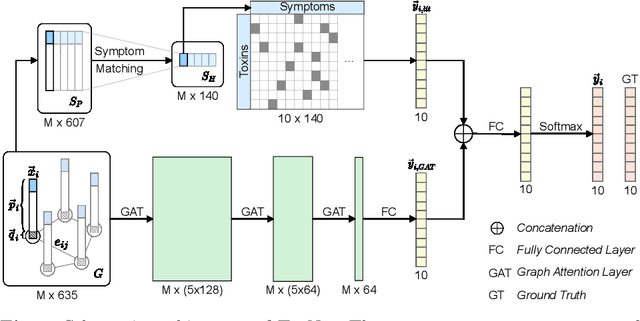
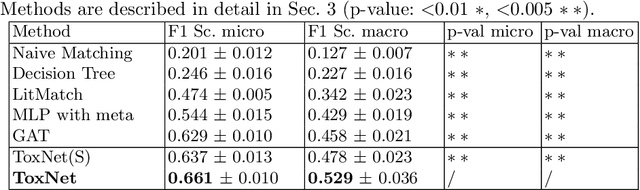
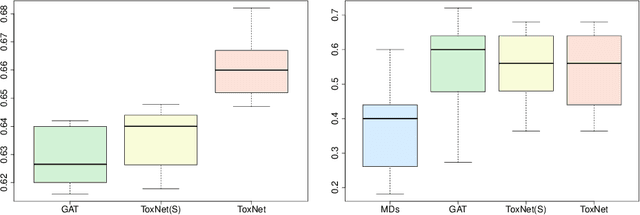
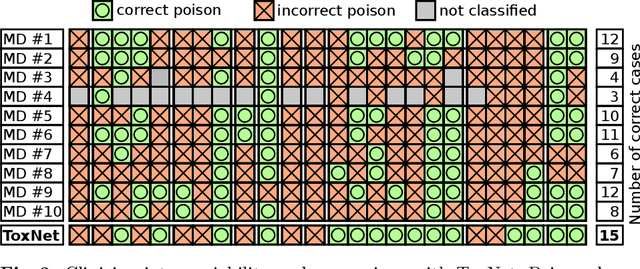
Every day, poison control centers (PCC) are called for immediate classification and treatment recommendations if an acute intoxication is suspected. Due to the time-sensitive nature of these cases, doctors are required to propose a correct diagnosis and intervention within a minimal time frame. Usually the toxin is known and recommendations can be made accordingly. However, in challenging cases only symptoms are mentioned and doctors have to rely on their clinical experience. Medical experts and our analyses of a regional dataset of intoxication records provide evidence that this is challenging, since occurring symptoms may not always match the textbook description due to regional distinctions, inter-rater variance, and institutional workflow. Computer-aided diagnosis (CADx) can provide decision support, but approaches so far do not consider additional information of the reported cases like age or gender, despite their potential value towards a correct diagnosis. In this work, we propose a new machine learning based CADx method which fuses symptoms and meta information of the patients using graph convolutional networks. We further propose a novel symptom matching method that allows the effective incorporation of prior knowledge into the learning process and evidently stabilizes the poison prediction. We validate our method against 10 medical doctors with different experience diagnosing intoxication cases for 10 different toxins from the PCC in Munich and show our method's superiority in performance for poison prediction.