 Add to Chrome
 Add to Firefox
 Add to Edge
Bridging the Training-Deployment Gap: Gated Encoding and Multi-Scale Refinement for Efficient Quantization-Aware Image Enhancement
Apr 23, 2026
Image enhancement models for mobile devices often struggle to balance high output quality with the fast processing speeds required by mobile hardware. While recent deep learning models can enhance low-quality mobile photos into high-quality images, their performance is often degraded when converted to lower-precision formats for actual use on mobile phones. To address this training-deployment mismatch, we propose an efficient image enhancement model designed specifically for mobile deployment. Our approach uses a hierarchical network architecture with gated encoder blocks and multiscale refinement to preserve fine-grained visual features. Moreover, we incorporate Quantization-Aware Training (QAT) to simulate the effects of low-precision representation during the training process. This allows the network to adapt and prevents the typical drop in quality seen with standard post-training quantization (PTQ). Experimental results demonstrate that the proposed method produces high-fidelity visual output while maintaining the low computational overhead needed for practical use on standard mobile devices. The code will be available at https://github.com/GenAI4E/QATIE.git.

Cycle Training with Semi-Supervised Domain Adaptation: Bridging Accuracy and Efficiency for Real-Time Mobile Scene Detection
Apr 12, 2025Nowadays, smartphones are ubiquitous, and almost everyone owns one. At the same time, the rapid development of AI has spurred extensive research on applying deep learning techniques to image classification. However, due to the limited resources available on mobile devices, significant challenges remain in balancing accuracy with computational efficiency. In this paper, we propose a novel training framework called Cycle Training, which adopts a three-stage training process that alternates between exploration and stabilization phases to optimize model performance. Additionally, we incorporate Semi-Supervised Domain Adaptation (SSDA) to leverage the power of large models and unlabeled data, thereby effectively expanding the training dataset. Comprehensive experiments on the CamSSD dataset for mobile scene detection demonstrate that our framework not only significantly improves classification accuracy but also ensures real-time inference efficiency. Specifically, our method achieves a 94.00% in Top-1 accuracy and a 99.17% in Top-3 accuracy and runs inference in just 1.61ms using CPU, demonstrating its suitability for real-world mobile deployment.
A Lightweight Moment Retrieval System with Global Re-Ranking and Robust Adaptive Bidirectional Temporal Search
Apr 12, 2025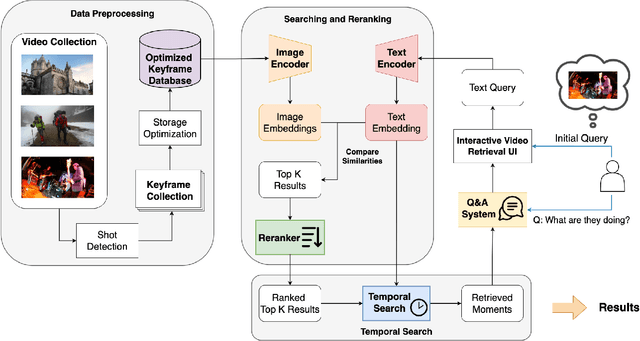

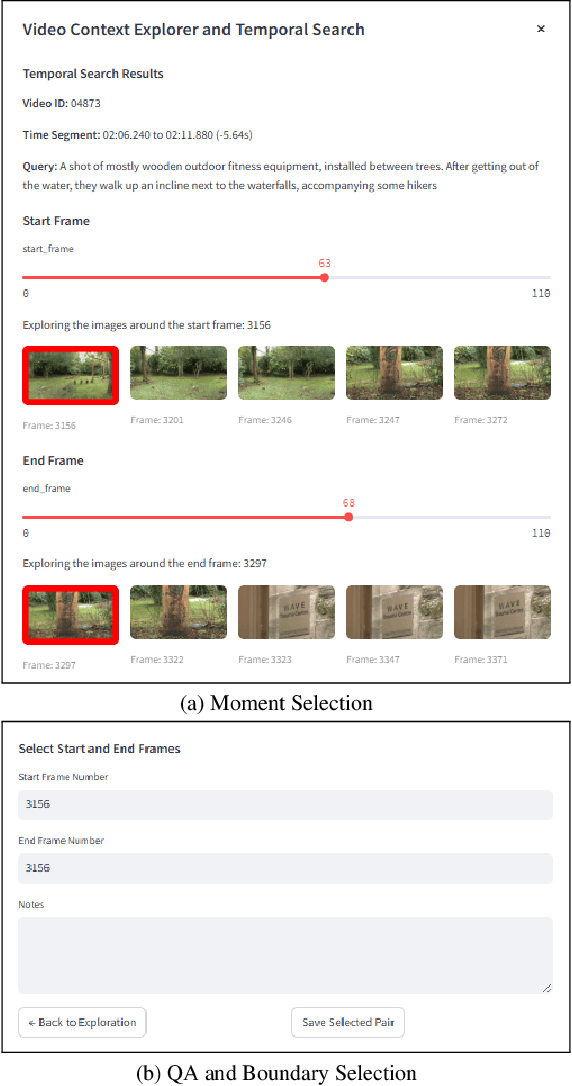
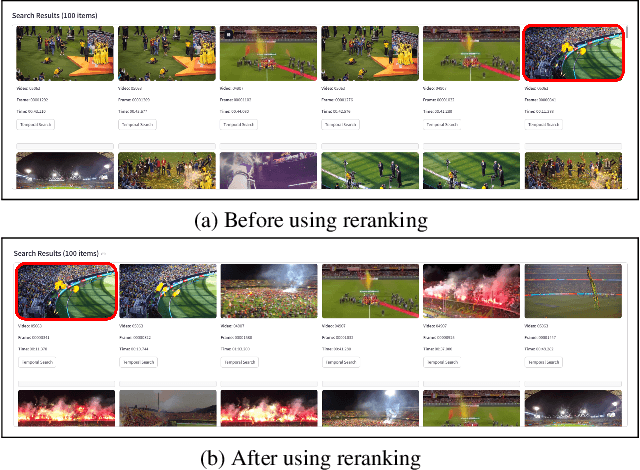
The exponential growth of digital video content has posed critical challenges in moment-level video retrieval, where existing methodologies struggle to efficiently localize specific segments within an expansive video corpus. Current retrieval systems are constrained by computational inefficiencies, temporal context limitations, and the intrinsic complexity of navigating video content. In this paper, we address these limitations through a novel Interactive Video Corpus Moment Retrieval framework that integrates a SuperGlobal Reranking mechanism and Adaptive Bidirectional Temporal Search (ABTS), strategically optimizing query similarity, temporal stability, and computational resources. By preprocessing a large corpus of videos using a keyframe extraction model and deduplication technique through image hashing, our approach provides a scalable solution that significantly reduces storage requirements while maintaining high localization precision across diverse video repositories.
Towards Efficient and Robust Moment Retrieval System: A Unified Framework for Multi-Granularity Models and Temporal Reranking
Apr 11, 2025Long-form video understanding presents significant challenges for interactive retrieval systems, as conventional methods struggle to process extensive video content efficiently. Existing approaches often rely on single models, inefficient storage, unstable temporal search, and context-agnostic reranking, limiting their effectiveness. This paper presents a novel framework to enhance interactive video retrieval through four key innovations: (1) an ensemble search strategy that integrates coarse-grained (CLIP) and fine-grained (BEIT3) models to improve retrieval accuracy, (2) a storage optimization technique that reduces redundancy by selecting representative keyframes via TransNetV2 and deduplication, (3) a temporal search mechanism that localizes video segments using dual queries for start and end points, and (4) a temporal reranking approach that leverages neighboring frame context to stabilize rankings. Evaluated on known-item search and question-answering tasks, our framework demonstrates substantial improvements in retrieval precision, efficiency, and user interpretability, offering a robust solution for real-world interactive video retrieval applications.