 Add to Chrome
 Add to Firefox
 Add to Edge
Latent Confidence Alignment for LLM Self-Assessment
Jun 20, 2026
Confidence calibration in large language models (LLMs) is commonly evaluated by comparing predicted confidence with observed accuracy. However, such approaches do not model item difficulty, making it difficult to interpret discrepancies and to determine whether model confidence reflects genuine self-assessment or is merely a byproduct of the response generation process. To address this, we adopt a Rasch model-based latent ability framework and a metacognitive perspective, and propose Latent Confidence Alignment Error (LCAE) to measure the consistency between model self-assessment and the latent error probability implied by model ability and item difficulty. We further incorporate item difficulty as an external signal with a reasoning mechanism. Experiments on a medical-domain dataset with 20 models show that the proposed approach improves self-assessment quality without affecting model ability, and reveals an association between reliability and inference cost.

Towards Interpretable Renal Health Decline Forecasting via Multi-LMM Collaborative Reasoning Framework
Jul 30, 2025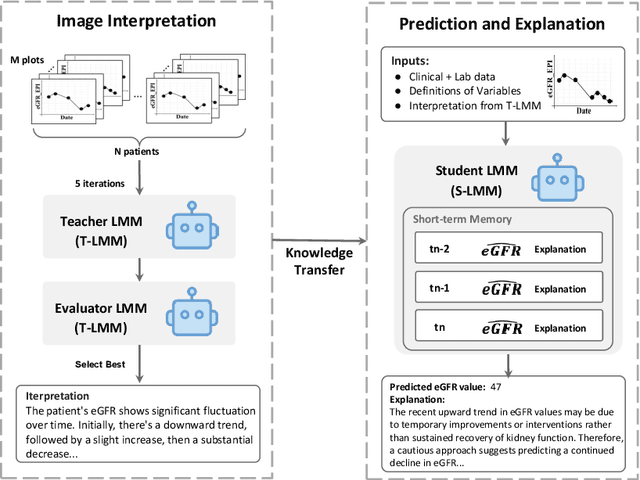
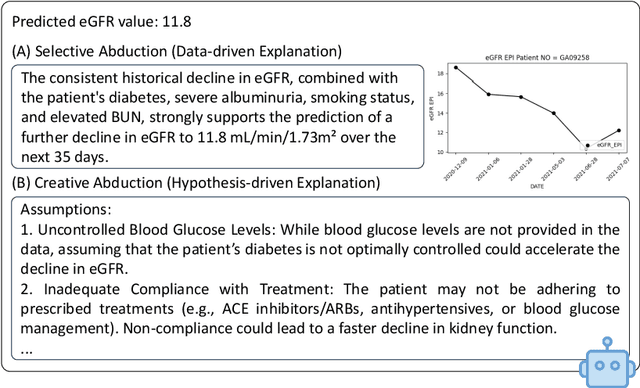
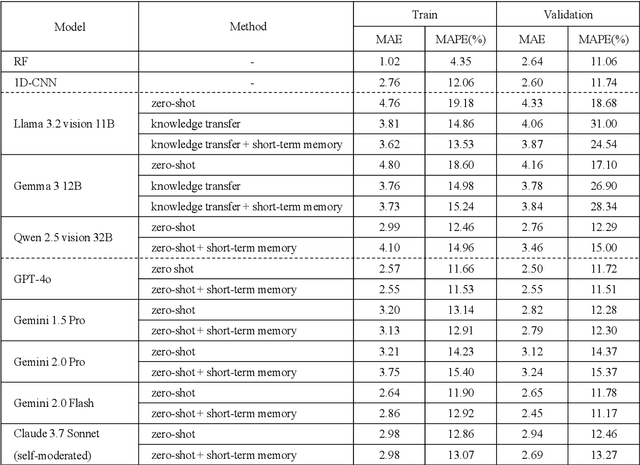
Accurate and interpretable prediction of estimated glomerular filtration rate (eGFR) is essential for managing chronic kidney disease (CKD) and supporting clinical decisions. Recent advances in Large Multimodal Models (LMMs) have shown strong potential in clinical prediction tasks due to their ability to process visual and textual information. However, challenges related to deployment cost, data privacy, and model reliability hinder their adoption. In this study, we propose a collaborative framework that enhances the performance of open-source LMMs for eGFR forecasting while generating clinically meaningful explanations. The framework incorporates visual knowledge transfer, abductive reasoning, and a short-term memory mechanism to enhance prediction accuracy and interpretability. Experimental results show that the proposed framework achieves predictive performance and interpretability comparable to proprietary models. It also provides plausible clinical reasoning processes behind each prediction. Our method sheds new light on building AI systems for healthcare that combine predictive accuracy with clinically grounded interpretability.