 Add to Chrome
 Add to Firefox
 Add to Edge
An explainable hierarchical self attention-based approach for tremor detection in the time domain
May 30, 2026
Tremor is a common movement disorder associated with conditions like Parkinson's disease and Essential tremor, traditionally diagnosed through expert clinician assessment. Current automated detection methods rely on frequency-domain features informed by clinical expertise. In this work, we present an explainable, two-stage hierarchical framework for tremor detection in the time domain that learns tremor patterns directly from 3D kinematic marker time-series data across entire tremor-provoking trials. Our framework combined a deep convolutional and long short-term memory network to learn tremor representations from short, discrete, non-overlapping time segments of kinematic time series data from trials, which are then processed by a vision transformer that models their long-term temporal dynamics of time segment features for trial (session) level classification. Evaluated across nine body parts, the framework achieved F1-scores of 0.594 - 0.947 depending on body parts (average: 0.765), falling short of the frequency-domain state-of-the-art performance (0.909) while requiring minimal preprocessing. Attention weights and gradient-based class activation maps (Grad-CAM) identified time-domain features of tremor across body parts. This proof of concept demonstrated the feasibility of data-driven time-domain modeling for tremor detection across anatomically diverse body parts, while reducing reliance on expert-engineered spectral features and providing posthoc interpretability of temporal and anatomical patterns of tremor.

Estimating Skin Tone and Effects on Classification Performance in Dermatology Datasets
Oct 29, 2019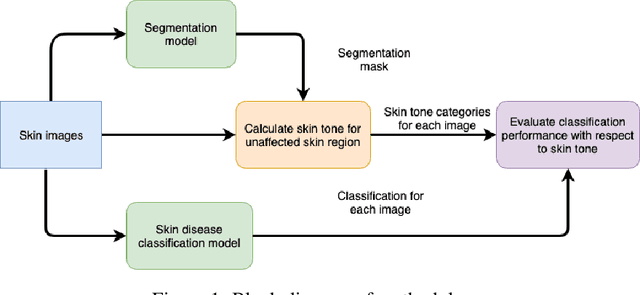
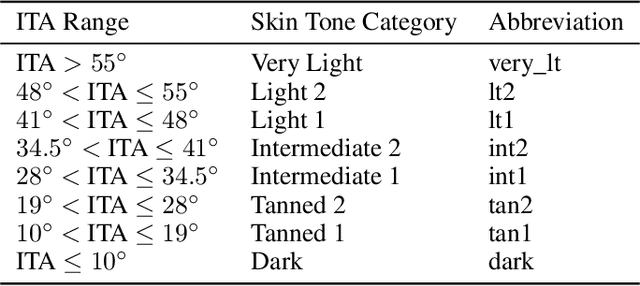
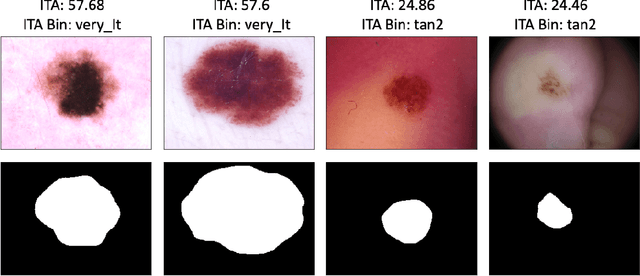
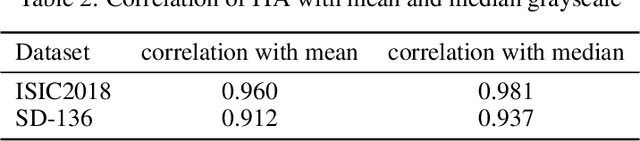
Recent advances in computer vision and deep learning have led to breakthroughs in the development of automated skin image analysis. In particular, skin cancer classification models have achieved performance higher than trained expert dermatologists. However, no attempt has been made to evaluate the consistency in performance of machine learning models across populations with varying skin tones. In this paper, we present an approach to estimate skin tone in benchmark skin disease datasets, and investigate whether model performance is dependent on this measure. Specifically, we use individual typology angle (ITA) to approximate skin tone in dermatology datasets. We look at the distribution of ITA values to better understand skin color representation in two benchmark datasets: 1) the ISIC 2018 Challenge dataset, a collection of dermoscopic images of skin lesions for the detection of skin cancer, and 2) the SD-198 dataset, a collection of clinical images capturing a wide variety of skin diseases. To estimate ITA, we first develop segmentation models to isolate non-diseased areas of skin. We find that the majority of the data in the the two datasets have ITA values between 34.5{\deg} and 48{\deg}, which are associated with lighter skin, and is consistent with under-representation of darker skinned populations in these datasets. We also find no measurable correlation between performance of machine learning model and ITA values, though more comprehensive data is needed for further validation.