 Add to Chrome
 Add to Firefox
 Add to Edge
LLM-Guided Neural Architecture Search for Robust Co-Design of Physical Neural Networks
Jun 09, 2026
Deploying neural networks on unconventional hardware demands architectures that co-optimize task accuracy and platform-specific constraints such as energy cost, physical non-idealities, and numerical precision. Existing neural architecture search (NAS) methods are typically tailored to a single hardware family, limiting cross-platform comparison and generalization. We introduce Unconventional Hardware Neural Architecture Search (UH-NAS), a hardware-agnostic, LLM-guided NAS framework that integrates language models as evolutionary operators to co-optimize accuracy and inference energy. By exposing hardware as a swappable backend with per-platform energy models, physical constraints, and non-ideality simulators, UH-NAS enables fair system-level comparisons across various backends without modifying the search algorithm. Tested on optical MZI hardware, UH-NAS discovers more diverse, robust architectures than conventional baselines while outperforming existing LLM-to-NAS approaches. Additional ablations on architecture robustness under non-idealities and the role of system prompts highlight the importance of architecture-hardware co-design for emerging computing platforms.

Improving Generalization by Permutation Routing Across Model Copies
May 10, 2026We introduce a use of the \(M\)-cover (or \(M\)-layer) transform for machine learning. The method replicates a model \(M\) times, but instead of coupling the copies through parameter averaging or an explicit attractive force, as in replicated SGD or Elastic SGD, it rewires the contexts in which local learning messages are computed. Each local loss is evaluated on a routed model whose parameters are drawn from different copies according to permutations sampled from a structured mixing kernel \(Q\). Training then uses the original local update rule, while the resulting learning messages are redistributed across the copies through these routed computational paths. Thus \(Q\) defines a topology for message transport and controls the long-loop structure of the lifted factor graph. We formulate this construction for perceptrons, committee machines, and multilayer perceptrons, showing that the same principle applies from discrete models to differentiable neural networks. The resulting framework provides a mechanism for improving generalization through structured message sharing rather than replica collapse or parameter-space coupling.
Contrastive Concept-Tree Search for LLM-Assisted Algorithm Discovery
Feb 03, 2026Large language Model (LLM)-assisted algorithm discovery is an iterative, black-box optimization process over programs to approximatively solve a target task, where an LLM proposes candidate programs and an external evaluator provides task feedback. Despite intense recent research on the topic and promising results, how can the LLM internal representation of the space of possible programs be maximally exploited to improve performance is an open question. Here, we introduce Contrastive Concept-Tree Search (CCTS), which extracts a hierarchical concept representation from the generated programs and learns a contrastive concept model that guides parent selection. By reweighting parents using a likelihood-ratio score between high- and low-performing solutions, CCTS biases search toward useful concept combinations and away from misleading ones, providing guidance through an explicit concept hierarchy rather than the algorithm lineage constructed by the LLM. We show that CCTS improves search efficiency over fitness-based baselines and produces interpretable, task-specific concept trees across a benchmark of open Erdős-type combinatorics problems. Our analysis indicates that the gains are driven largely by learning which concepts to avoid. We further validate these findings in a controlled synthetic algorithm-discovery environment, which reproduces qualitatively the search dynamics observed with the LLMs.
Neural Ising Machines via Unrolling and Zeroth-Order Training
Jan 30, 2026We propose a data-driven heuristic for NP-hard Ising and Max-Cut optimization that learns the update rule of an iterative dynamical system. The method learns a shared, node-wise update rule that maps local interaction fields to spin updates, parameterized by a compact multilayer perceptron with a small number of parameters. Training is performed using a zeroth-order optimizer, since backpropagation through long, recurrent Ising-machine dynamics leads to unstable and poorly informative gradients. We call this approach a neural network parameterized Ising machine (NPIM). Despite its low parameter count, the learned dynamics recover effective algorithmic structure, including momentum-like behavior and time-varying schedules, enabling efficient search in highly non-convex energy landscapes. Across standard Ising and neural combinatorial optimization benchmarks, NPIM achieves competitive solution quality and time-to-solution relative to recent learning-based methods and strong classical Ising-machine heuristics.
Dynamic Anisotropic Smoothing for Noisy Derivative-Free Optimization
May 02, 2024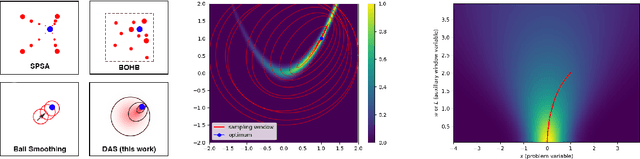
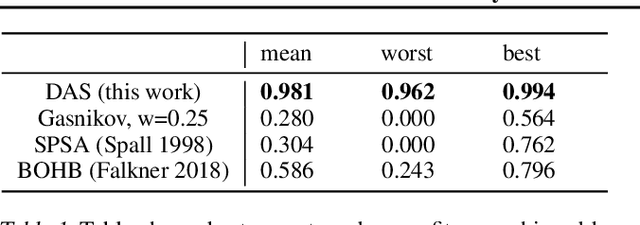
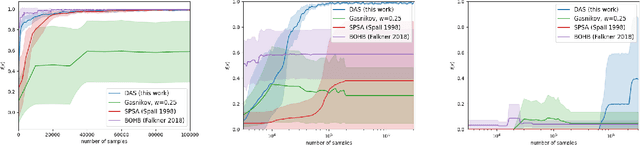
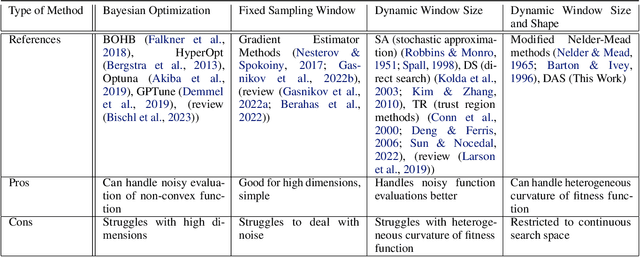
We propose a novel algorithm that extends the methods of ball smoothing and Gaussian smoothing for noisy derivative-free optimization by accounting for the heterogeneous curvature of the objective function. The algorithm dynamically adapts the shape of the smoothing kernel to approximate the Hessian of the objective function around a local optimum. This approach significantly reduces the error in estimating the gradient from noisy evaluations through sampling. We demonstrate the efficacy of our method through numerical experiments on artificial problems. Additionally, we show improved performance when tuning NP-hard combinatorial optimization solvers compared to existing state-of-the-art heuristic derivative-free and Bayesian optimization methods.