 Add to Chrome
 Add to Firefox
 Add to Edge
CANTANTE: Optimizing Agentic Systems via Contrastive Credit Attribution
May 13, 2026
LLM-based multi-agent systems have demonstrated strong performance across complex real-world tasks, such as software engineering, predictive modeling, and retrieval-augmented generation. Yet automating their configuration remains a structural challenge, as scores are available only at the system level, whereas the parameters governing agent behavior are local. We argue that optimizing these systems is fundamentally a credit-assignment problem. We therefore introduce CANTANTE, a framework that decomposes system-level rewards into per-agent update signals by contrasting rollouts of multiple joint configurations on the same query. We instantiate it for prompt optimization, treating agent prompts as learnable system parameters. We evaluate CANTANTE against GEPA and MIPROv2 on programming (MBPP), mathematical reasoning (GSM8K), and multi-hop question answering (HotpotQA). Across these benchmarks, CANTANTE achieves the best average rank among all evaluated optimizers and consistently outperforms unoptimized prompts. It improves over the strongest baseline by +18.9 percentage points on MBPP and +12.5 percentage points on GSM8K, while incurring a lower inference cost. It remains within one standard deviation of the strongest baseline on HotpotQA. Crucially, our credit correlation analysis confirms that the attributer produces meaningful per-agent signals rather than echoing the global system score.

CAPO: Cost-Aware Prompt Optimization
Apr 22, 2025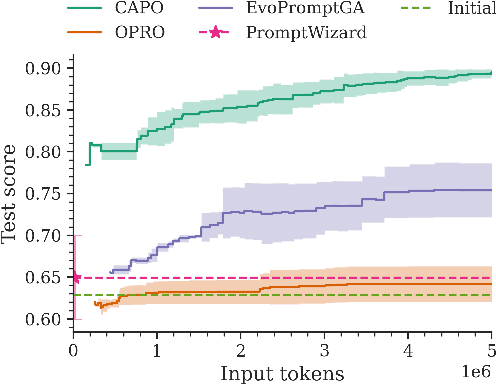
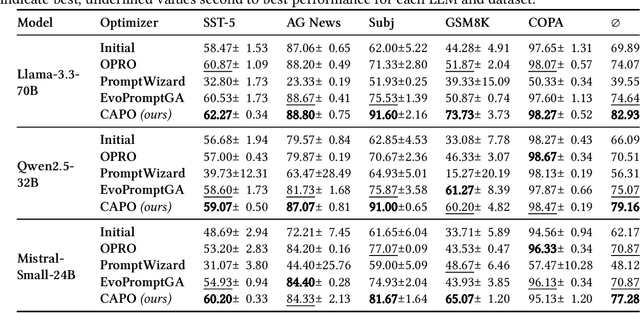
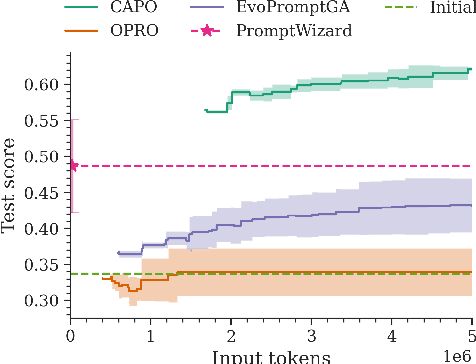
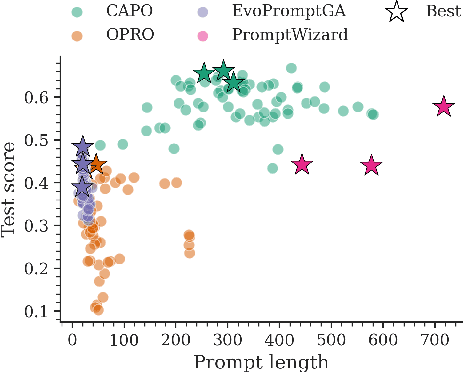
Large language models (LLMs) have revolutionized natural language processing by solving a wide range of tasks simply guided by a prompt. Yet their performance is highly sensitive to prompt formulation. While automated prompt optimization addresses this challenge by finding optimal prompts, current methods require a substantial number of LLM calls and input tokens, making prompt optimization expensive. We introduce CAPO (Cost-Aware Prompt Optimization), an algorithm that enhances prompt optimization efficiency by integrating AutoML techniques. CAPO is an evolutionary approach with LLMs as operators, incorporating racing to save evaluations and multi-objective optimization to balance performance with prompt length. It jointly optimizes instructions and few-shot examples while leveraging task descriptions for improved robustness. Our extensive experiments across diverse datasets and LLMs demonstrate that CAPO outperforms state-of-the-art discrete prompt optimization methods in 11/15 cases with improvements up to 21%p. Our algorithm achieves better performances already with smaller budgets, saves evaluations through racing, and decreases average prompt length via a length penalty, making it both cost-efficient and cost-aware. Even without few-shot examples, CAPO outperforms its competitors and generally remains robust to initial prompts. CAPO represents an important step toward making prompt optimization more powerful and accessible by improving cost-efficiency.