 Add to Chrome
 Add to Firefox
 Add to Edge
StaticSegFormer: An Efficient High-Performance Semantic Segmentation Based on Static Structured Pruning
Aug 05, 2026
Structured pruning enhances the efficiency of deep neural networks (DNNs) by eliminating groups of parameters during inference. Previous methods mostly reduce computational complexity (FLOPs), while semantic segmentation performance (mIoU) slightly drops. Accordingly, recent dynamic structured pruning methods aim at reducing the performance drop, while lowering the FLOPs even more. However, on the ADE20K and Cityscapes benchmarks, our study reveals that on a GPU platform such dynamic methods exhibit a surprisingly low frame rate far below a simple static approach, while having comparable results in mIoU and FLOPs. To address this issue, we propose a static structured pruning method for attention layers, that achieves both, a lower FLOPs and a high frame rate [fps] of the SegFormer network, the latter increased by up to 34% relative on the Cityscapes dataset, while having no mIoU performance drop at all. Our so-called StaticSegFormer method is strongest for small encoders and large images.

Adversarial Attack and Disturbance Detection by Hadamard-Coded Output Representations for Object Detection and Semantic Segmentation
Jun 08, 2026Conventional one-hot encodings often yield poorly calibrated models, being overconfident under attack, and letting entropy-based detection algorithms fail. Previous image classification works have demonstrated that Hadamard-coded output representations can improve adversarial robustness. However, attempts to integrate Hadamard codes into semantic segmentation fall far behind state-of-the-art models in mean intersection-over-union performance. Regarding object detection, such output encodings have not yet been investigated at all. Further, no prior art addressed intrinsic codeword inconsistencies or actually exploited intrinsic codeword redundancy. Accordingly, we first derive a novel decoding procedure for Hadamard codewords towards optimal class-wise probabilities, solving the underlying optimization problem by using the projection onto the probability simplex. Second, our optimization delivers a measure of prediction inconsistency. Third, we are the first to show how to exploit these inconsistencies for adversarial attack and disturbance detection. Fourth, we introduce HadamardNet, a framework employing Hadamard codes as output representations for semantic segmentation and object detection models and tasks. We conduct a comprehensive evaluation both on disturbances and adversarial attacks, achieving state-of-the-art perturbation detection performance for both tasks in only a single detection pass, while delivering equivalent or close-by reference performance on clean data.
Distributed Semantic Segmentation with Efficient Joint Source and Task Decoding
Jul 15, 2024
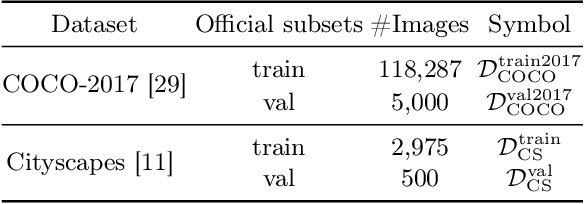
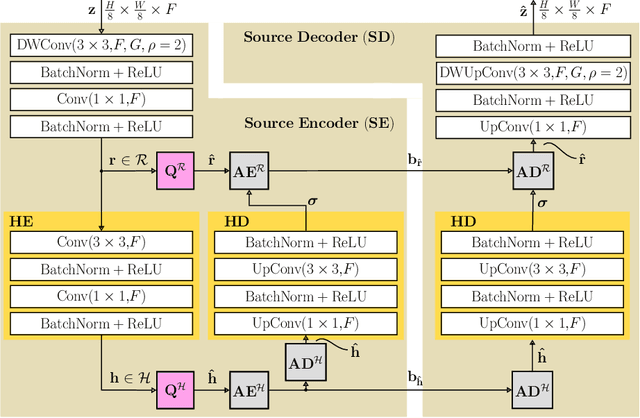

Distributed computing in the context of deep neural networks (DNNs) implies the execution of one part of the network on edge devices and the other part typically on a large-scale cloud platform. Conventional methods propose to employ a serial concatenation of a learned image and source encoder, the latter projecting the image encoder output (bottleneck features) into a quantized representation for bitrate-efficient transmission. In the cloud, a respective source decoder reprojects the quantized representation to the original feature representation, serving as an input for the downstream task decoder performing, e.g., semantic segmentation. In this work, we propose joint source and task decoding, as it allows for a smaller network size in the cloud. This further enables the scalability of such services in large numbers without requiring extensive computational load on the cloud per channel. We demonstrate the effectiveness of our method by achieving a distributed semantic segmentation SOTA over a wide range of bitrates on the mean intersection over union metric, while using only $9.8 \%$ ... $11.59 \%$ of cloud DNN parameters used in the previous SOTA on the COCO and Cityscapes datasets.
A Re-Parameterized Vision Transformer (ReVT) for Domain-Generalized Semantic Segmentation
Aug 25, 2023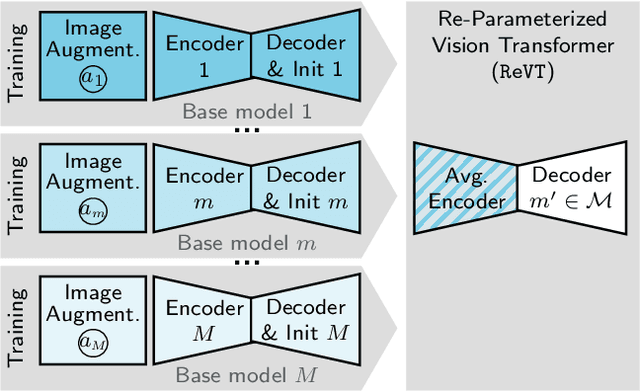
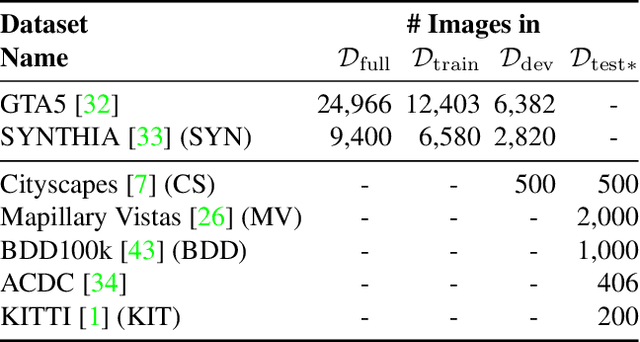
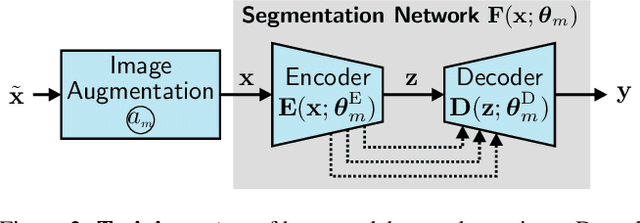
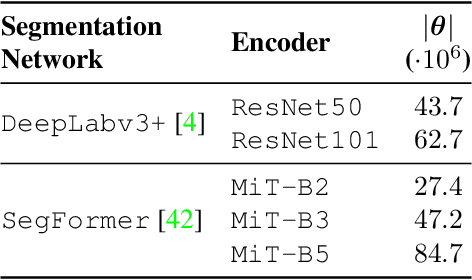
The task of semantic segmentation requires a model to assign semantic labels to each pixel of an image. However, the performance of such models degrades when deployed in an unseen domain with different data distributions compared to the training domain. We present a new augmentation-driven approach to domain generalization for semantic segmentation using a re-parameterized vision transformer (ReVT) with weight averaging of multiple models after training. We evaluate our approach on several benchmark datasets and achieve state-of-the-art mIoU performance of 47.3% (prior art: 46.3%) for small models and of 50.1% (prior art: 47.8%) for midsized models on commonly used benchmark datasets. At the same time, our method requires fewer parameters and reaches a higher frame rate than the best prior art. It is also easy to implement and, unlike network ensembles, does not add any computational complexity during inference.