 Add to Chrome
 Add to Firefox
 Add to Edge
StaticSegFormer: An Efficient High-Performance Semantic Segmentation Based on Static Structured Pruning
Aug 05, 2026
Structured pruning enhances the efficiency of deep neural networks (DNNs) by eliminating groups of parameters during inference. Previous methods mostly reduce computational complexity (FLOPs), while semantic segmentation performance (mIoU) slightly drops. Accordingly, recent dynamic structured pruning methods aim at reducing the performance drop, while lowering the FLOPs even more. However, on the ADE20K and Cityscapes benchmarks, our study reveals that on a GPU platform such dynamic methods exhibit a surprisingly low frame rate far below a simple static approach, while having comparable results in mIoU and FLOPs. To address this issue, we propose a static structured pruning method for attention layers, that achieves both, a lower FLOPs and a high frame rate [fps] of the SegFormer network, the latter increased by up to 34% relative on the Cityscapes dataset, while having no mIoU performance drop at all. Our so-called StaticSegFormer method is strongest for small encoders and large images.

Efficient Multi-View 3D Object Detection by Dynamic Token Selection and Fine-Tuning
Apr 15, 2026Existing multi-view three-dimensional (3D) object detection approaches widely adopt large-scale pre-trained vision transformer (ViT)-based foundation models as backbones, being computationally complex. To address this problem, current state-of-the-art (SOTA) \texttt{ToC3D} for efficient multi-view ViT-based 3D object detection employs ego-motion-based relevant token selection. However, there are two key limitations: (1) The fixed layer-individual token selection ratios limit computational efficiency during both training and inference. (2) Full end-to-end retraining of the ViT backbone is required for the multi-view 3D object detection method. In this work, we propose an image token compensator combined with a token selection for ViT backbones to accelerate multi-view 3D object detection. Unlike \texttt{ToC3D}, our approach enables dynamic layer-wise token selection within the ViT backbone. Furthermore, we introduce a parameter-efficient fine-tuning strategy, which trains only the proposed modules, thereby reducing the number of fine-tuned parameters from more than $300$ million (M) to only $1.6$ M. Experiments on the large-scale NuScenes dataset across three multi-view 3D object detection approaches demonstrate that our proposed method decreases computational complexity (GFLOPs) by $48\%$ ... $55\%$, inference latency (on an \texttt{NVIDIA-GV100} GPU) by $9\%$ ... $25\%$, while still improving mean average precision by $1.0\%$ ... $2.8\%$ absolute and NuScenes detection score by $0.4\%$ ... $1.2\%$ absolute compared to so-far SOTA \texttt{ToC3D}.
Distributed Semantic Segmentation with Efficient Joint Source and Task Decoding
Jul 15, 2024
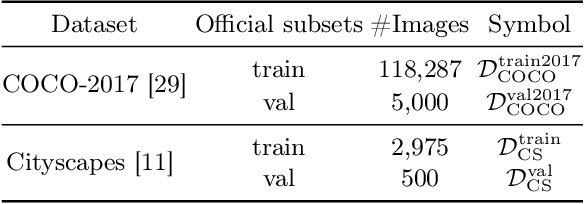
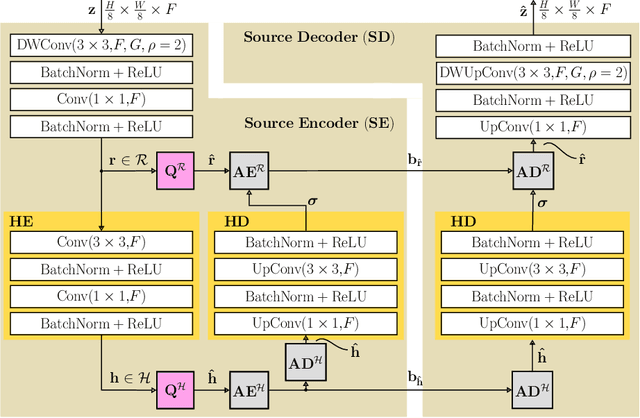

Distributed computing in the context of deep neural networks (DNNs) implies the execution of one part of the network on edge devices and the other part typically on a large-scale cloud platform. Conventional methods propose to employ a serial concatenation of a learned image and source encoder, the latter projecting the image encoder output (bottleneck features) into a quantized representation for bitrate-efficient transmission. In the cloud, a respective source decoder reprojects the quantized representation to the original feature representation, serving as an input for the downstream task decoder performing, e.g., semantic segmentation. In this work, we propose joint source and task decoding, as it allows for a smaller network size in the cloud. This further enables the scalability of such services in large numbers without requiring extensive computational load on the cloud per channel. We demonstrate the effectiveness of our method by achieving a distributed semantic segmentation SOTA over a wide range of bitrates on the mean intersection over union metric, while using only $9.8 \%$ ... $11.59 \%$ of cloud DNN parameters used in the previous SOTA on the COCO and Cityscapes datasets.