 Add to Chrome
 Add to Firefox
 Add to Edge
QEDBENCH: Quantifying the Alignment Gap in Automated Evaluation of University-Level Mathematical Proofs
Feb 24, 2026
As Large Language Models (LLMs) saturate elementary benchmarks, the research frontier has shifted from generation to the reliability of automated evaluation. We demonstrate that standard "LLM-as-a-Judge" protocols suffer from a systematic Alignment Gap when applied to upper-undergraduate to early graduate level mathematics. To quantify this, we introduce QEDBench, the first large-scale dual-rubric alignment benchmark to systematically measure alignment with human experts on university-level math proofs by contrasting course-specific rubrics against expert common knowledge criteria. By deploying a dual-evaluation matrix (7 judges x 5 solvers) against 1,000+ hours of human evaluation, we reveal that certain frontier evaluators like Claude Opus 4.5, DeepSeek-V3, Qwen 2.5 Max, and Llama 4 Maverick exhibit significant positive bias (up to +0.18, +0.20, +0.30, +0.36 mean score inflation, respectively). Furthermore, we uncover a critical reasoning gap in the discrete domain: while Gemini 3.0 Pro achieves state-of-the-art performance (0.91 average human evaluation score), other reasoning models like GPT-5 Pro and Claude Sonnet 4.5 see their performance significantly degrade in discrete domains. Specifically, their average human evaluation scores drop to 0.72 and 0.63 in Discrete Math, and to 0.74 and 0.50 in Graph Theory. In addition to these research results, we also release QEDBench as a public benchmark for evaluating and improving AI judges. Our benchmark is publicly published at https://github.com/qqliu/Yale-QEDBench.

Adaptive compressed 3D imaging based on wavelet trees and Hadamard multiplexing with a single photon counting detector
Sep 15, 2017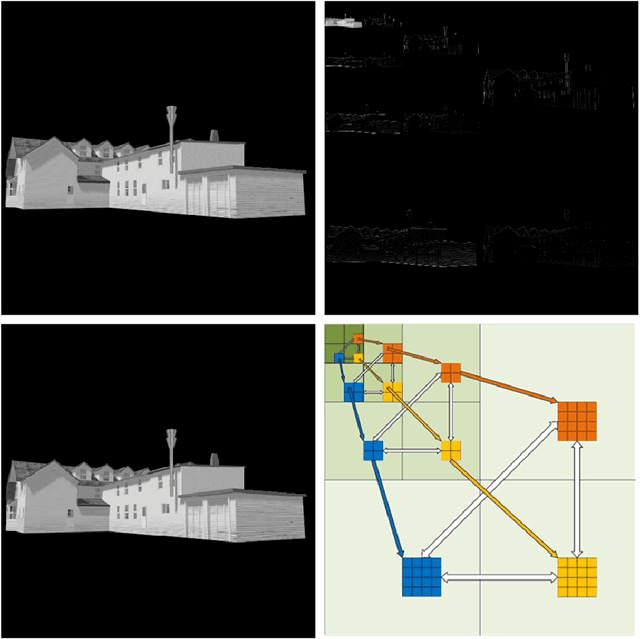

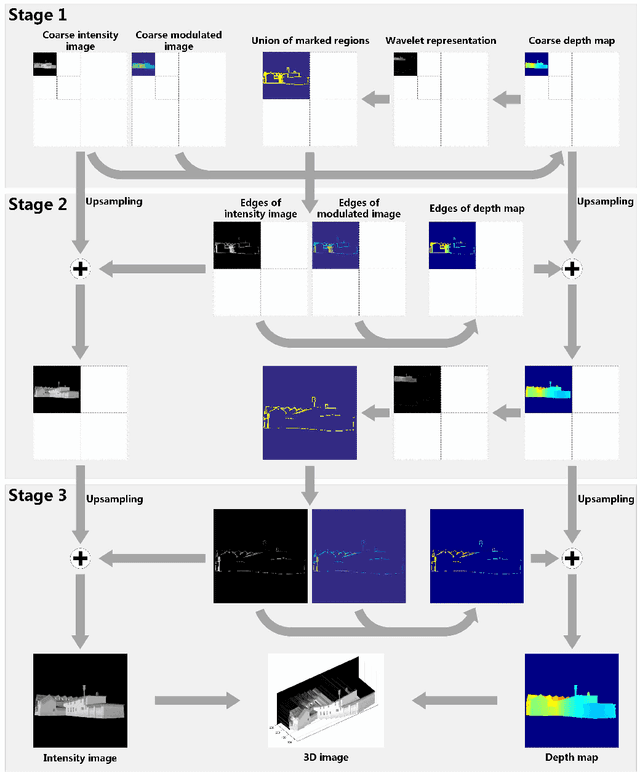
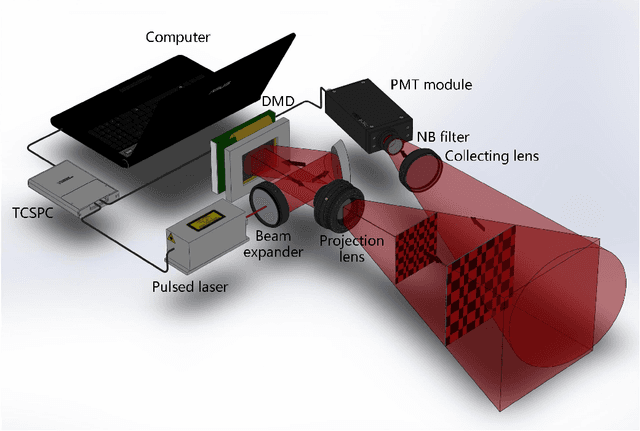
Photon counting 3D imaging allows to obtain 3D images with single-photon sensitivity and sub-ns temporal resolution. However, it is challenging to scale to high spatial resolution. In this work, we demonstrate a photon counting 3D imaging technique with short-pulsed structured illumination and a single-pixel photon counting detector. The proposed multi-resolution photon counting 3D imaging technique acquires a high-resolution 3D image from a coarse image and edges at successfully finer resolution sampled by Hadamard multiplexing along the wavelet trees. The detected power is significantly increased thanks to the Hadamard multiplexing. Both the required measurements and the reconstruction time can be significantly reduced by performing wavelet-tree-based regions of edges predication and Hadamard demultiplexing, which makes the proposed technique suitable for scenes with high spatial resolution. The experimental results indicate that a 3D image at resolution up to 512*512 pixels can be acquired and retrieved with practical time as low as 17 seconds.