 Add to Chrome
 Add to Firefox
 Add to Edge
QO-Bench: Diagnosing Query-Operator-Preserving Retrieval over Typed Event Tuples
Jun 03, 2026
Many real-world questions over business, legal, and scientific corpora are natural-language versions of database-style queries over records latent in text. Existing retrieval-augmented generation (RAG) systems are optimized primarily for semantic relevance, but retrieving plausible passages does not guarantee correct query execution. We introduce QO-Bench, a diagnostic benchmark for query-operator question answering over typed event tuples. The benchmark covers 22,984 news articles and 614 corporate events across 18 query templates, evaluated on 785 questions. Each gold answer is deterministically computed from typed event tuples and scored by recall, with answers matched to the gold tuples by exact match rather than an LLM judge. This design enables operator-level diagnosis such as joins and intersection. We evaluate RAG, ReAct RAG, GraphRAG, and information-extraction-to-SQL under matched conditions, with a long-context oracle ceiling to isolate retrieval failure. A two-axis framework -- index-time preservation versus query-time execution -- predicts where each paradigm fails, and the results bear it out: systems retrieve relevant text but discard the typed values operators need, and the deployable paradigm ranking inverts across operators, with similarity retrieval leading on filter/project and extraction-to-SQL on intersection and counting. Even given the gold evidence, a long-context oracle stays far from saturated, so operator execution -- not retrieval alone -- is a core bottleneck that a stronger answer model does not remove. QO-Bench reframes the goal from passage relevance to query-operator-preserving retrieval.

FAITH: A Framework for Assessing Intrinsic Tabular Hallucinations in finance
Aug 07, 2025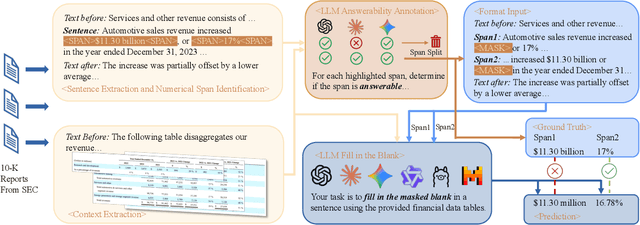
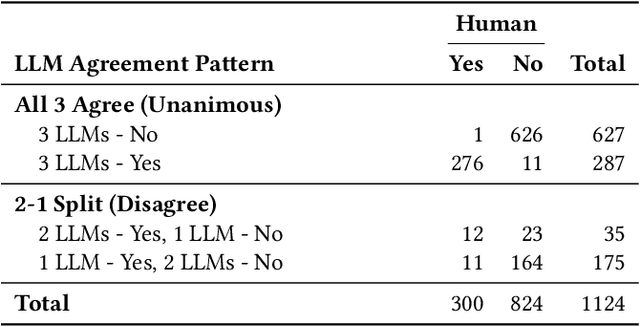
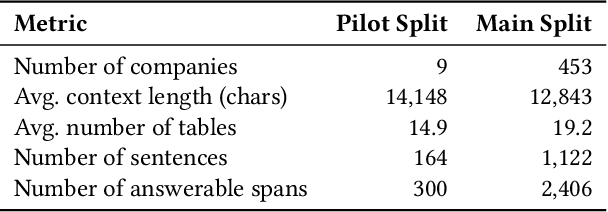
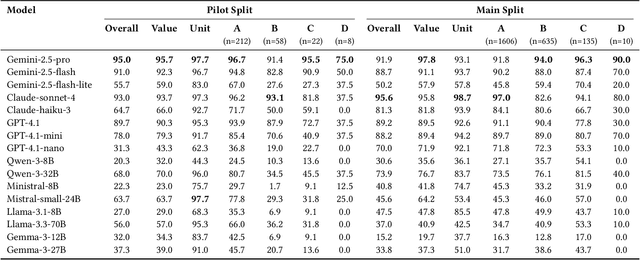
Hallucination remains a critical challenge for deploying Large Language Models (LLMs) in finance. Accurate extraction and precise calculation from tabular data are essential for reliable financial analysis, since even minor numerical errors can undermine decision-making and regulatory compliance. Financial applications have unique requirements, often relying on context-dependent, numerical, and proprietary tabular data that existing hallucination benchmarks rarely capture. In this study, we develop a rigorous and scalable framework for evaluating intrinsic hallucinations in financial LLMs, conceptualized as a context-aware masked span prediction task over real-world financial documents. Our main contributions are: (1) a novel, automated dataset creation paradigm using a masking strategy; (2) a new hallucination evaluation dataset derived from S&P 500 annual reports; and (3) a comprehensive evaluation of intrinsic hallucination patterns in state-of-the-art LLMs on financial tabular data. Our work provides a robust methodology for in-house LLM evaluation and serves as a critical step toward building more trustworthy and reliable financial Generative AI systems.