 Add to Chrome
 Add to Firefox
 Add to Edge
Automatically Generating Hard Math Problems from Hypothesis-Driven Error Analysis
Apr 06, 2026
Numerous math benchmarks exist to evaluate LLMs' mathematical capabilities. However, most involve extensive manual effort and are difficult to scale. Consequently, they cannot keep pace with LLM development or easily provide new instances to mitigate overfitting. Some researchers have proposed automatic benchmark generation methods, but few focus on identifying the specific math concepts and skills on which LLMs are error-prone, and most can only generate category-specific benchmarks. To address these limitations, we propose a new math benchmark generation pipeline that uses AI-generated hypotheses to identify the specific math concepts and skills that LLMs struggle with, and then generates new benchmark problems targeting these weaknesses. Experiments show that hypothesis accuracy positively correlates with the difficulty of the generated problems: problems generated from the most accurate hypotheses reduce Llama-3.3-70B-Instruct's accuracy to as low as 45%, compared to 77% on the original MATH benchmark. Furthermore, our pipeline is highly adaptable and can be applied beyond math to explore a wide range of LLM capabilities, making it a valuable tool for investigating how LLMs perform across different domains.

FAITH: A Framework for Assessing Intrinsic Tabular Hallucinations in finance
Aug 07, 2025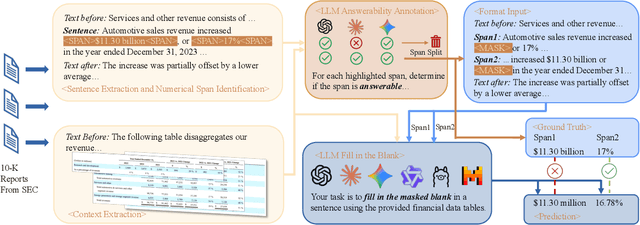
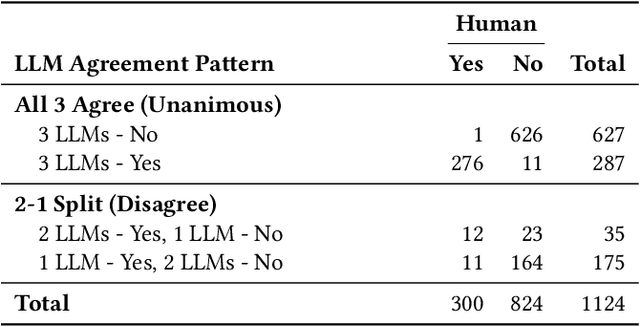
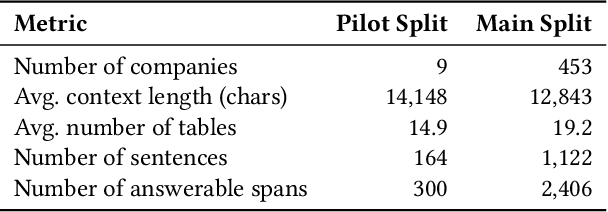
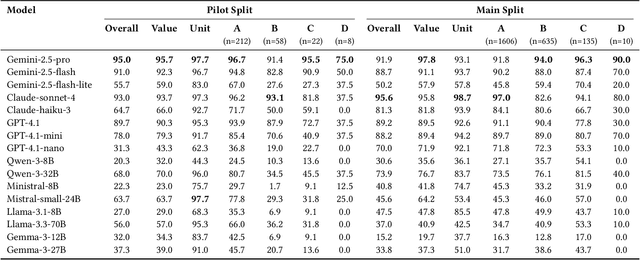
Hallucination remains a critical challenge for deploying Large Language Models (LLMs) in finance. Accurate extraction and precise calculation from tabular data are essential for reliable financial analysis, since even minor numerical errors can undermine decision-making and regulatory compliance. Financial applications have unique requirements, often relying on context-dependent, numerical, and proprietary tabular data that existing hallucination benchmarks rarely capture. In this study, we develop a rigorous and scalable framework for evaluating intrinsic hallucinations in financial LLMs, conceptualized as a context-aware masked span prediction task over real-world financial documents. Our main contributions are: (1) a novel, automated dataset creation paradigm using a masking strategy; (2) a new hallucination evaluation dataset derived from S&P 500 annual reports; and (3) a comprehensive evaluation of intrinsic hallucination patterns in state-of-the-art LLMs on financial tabular data. Our work provides a robust methodology for in-house LLM evaluation and serves as a critical step toward building more trustworthy and reliable financial Generative AI systems.