 Add to Chrome
 Add to Firefox
 Add to Edge
Noise-Aware Framework for Correcting Corrupted Labels
Jun 10, 2026
High-quality labeled data is essential for training reliable ML/DL models. However, real-world datasets often contain a considerable proportion of corrupted labels, which can severely degrade model performance. To address this problem, we propose CANOLA, a novel framework for correcting corrupted labels through noise-aware learning and iterative label refinement. CANOLA explicitly estimates the underlying noise distribution of the dataset and incorporates this information into the training of a noise-aware Deep Neural Network. By incorporating noise characteristics during learning, CANOLA enables the model to down-weight unreliable supervision signals and focus on trustworthy patterns, thereby improving robustness and generalization. Label correction is performed via cautious, iterative soft label refinement, in which model predictions are blended with observed labels to prevent premature or erroneous updates. This progressive refinement allows the dataset to be repaired in a stable and controlled manner. We evaluate CANOLA on six widely used datasets under realistic noisy labeling scenarios. Experimental results show that CANOLA consistently outperforms SOTA label correction methods, achieving relative improvements ranging from 19% to 52% in error reduction. Moreover, models trained on datasets corrected by CANOLA obtain substantial downstream performance gains. Even simple classifiers trained on CANOLA's corrected data can outperform complex model-centric approaches by margins of up to 67%.

A Data-Centric Framework for Detecting and Correcting Corrupted Labels
Jun 10, 2026The performance of machine learning and deep learning models largely depends on the quality of the training data. However, the quality of the real-world datasets is often compromised by noisy labels, which can substantially degrade model accuracy and reliability. To address this challenge, we propose Relabeler, an end-to-end data-centric framework for detecting and correcting corrupted labels. For corrupted label detection, Relabeler jointly leverages both local and global relationships among data instances to identify potentially noisy samples. After detecting suspicious instances, Relabeler further performs label correction by estimating the most probable clean label for each instance based on both its input features and observed noisy label. Extensive experiments across multiple datasets, noise types, and noise rates demonstrate that Relabeler consistently outperforms state-of-the-art baselines, achieving up to 58% improvement in label correction precision and 6% improvement in downstream task performance.
A Multi-Agent Framework for Code-Guided, Modular, and Verifiable Automated Machine Learning
Feb 15, 2026Automated Machine Learning (AutoML) has revolutionized the development of data-driven solutions; however, traditional frameworks often function as "black boxes", lacking the flexibility and transparency required for complex, real-world engineering tasks. Recent Large Language Model (LLM)-based agents have shifted toward code-driven approaches. However, they frequently suffer from hallucinated logic and logic entanglement, where monolithic code generation leads to unrecoverable runtime failures. In this paper, we present iML, a novel multi-agent framework designed to shift AutoML from black-box prompting to a code-guided, modular, and verifiable architectural paradigm. iML introduces three main ideas: (1) Code-Guided Planning, which synthesizes a strategic blueprint grounded in autonomous empirical profiling to eliminate hallucination; (2) Code-Modular Implementation, which decouples preprocessing and modeling into specialized components governed by strict interface contracts; and (3) Code-Verifiable Integration, which enforces physical feasibility through dynamic contract verification and iterative self-correction. We evaluate iML across MLE-BENCH and the newly introduced iML-BENCH, comprising a diverse range of real-world Kaggle competitions. The experimental results show iML's superiority over state-of-the-art agents, achieving a valid submission rate of 85% and a competitive medal rate of 45% on MLE-BENCH, with an average standardized performance score (APS) of 0.77. On iML-BENCH, iML significantly outperforms the other approaches by 38%-163% in APS. Furthermore, iML maintains a robust 70% success rate even under stripped task descriptions, effectively filling information gaps through empirical profiling. These results highlight iML's potential to bridge the gap between stochastic generation and reliable engineering, marking a meaningful step toward truly AutoML.
Generating Critical Scenarios for Testing Automated Driving Systems
Dec 03, 2024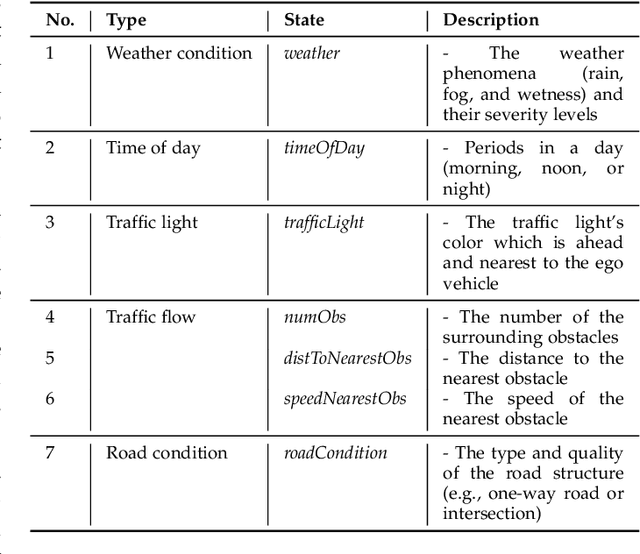
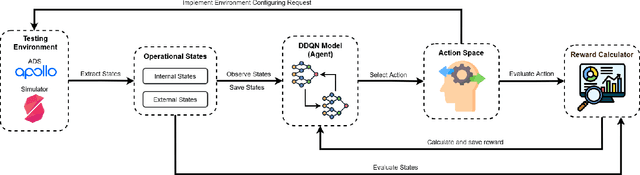
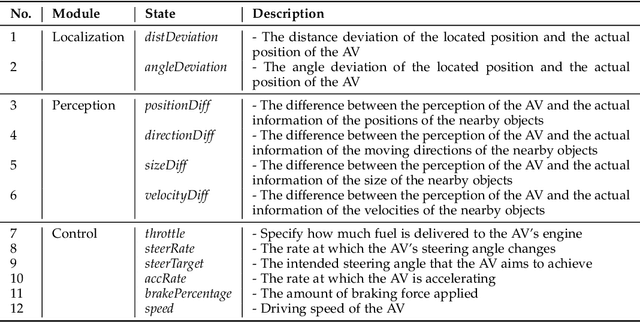
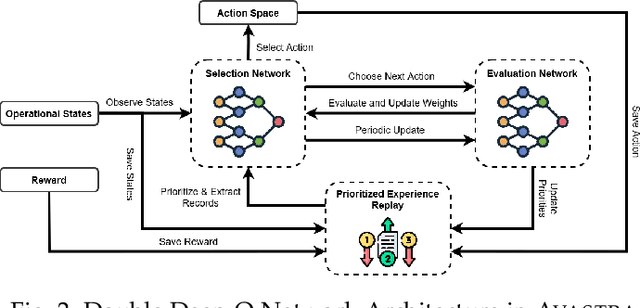
Autonomous vehicles (AVs) have demonstrated significant potential in revolutionizing transportation, yet ensuring their safety and reliability remains a critical challenge, especially when exposed to dynamic and unpredictable environments. Real-world testing of an Autonomous Driving System (ADS) is both expensive and risky, making simulation-based testing a preferred approach. In this paper, we propose AVASTRA, a Reinforcement Learning (RL)-based approach to generate realistic critical scenarios for testing ADSs in simulation environments. To capture the complexity of driving scenarios, AVASTRA comprehensively represents the environment by both the internal states of an ADS under-test (e.g., the status of the ADS's core components, speed, or acceleration) and the external states of the surrounding factors in the simulation environment (e.g., weather, traffic flow, or road condition). AVASTRA trains the RL agent to effectively configure the simulation environment that places the AV in dangerous situations and potentially leads it to collisions. We introduce a diverse set of actions that allows the RL agent to systematically configure both environmental conditions and traffic participants. Additionally, based on established safety requirements, we enforce heuristic constraints to ensure the realism and relevance of the generated test scenarios. AVASTRA is evaluated on two popular simulation maps with four different road configurations. Our results show AVASTRA's ability to outperform the state-of-the-art approach by generating 30% to 115% more collision scenarios. Compared to the baseline based on Random Search, AVASTRA achieves up to 275% better performance. These results highlight the effectiveness of AVASTRA in enhancing the safety testing of AVs through realistic comprehensive critical scenario generation.
An Empirical Study on Capability of Large Language Models in Understanding Code Semantics
Jul 04, 2024Large Language Models for Code (code LLMs) have demonstrated remarkable performance across various software engineering (SE) tasks, increasing the application of code LLMs in software development. Despite the success of code LLMs, there remain significant concerns about the actual capabilities and reliability of these models, "whether these models really learn the semantics of code from the training data and leverage the learned knowledge to perform the SE tasks". In this paper, we introduce EMPICA, a comprehensive framework designed to systematically and empirically evaluate the capabilities of code LLMs in understanding code semantics. Specifically, EMPICA systematically introduces controlled modifications/transformations into the input code and examines the models' responses. Generally, code LLMs must be robust to semantically equivalent code inputs and be sensitive to non-equivalent ones for all SE tasks. Specifically, for every SE task, given an input code snippet c and its semantic equivalent variants, code LLMs must robustly produce consistent/equivalent outputs while they are expected to generate different outputs for c and its semantic non-equivalent variants. Our experimental results on three representative code understanding tasks, including code summarization, method name prediction, and output prediction, reveal that the robustness and sensitivity of the state-of-the-art code LLMs to code transformations vary significantly across tasks and transformation operators. In addition, the code LLMs exhibit better robustness to the semantic preserving transformations than their sensitivity to the semantic non-preserving transformations. These results highlight a need to enhance the model's capabilities of understanding code semantics, especially the sensitivity property.
ARIST: An Effective API Argument Recommendation Approach
Jun 11, 2023
Learning and remembering to use APIs are difficult. Several techniques have been proposed to assist developers in using APIs. Most existing techniques focus on recommending the right API methods to call, but very few techniques focus on recommending API arguments. In this paper, we propose ARIST, a novel automated argument recommendation approach which suggests arguments by predicting developers' expectations when they define and use API methods. To implement this idea in the recommendation process, ARIST combines program analysis (PA), language models (LMs), and several features specialized for the recommendation task which consider the functionality of formal parameters and the positional information of code elements (e.g., variables or method calls) in the given context. In ARIST, the LMs and the recommending features are used to suggest the promising candidates identified by PA. Meanwhile, PA navigates the LMs and the features working on the set of the valid candidates which satisfy syntax, accessibility, and type-compatibility constraints defined by the programming language in use. Our evaluation on a large dataset of real-world projects shows that ARIST improves the state-of-the-art approach by 19% and 18% in top-1 precision and recall for recommending arguments of frequently-used libraries. For general argument recommendation task, i.e., recommending arguments for every method call, ARIST outperforms the baseline approaches by up to 125% top-1 accuracy. Moreover, for newly-encountered projects, ARIST achieves more than 60% top-3 accuracy when evaluating on a larger dataset. For working/maintaining projects, with a personalized LM to capture developers' coding practice, ARIST can productively rank the expected arguments at the top-1 position in 7/10 requests.