 Add to Chrome
 Add to Firefox
 Add to Edge
Noise-Aware Framework for Correcting Corrupted Labels
Jun 10, 2026
High-quality labeled data is essential for training reliable ML/DL models. However, real-world datasets often contain a considerable proportion of corrupted labels, which can severely degrade model performance. To address this problem, we propose CANOLA, a novel framework for correcting corrupted labels through noise-aware learning and iterative label refinement. CANOLA explicitly estimates the underlying noise distribution of the dataset and incorporates this information into the training of a noise-aware Deep Neural Network. By incorporating noise characteristics during learning, CANOLA enables the model to down-weight unreliable supervision signals and focus on trustworthy patterns, thereby improving robustness and generalization. Label correction is performed via cautious, iterative soft label refinement, in which model predictions are blended with observed labels to prevent premature or erroneous updates. This progressive refinement allows the dataset to be repaired in a stable and controlled manner. We evaluate CANOLA on six widely used datasets under realistic noisy labeling scenarios. Experimental results show that CANOLA consistently outperforms SOTA label correction methods, achieving relative improvements ranging from 19% to 52% in error reduction. Moreover, models trained on datasets corrected by CANOLA obtain substantial downstream performance gains. Even simple classifiers trained on CANOLA's corrected data can outperform complex model-centric approaches by margins of up to 67%.

A Data-Centric Framework for Detecting and Correcting Corrupted Labels
Jun 10, 2026The performance of machine learning and deep learning models largely depends on the quality of the training data. However, the quality of the real-world datasets is often compromised by noisy labels, which can substantially degrade model accuracy and reliability. To address this challenge, we propose Relabeler, an end-to-end data-centric framework for detecting and correcting corrupted labels. For corrupted label detection, Relabeler jointly leverages both local and global relationships among data instances to identify potentially noisy samples. After detecting suspicious instances, Relabeler further performs label correction by estimating the most probable clean label for each instance based on both its input features and observed noisy label. Extensive experiments across multiple datasets, noise types, and noise rates demonstrate that Relabeler consistently outperforms state-of-the-art baselines, achieving up to 58% improvement in label correction precision and 6% improvement in downstream task performance.
A Wearable Resistance Devices Motor Learning Effects in Exercise
May 24, 2024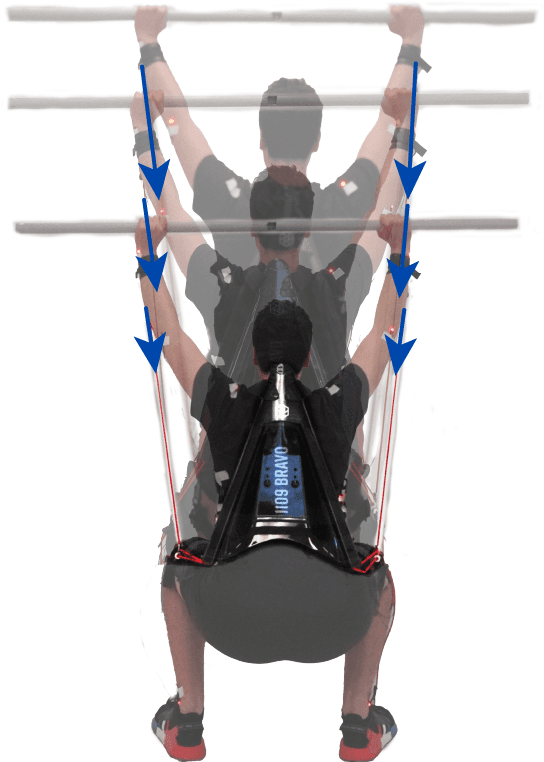
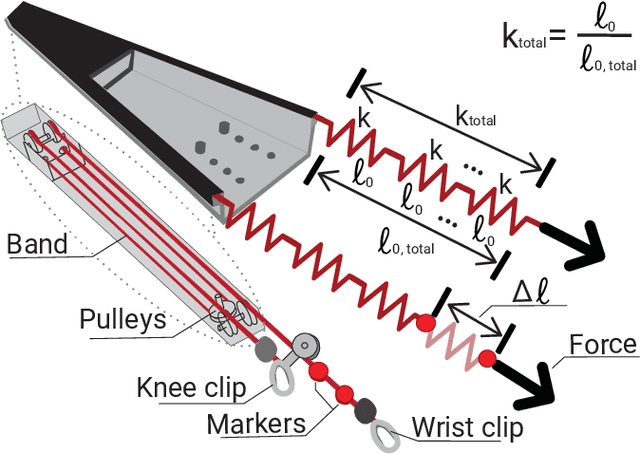
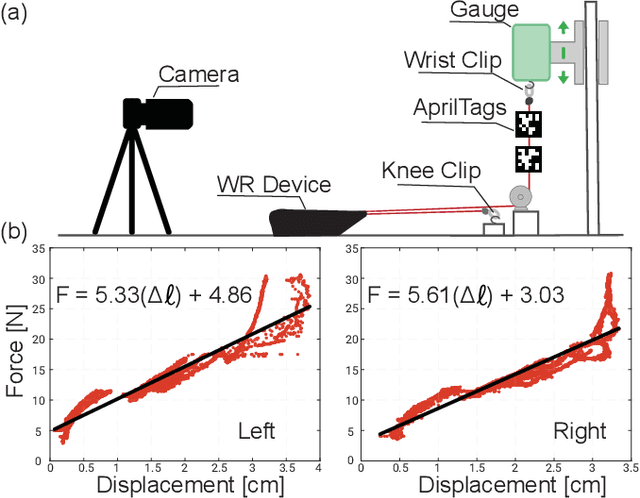
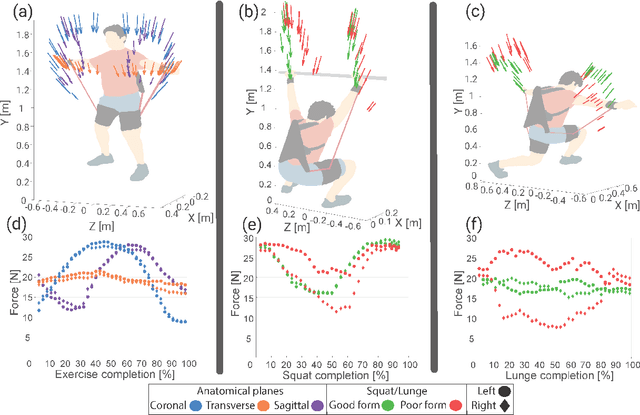
The integration of technology into exercise regimens has emerged as a strategy to enhance normal human capabilities and return human motor function after injury or illness by enhancing motor learning and retention. Much research has focused on how active devices, whether confined to a lab or made into a wearable format, can apply forces at set times and conditions to optimize the process of learning. However, the focus on active force production often forces devices to either be confined to simple movements or interventions. As such, in this paper, we investigate how passive device behaviors can contribute to the process of motor learning by themselves. Our approach involves using a wearable resistance (WR) device, which is outfitted with elastic bands, to apply a force field that changes in response to a person's movements while performing exercises. We develop a method to measure the produced forces from the device without impeding the function and we characterize the device's force generation abilities. We then present a study assessing the impact of the WR device on motor learning of proper squat form compared to visual or no feedback. Biometrics such as knee and hip angles were used to monitor and assess subject performance. Our findings indicate that the force fields produced while training with the WR device can improve performance in full-body exercises similarly to a more direct visual feedback mechanism, though the improvement is not consistent across all performance metrics. Through our research, we contribute important insights into the application of passive wearable resistance technology in practical exercise settings.