 Add to Chrome
 Add to Firefox
 Add to Edge
GenMatter: Perceiving Physical Objects with Generative Matter Models
Apr 24, 2026
Human visual perception offers valuable insights for understanding computational principles of motion-based scene interpretation. Humans robustly detect and segment moving entities that constitute independently moveable chunks of matter, whether observing sparse moving dots, textured surfaces, or naturalistic scenes. In contrast, existing computer vision systems lack a unified approach that works across these diverse settings. Inspired by principles of human perception, we propose a generative model that hierarchically groups low-level motion cues and high-level appearance features into particles (small Gaussians representing local matter), and groups particles into clusters capturing coherently and independently moveable physical entities. We develop a hardware-accelerated inference algorithm based on parallelized block Gibbs sampling to recover stable particle motion and groupings. Our model operates on different kinds of inputs (random dots, stylized textures, or naturalistic RGB video), enabling it to work across settings where biological vision succeeds but existing computer vision approaches do not. We validate this unified framework across three domains: on 2D random dot kinematograms, our approach captures human object perception including graded uncertainty across ambiguous conditions; on a Gestalt-inspired dataset of camouflaged rotating objects, our approach recovers correct 3D structure from motion and thereby accurate 2D object segmentation; and on naturalistic RGB videos, our model tracks the moving 3D matter that makes up deforming objects, enabling robust object-level scene understanding. This work thus establishes a general framework for motion-based perception grounded in principles of human vision.

Evaluating Multiview Object Consistency in Humans and Image Models
Sep 10, 2024
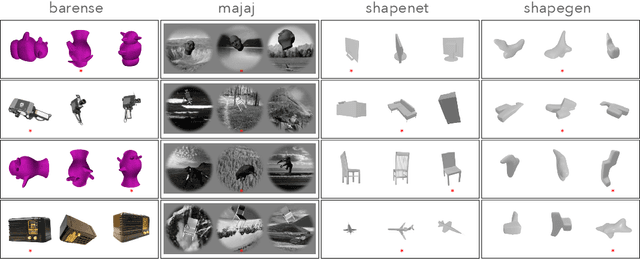


We introduce a benchmark to directly evaluate the alignment between human observers and vision models on a 3D shape inference task. We leverage an experimental design from the cognitive sciences which requires zero-shot visual inferences about object shape: given a set of images, participants identify which contain the same/different objects, despite considerable viewpoint variation. We draw from a diverse range of images that include common objects (e.g., chairs) as well as abstract shapes (i.e., procedurally generated `nonsense' objects). After constructing over 2000 unique image sets, we administer these tasks to human participants, collecting 35K trials of behavioral data from over 500 participants. This includes explicit choice behaviors as well as intermediate measures, such as reaction time and gaze data. We then evaluate the performance of common vision models (e.g., DINOv2, MAE, CLIP). We find that humans outperform all models by a wide margin. Using a multi-scale evaluation approach, we identify underlying similarities and differences between models and humans: while human-model performance is correlated, humans allocate more time/processing on challenging trials. All images, data, and code can be accessed via our project page.