 Add to Chrome
 Add to Firefox
 Add to Edge
RoughNet: Mapping Arctic Sea Ice Roughness Using Diffusion-Based Super-Resolution of Satellite Imagery
Jul 15, 2026
Accurate estimation of landfast sea ice roughness is critical for climate modeling and safe Arctic over-ice travel, yet existing approaches rely on costly airborne surveys or sparse in-situ measurements, limiting spatial coverage and operational scalability. Here we show that high-resolution sea ice topography can be reconstructed directly from optical satellite imagery using a conditional diffusion framework. Our approach, RoughNet, learns to map 10 m Sentinel-2 multispectral images to locally normalized 1 m surface elevation residual fields, enabling fine-scale roughness characterization from widely available satellite data. Trained on airborne LiDAR data from two Arctic regions and evaluated on an unseen third Arctic region, the model generalizes across diverse ice conditions and partially reproduces small-scale topographic structure. The best-performing model achieves an out-of-domain root mean squared error of 9 cm while preserving the statistical and spectral properties of the underlying roughness field. These results demonstrate that generative diffusion models can recover physically meaningful surface structure from optical imagery alone, providing a scalable pathway for high-resolution sea ice mapping and roughness estimation in data-sparse environments.

Deep Learning Surrogates for Real-Time Gas Emission Inversion
Jun 17, 2025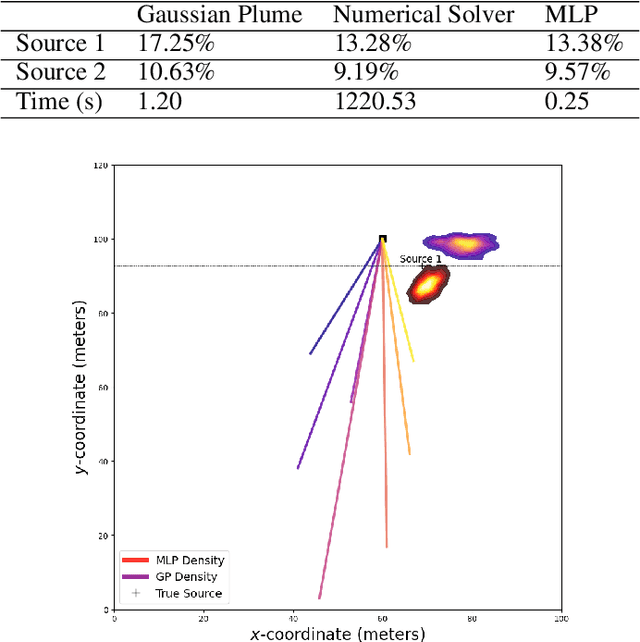

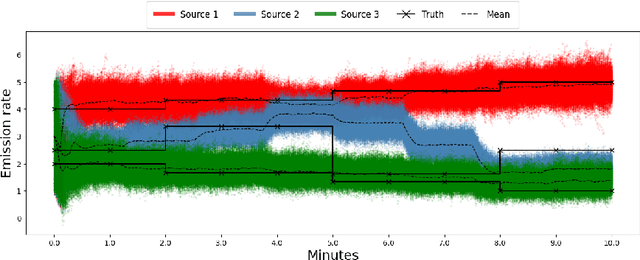
Real-time identification and quantification of greenhouse-gas emissions under transient atmospheric conditions is a critical challenge in environmental monitoring. We introduce a spatio-temporal inversion framework that embeds a deep-learning surrogate of computational fluid dynamics (CFD) within a sequential Monte Carlo algorithm to perform Bayesian inference of both emission rate and source location in dynamic flow fields. By substituting costly numerical solvers with a multilayer perceptron trained on high-fidelity CFD outputs, our surrogate captures spatial heterogeneity and temporal evolution of gas dispersion, while delivering near-real-time predictions. Validation on the Chilbolton methane release dataset demonstrates comparable accuracy to full CFD solvers and Gaussian plume models, yet achieves orders-of-magnitude faster runtimes. Further experiments under simulated obstructed-flow scenarios confirm robustness in complex environments. This work reconciles physical fidelity with computational feasibility, offering a scalable solution for industrial emissions monitoring and other time-sensitive spatio-temporal inversion tasks in environmental and scientific modeling.