 Add to Chrome
 Add to Firefox
 Add to Edge
Convergence of projected stochastic natural gradient variational inference for various step size and sample or batch size schedules
Apr 01, 2026
Stochastic natural gradient variational inference (NGVI) is a popular and efficient algorithm for Bayesian inference. Despite empirical success, the convergence of this method is still not fully understood. In this work, we define and study a projected stochastic NGVI when variational distributions form an exponential family. Stochasticity arises when either gradients are intractable expectations or large sums. We prove new non-asymptotic convergence results for combinations of constant or decreasing step sizes and constant or increasing sample/batch sizes. When all hyperparameters are fixed, NGVI is shown to converge geometrically to a neighborhood of the optimum, while we establish convergence to the optimum with rates of the form $\mathcal{O}\left(\frac{1}{T^ρ} \right)$, possibly with $ρ\geq 1$, for all other combinations of step size and sample/batch size schedules. These rates apply when the target posterior distribution is close in some sense to the considered exponential family. Our theoretical results extend existing NGVI and stochastic optimization results and provide more flexibility to adjust, in a principled way, step sizes and sample/batch sizes in order to meet speed, resources, or accuracy constraints.

Adaptive importance sampling for heavy-tailed distributions via $α$-divergence minimization
Oct 25, 2023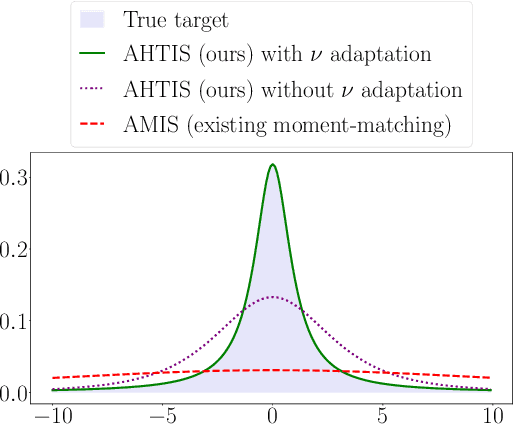
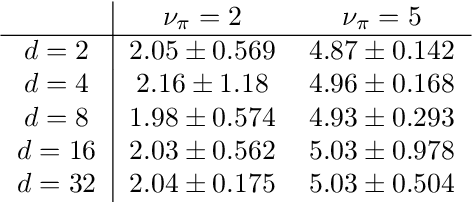
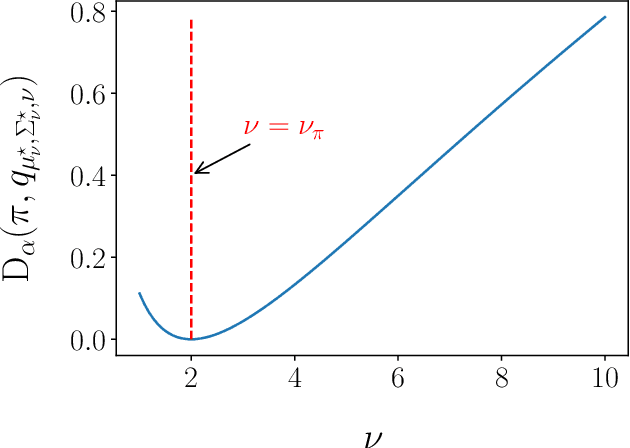
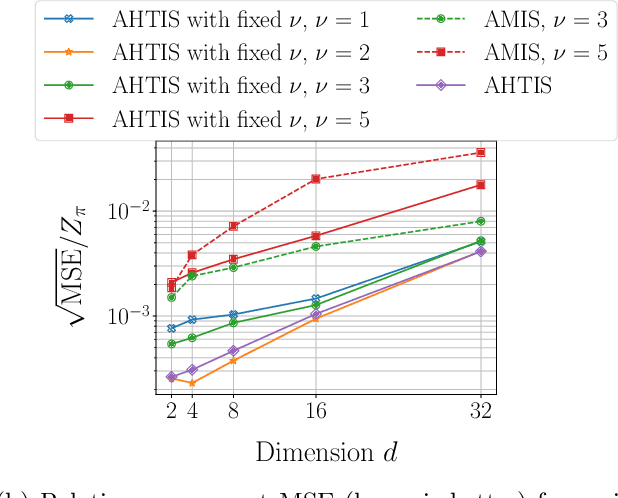
Adaptive importance sampling (AIS) algorithms are widely used to approximate expectations with respect to complicated target probability distributions. When the target has heavy tails, existing AIS algorithms can provide inconsistent estimators or exhibit slow convergence, as they often neglect the target's tail behaviour. To avoid this pitfall, we propose an AIS algorithm that approximates the target by Student-t proposal distributions. We adapt location and scale parameters by matching the escort moments - which are defined even for heavy-tailed distributions - of the target and the proposal. These updates minimize the $\alpha$-divergence between the target and the proposal, thereby connecting with variational inference. We then show that the $\alpha$-divergence can be approximated by a generalized notion of effective sample size and leverage this new perspective to adapt the tail parameter with Bayesian optimization. We demonstrate the efficacy of our approach through applications to synthetic targets and a Bayesian Student-t regression task on a real example with clinical trial data.