 Add to Chrome
 Add to Firefox
 Add to Edge
Thomas Drugman

Distribution augmentation for low-resource expressive text-to-speech
Feb 13, 2022

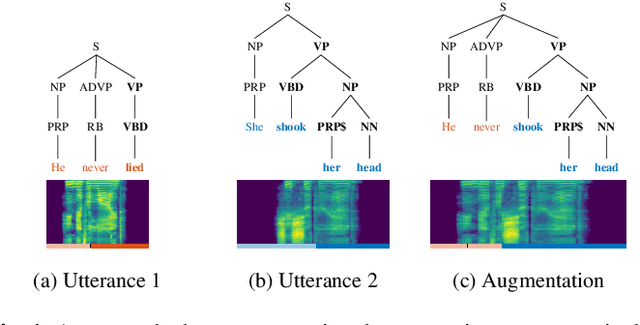
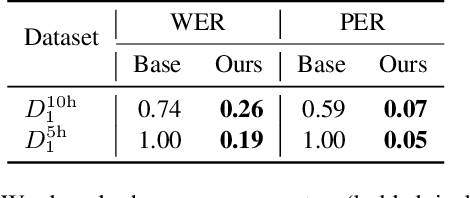
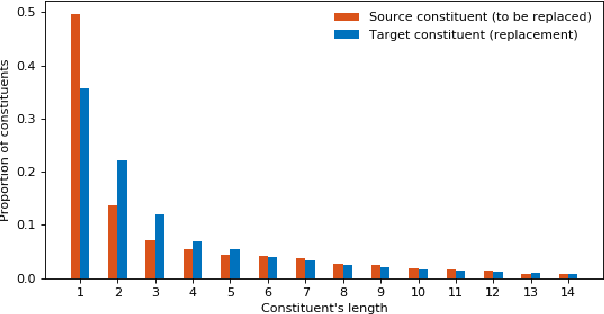
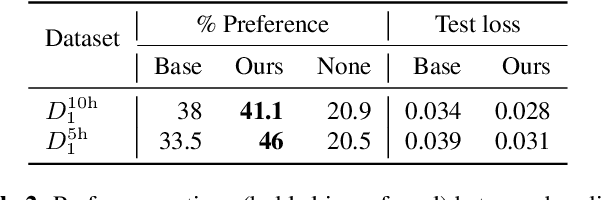
This paper presents a novel data augmentation technique for text-to-speech (TTS), that allows to generate new (text, audio) training examples without requiring any additional data. Our goal is to increase diversity of text conditionings available during training. This helps to reduce overfitting, especially in low-resource settings. Our method relies on substituting text and audio fragments in a way that preserves syntactical correctness. We take additional measures to ensure that synthesized speech does not contain artifacts caused by combining inconsistent audio samples. The perceptual evaluations show that our method improves speech quality over a number of datasets, speakers, and TTS architectures. We also demonstrate that it greatly improves robustness of attention-based TTS models.

Multi-Scale Spectrogram Modelling for Neural Text-to-Speech
Jun 29, 2021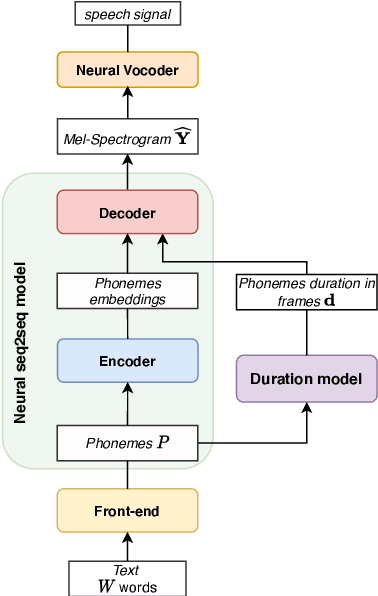
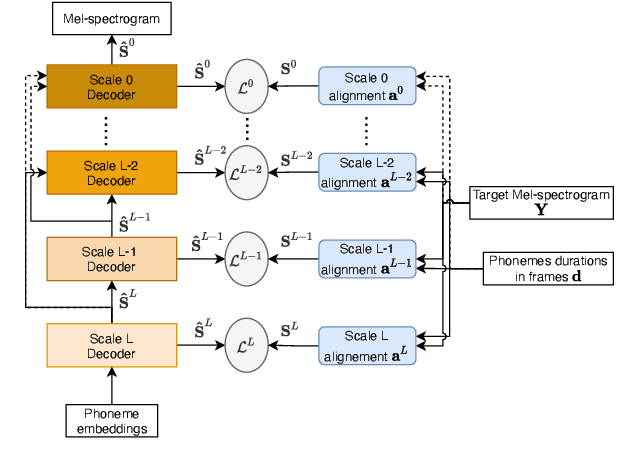
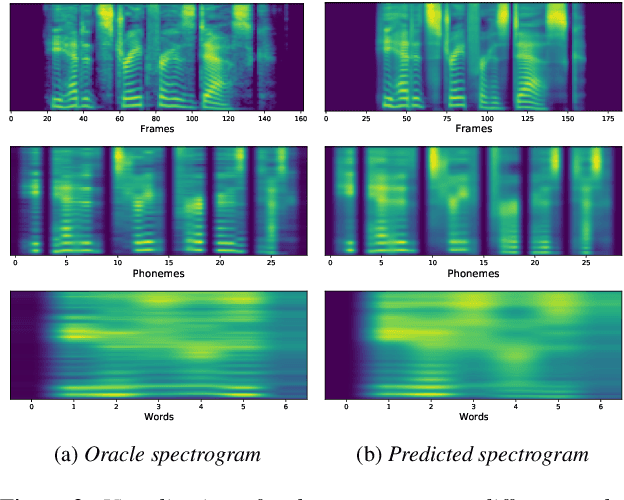
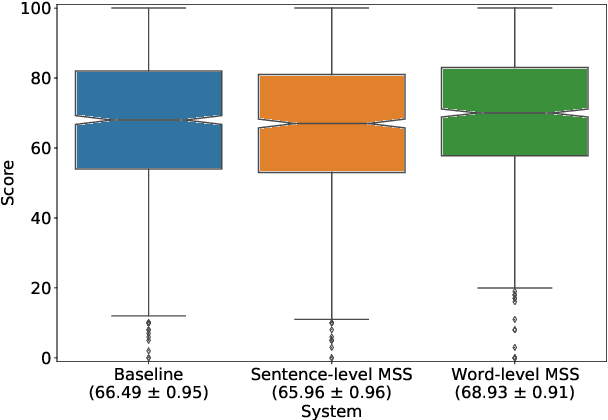
We propose a novel Multi-Scale Spectrogram (MSS) modelling approach to synthesise speech with an improved coarse and fine-grained prosody. We present a generic multi-scale spectrogram prediction mechanism where the system first predicts coarser scale mel-spectrograms that capture the suprasegmental information in speech, and later uses these coarser scale mel-spectrograms to predict finer scale mel-spectrograms capturing fine-grained prosody. We present details for two specific versions of MSS called Word-level MSS and Sentence-level MSS where the scales in our system are motivated by the linguistic units. The Word-level MSS models word, phoneme, and frame-level spectrograms while Sentence-level MSS models sentence-level spectrogram in addition. Subjective evaluations show that Word-level MSS performs statistically significantly better compared to the baseline on two voices.
Voicy: Zero-Shot Non-Parallel Voice Conversion in Noisy Reverberant Environments
Jun 16, 2021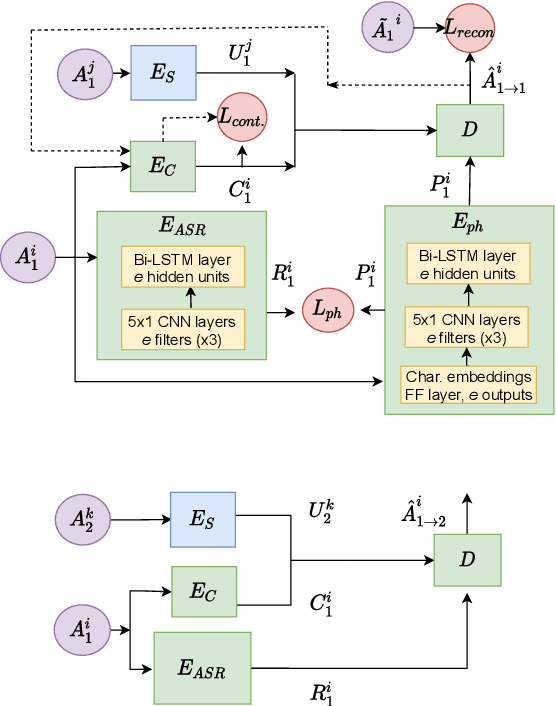
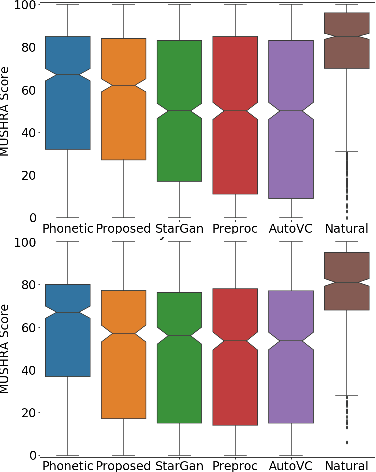
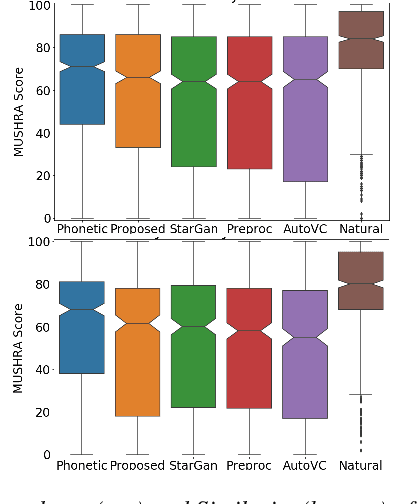
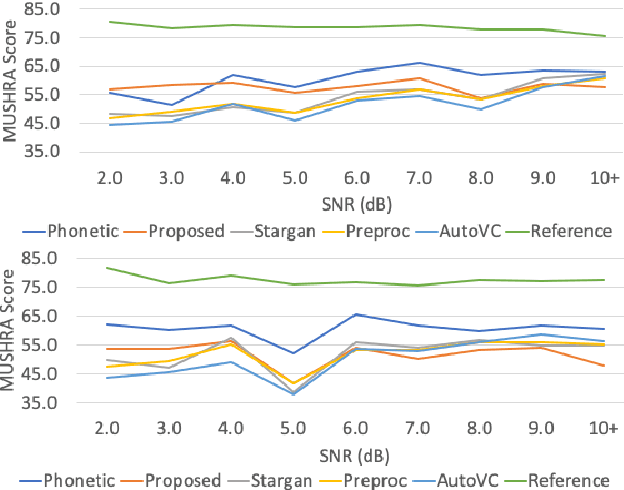
Voice Conversion (VC) is a technique that aims to transform the non-linguistic information of a source utterance to change the perceived identity of the speaker. While there is a rich literature on VC, most proposed methods are trained and evaluated on clean speech recordings. However, many acoustic environments are noisy and reverberant, severely restricting the applicability of popular VC methods to such scenarios. To address this limitation, we propose Voicy, a new VC framework particularly tailored for noisy speech. Our method, which is inspired by the de-noising auto-encoders framework, is comprised of four encoders (speaker, content, phonetic and acoustic-ASR) and one decoder. Importantly, Voicy is capable of performing non-parallel zero-shot VC, an important requirement for any VC system that needs to work on speakers not seen during training. We have validated our approach using a noisy reverberant version of the LibriSpeech dataset. Experimental results show that Voicy outperforms other tested VC techniques in terms of naturalness and target speaker similarity in noisy reverberant environments.
A learned conditional prior for the VAE acoustic space of a TTS system
Jun 14, 2021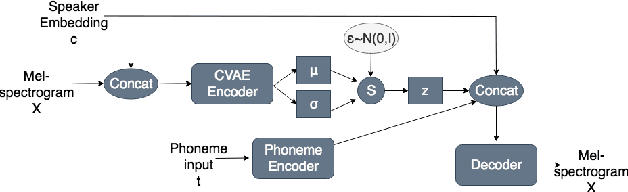
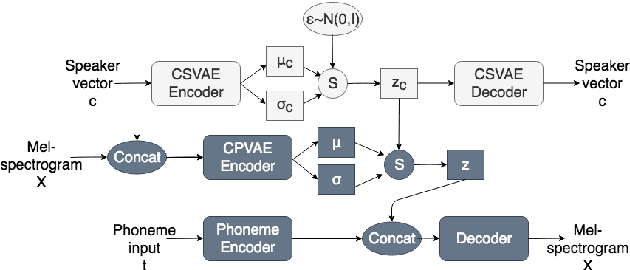
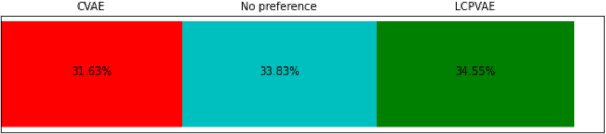
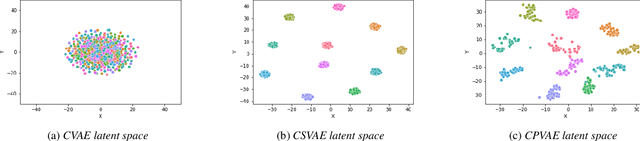
Many factors influence speech yielding different renditions of a given sentence. Generative models, such as variational autoencoders (VAEs), capture this variability and allow multiple renditions of the same sentence via sampling. The degree of prosodic variability depends heavily on the prior that is used when sampling. In this paper, we propose a novel method to compute an informative prior for the VAE latent space of a neural text-to-speech (TTS) system. By doing so, we aim to sample with more prosodic variability, while gaining controllability over the latent space's structure. By using as prior the posterior distribution of a secondary VAE, which we condition on a speaker vector, we can sample from the primary VAE taking explicitly the conditioning into account and resulting in samples from a specific region of the latent space for each condition (i.e. speaker). A formal preference test demonstrates significant preference of the proposed approach over standard Conditional VAE. We also provide visualisations of the latent space where well-separated condition-specific clusters appear, as well as ablation studies to better understand the behaviour of the system.
Weakly-supervised word-level pronunciation error detection in non-native English speech
Jun 07, 2021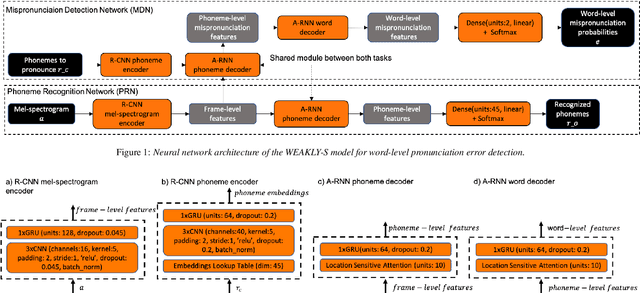
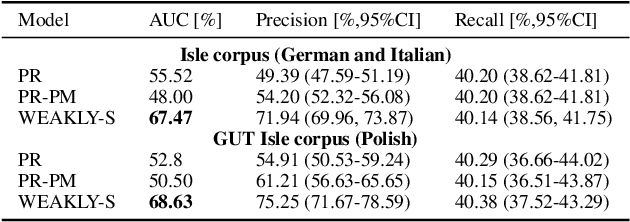

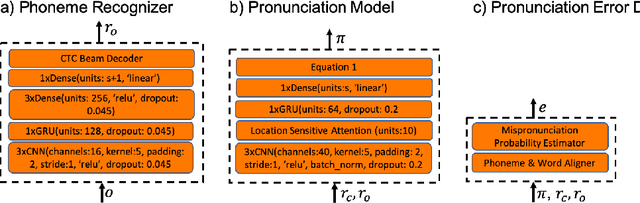
We propose a weakly-supervised model for word-level mispronunciation detection in non-native (L2) English speech. To train this model, phonetically transcribed L2 speech is not required and we only need to mark mispronounced words. The lack of phonetic transcriptions for L2 speech means that the model has to learn only from a weak signal of word-level mispronunciations. Because of that and due to the limited amount of mispronounced L2 speech, the model is more likely to overfit. To limit this risk, we train it in a multi-task setup. In the first task, we estimate the probabilities of word-level mispronunciation. For the second task, we use a phoneme recognizer trained on phonetically transcribed L1 speech that is easily accessible and can be automatically annotated. Compared to state-of-the-art approaches, we improve the accuracy of detecting word-level pronunciation errors in AUC metric by 30% on the GUT Isle Corpus of L2 Polish speakers, and by 21.5% on the Isle Corpus of L2 German and Italian speakers.
Mispronunciation Detection in Non-native (L2) English with Uncertainty Modeling
Feb 08, 2021
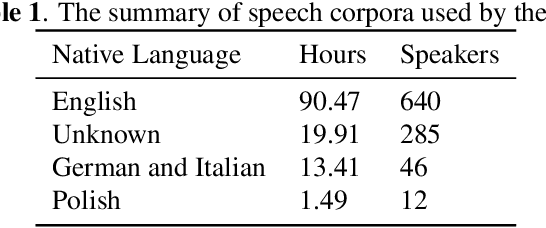
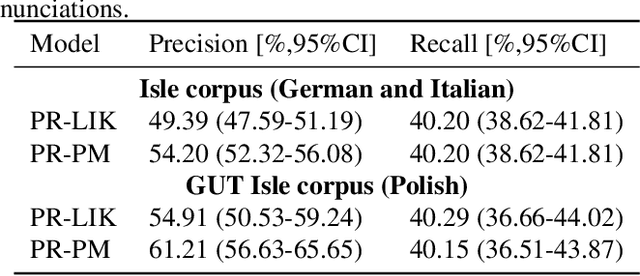
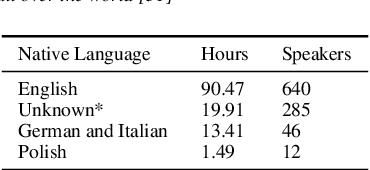
A common approach to the automatic detection of mispronunciation in language learning is to recognize the phonemes produced by a student and compare it to the expected pronunciation of a native speaker. This approach makes two simplifying assumptions: a) phonemes can be recognized from speech with high accuracy, b) there is a single correct way for a sentence to be pronounced. These assumptions do not always hold, which can result in a significant amount of false mispronunciation alarms. We propose a novel approach to overcome this problem based on two principles: a) taking into account uncertainty in the automatic phoneme recognition step, b) accounting for the fact that there may be multiple valid pronunciations. We evaluate the model on non-native (L2) English speech of German, Italian and Polish speakers, where it is shown to increase the precision of detecting mispronunciations by up to 18% (relative) compared to the common approach.
EmoCat: Language-agnostic Emotional Voice Conversion
Jan 14, 2021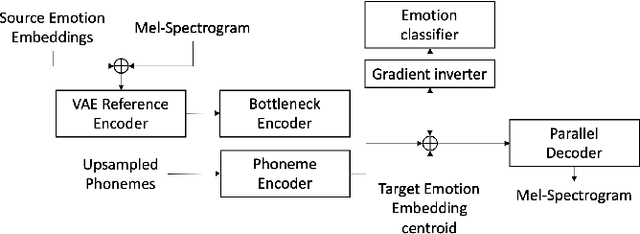
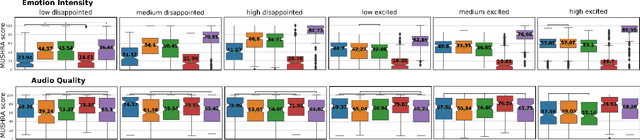
Emotional voice conversion models adapt the emotion in speech without changing the speaker identity or linguistic content. They are less data hungry than text-to-speech models and allow to generate large amounts of emotional data for downstream tasks. In this work we propose EmoCat, a language-agnostic emotional voice conversion model. It achieves high-quality emotion conversion in German with less than 45 minutes of German emotional recordings by exploiting large amounts of emotional data in US English. EmoCat is an encoder-decoder model based on CopyCat, a voice conversion system which transfers prosody. We use adversarial training to remove emotion leakage from the encoder to the decoder. The adversarial training is improved by a novel contribution to gradient reversal to truly reverse gradients. This allows to remove only the leaking information and to converge to better optima with higher conversion performance. Evaluations show that Emocat can convert to different emotions but misses on emotion intensity compared to the recordings, especially for very expressive emotions. EmoCat is able to achieve audio quality on par with the recordings for five out of six tested emotion intensities.
Detection of Lexical Stress Errors in Non-native (L2) English with Data Augmentation and Attention
Dec 29, 2020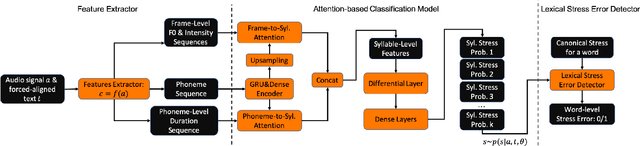
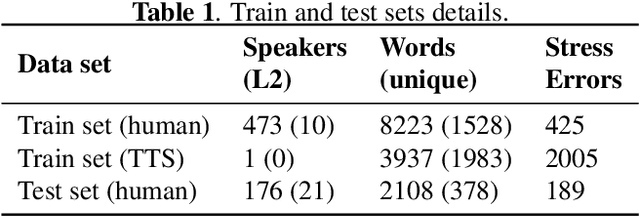
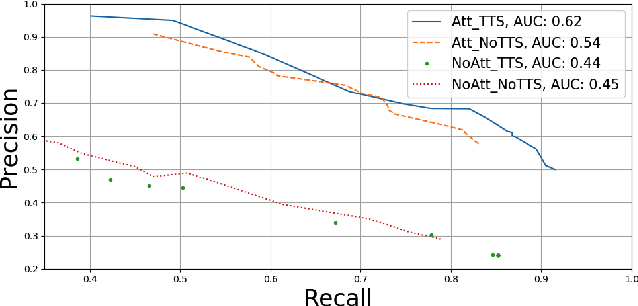
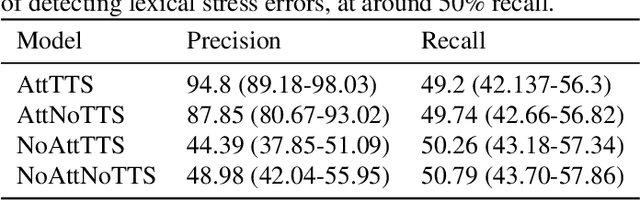
This paper describes two novel complementary techniques that improve the detection of lexical stress errors in non-native (L2) English speech: attention-based feature extraction and data augmentation based on Neural Text-To-Speech (TTS). In a classical approach, audio features are usually extracted from fixed regions of speech such as syllable nucleus. We propose an attention-based deep learning model that automatically derives optimal syllable-level representation from frame-level and phoneme-level audio features. Training this model is challenging because of the limited amount of incorrect stress patterns. To solve this problem, we propose to augment the training set with incorrectly stressed words generated with Neural TTS. Combining both techniques achieves 94.8\% precision and 49.2\% recall for the detection of incorrectly stressed words in L2 English speech of Slavic speakers.
Prosodic Representation Learning and Contextual Sampling for Neural Text-to-Speech
Nov 04, 2020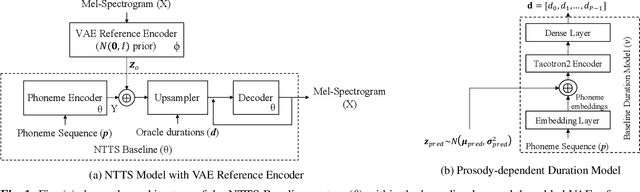
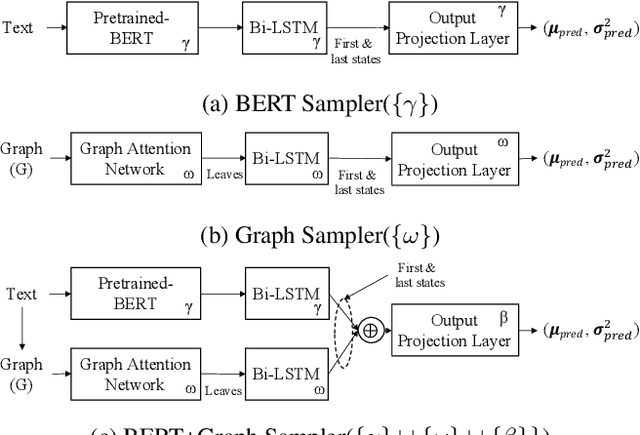
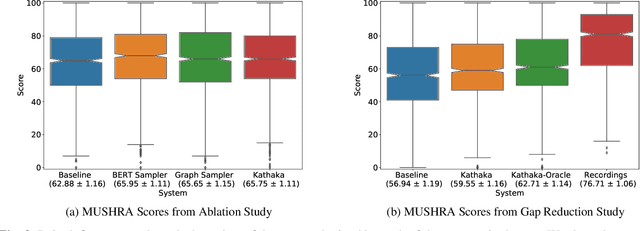
In this paper, we introduce Kathaka, a model trained with a novel two-stage training process for neural speech synthesis with contextually appropriate prosody. In Stage I, we learn a prosodic distribution at the sentence level from mel-spectrograms available during training. In Stage II, we propose a novel method to sample from this learnt prosodic distribution using the contextual information available in text. To do this, we use BERT on text, and graph-attention networks on parse trees extracted from text. We show a statistically significant relative improvement of $13.2\%$ in naturalness over a strong baseline when compared to recordings. We also conduct an ablation study on variations of our sampling technique, and show a statistically significant improvement over the baseline in each case.