 Add to Chrome
 Add to Firefox
 Add to Edge
Control-DINO: Feature Space Conditioning for Controllable Image-to-Video Diffusion
Apr 02, 2026
Video models have recently been applied with success to problems in content generation, novel view synthesis, and, more broadly, world simulation. Many applications in generation and transfer rely on conditioning these models, typically through perceptual, geometric, or simple semantic signals, fundamentally using them as generative renderers. At the same time, high-dimensional features obtained from large-scale self-supervised learning on images or point clouds are increasingly used as a general-purpose interface for vision models. The connection between the two has been explored for subject specific editing, aligning and training video diffusion models, but not in the role of a more general conditioning signal for pretrained video diffusion models. Features obtained through self-supervised learning like DINO, contain a lot of entangled information about style, lighting and semantics of the scene. This makes them great at reconstruction tasks but limits their generative capabilities. In this paper, we show how we can use the features for tasks such as video domain transfer and video-from-3D generation. We introduce a lightweight architecture and training strategy that decouples appearance from other features that we wish to preserve, enabling robust control for appearance changes such as stylization and relighting. Furthermore, we show that low spatial resolution can be compensated by higher feature dimensionality, improving controllability in generative rendering from explicit spatial representations.

Scene Generation at Absolute Scale: Utilizing Semantic and Geometric Guidance From Text for Accurate and Interpretable 3D Indoor Scene Generation
Mar 14, 2026We present GuidedSceneGen, a text-to-3D generation framework that produces metrically accurate, globally consistent, and semantically interpretable indoor scenes. Unlike prior text-driven methods that often suffer from geometric drift or scale ambiguity, our approach maintains an absolute world coordinate frame throughout the entire generation process. Starting from a textual scene description, we predict a global 3D layout encoding both semantic and geometric structure, which serves as a guiding proxy for downstream stages. A semantics- and depth-conditioned panoramic diffusion model then synthesizes 360° imagery aligned with the global layout, substantially improving spatial coherence. To explore unobserved regions, we employ a video diffusion model guided by optimized camera trajectories that balances coverage and collision avoidance, achieving up to 10x faster sampling compared to exhaustive path exploration. The generated views are fused using 3D Gaussian Splatting, yielding a consistent and fully navigable 3D scene in absolute scale. GuidedSceneGen enables accurate transfer of object poses and semantic labels from layout to reconstruction, and supports progressive scene expansion without re-alignment. Quantitative results and a user study demonstrate greater 3D consistency and layout plausibility compared to recent panoramic text-to-3D baselines.
SOF: Sorted Opacity Fields for Fast Unbounded Surface Reconstruction
Jun 23, 2025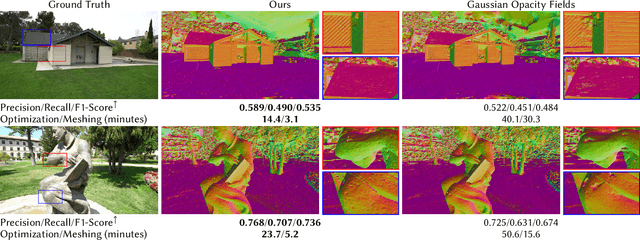
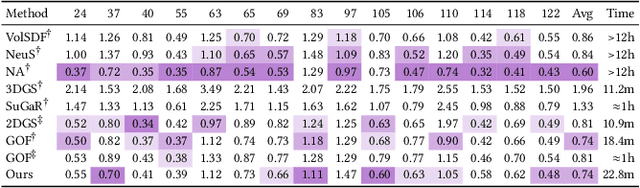
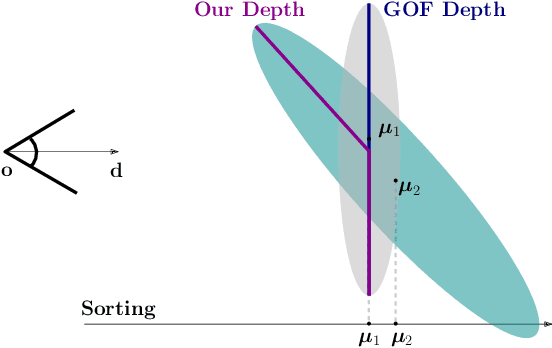
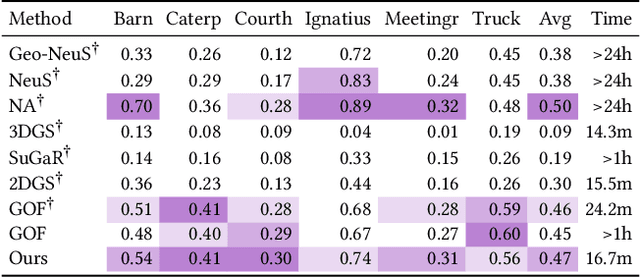
Recent advances in 3D Gaussian representations have significantly improved the quality and efficiency of image-based scene reconstruction. Their explicit nature facilitates real-time rendering and fast optimization, yet extracting accurate surfaces - particularly in large-scale, unbounded environments - remains a difficult task. Many existing methods rely on approximate depth estimates and global sorting heuristics, which can introduce artifacts and limit the fidelity of the reconstructed mesh. In this paper, we present Sorted Opacity Fields (SOF), a method designed to recover detailed surfaces from 3D Gaussians with both speed and precision. Our approach improves upon prior work by introducing hierarchical resorting and a robust formulation of Gaussian depth, which better aligns with the level-set. To enhance mesh quality, we incorporate a level-set regularizer operating on the opacity field and introduce losses that encourage geometrically-consistent primitive shapes. In addition, we develop a parallelized Marching Tetrahedra algorithm tailored to our opacity formulation, reducing meshing time by up to an order of magnitude. As demonstrated by our quantitative evaluation, SOF achieves higher reconstruction accuracy while cutting total processing time by more than a factor of three. These results mark a step forward in turning efficient Gaussian-based rendering into equally efficient geometry extraction.