 Add to Chrome
 Add to Firefox
 Add to Edge
From Global Benchmarks to Local Evaluations: Benchmarking LLMs for the German Public Sector
Aug 18, 2026
Public institutions face a persistent challenge in selecting LLMs suited to their specific context. Existing benchmarks, however, are of limited use as they primarily reflect English-language and US-centric settings, and often only evaluate task performance. In this paper, we present first results of MÖVE, a holistic evaluation framework for the German public sector, examining three rarely considered governance dimensions: energy consumption, provider transparency, and knowledge of German-party positions. Our results reveal significant trade-offs, with no single model excelling across all dimensions: estimated energy consumption varies more than 60-fold and is not explained by model size alone, information disclosure varies systematically across providers, and European models do not exhibit stronger knowledge of German party positions. Model selection for public institutions thus cannot rely on performance rankings alone. Instead, evaluations should also reflect the governance requirements of the deployment context.

MÖVE: A Holistic LLM Benchmark for the German Public Sector
Jun 11, 2026We present MÖVE (Modelle für die Öffentliche Verwaltung Evaluieren), a holistic benchmark for evaluating large language models (LLMs) in the context of the German public sector. While LLMs are increasingly adopted in public administration, model selection remains largely ad hoc, and existing benchmarks offer limited guidance: they are predominantly English-centric, US-centric in content, and focus exclusively on task performance. MÖVE addresses these gaps by evaluating 39 models across two complementary dimensions. Performance criteria cover summarization, question answering, and topic extraction. Governance criteria assess hallucination tendencies, energy consumption, provider transparency, and alignment with German constitutional values and knowledge about positions by German political parties. In total, we utilize ten German-language datasets, including gold- and silverstandard datasets that we constructed to reflect public-administration domains. We employ a multi-metric evaluation strategy combining classical NLP metrics, embedding-based methods, and LLM-as-a-judge approaches. Our results show that no single model dominates across all criteria: top performers differ between tasks, and model size alone is a poor predictor of quality. We further evaluate the benchmark itself, analyzing its statistical precision, LLM judge reliability, the impact of our private datasets on model rankings, the sensitivity of our results to prompt formulation, and the validity of our energy consumption estimates. MÖVE is designed as a living benchmark under active development; results are publicly available at https://moeve.bundesdruckerei.de/.
Bias-Aware Loss for Training Image and Speech Quality Prediction Models from Multiple Datasets
Apr 20, 2021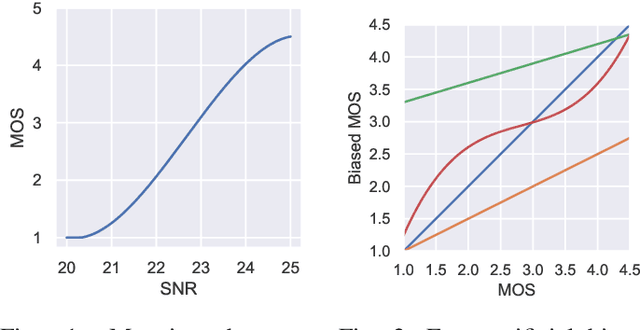
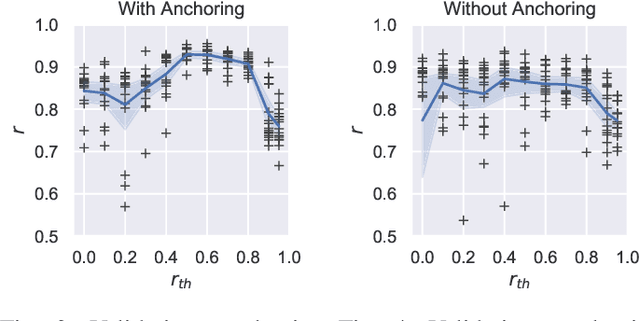
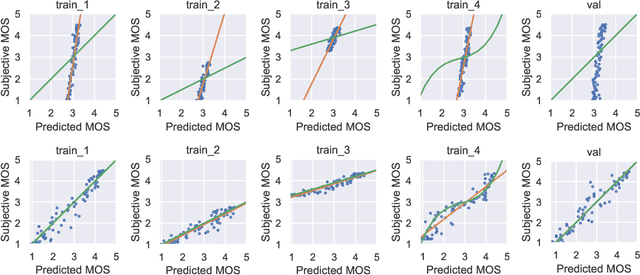
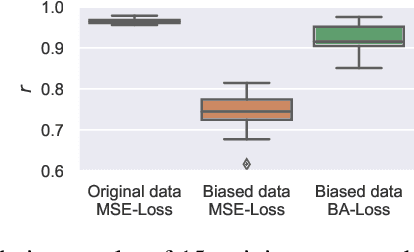
The ground truth used for training image, video, or speech quality prediction models is based on the Mean Opinion Scores (MOS) obtained from subjective experiments. Usually, it is necessary to conduct multiple experiments, mostly with different test participants, to obtain enough data to train quality models based on machine learning. Each of these experiments is subject to an experiment-specific bias, where the rating of the same file may be substantially different in two experiments (e.g. depending on the overall quality distribution). These different ratings for the same distortion levels confuse neural networks during training and lead to lower performance. To overcome this problem, we propose a bias-aware loss function that estimates each dataset's biases during training with a linear function and considers it while optimising the network weights. We prove the efficiency of the proposed method by training and validating quality prediction models on synthetic and subjective image and speech quality datasets.