 Add to Chrome
 Add to Firefox
 Add to Edge
Cell-Free Massive MIMO-Assisted SWIPT Using Stacked Intelligent Metasurfaces
Feb 24, 2026
This study explores a next-generation multiple access (NGMA) framework for cell-free massive MIMO (CF-mMIMO) systems enhanced by stacked intelligent metasurfaces (SIMs), aiming to improve simultaneous wireless information and power transfer (SWIPT) performance. A fundamental challenge lies in optimally selecting the operating modes of access points (APs) to jointly maximize the received energy and satisfy spectral efficiency (SE) quality-of-service constraints. Practical system impairments, including a non-linear harvested energy model, pilot contamination (PC), channel estimation errors, and reliance on long-term statistical channel state information (CSI), are considered. We derive closed-form expressions for both the achievable SE and the average sum harvested energy (sum-HE). A mixed-integer non-convex optimization problem is formulated to jointly optimize the SIM phase shifts, APs mode selection, and power allocation to maximize average sum-HE under SE and average harvested energy constraints. To solve this problem, we propose a centralized training, decentralized execution (CTDE) framework based on deep reinforcement learning (DRL), which efficiently handles high-dimensional decision spaces. A Markovian environment and a normalized joint reward function are introduced to enhance the training stability across on-policy and off-policy DRL algorithms. Additionally, we provide a two-phase convex-based solution as a theoretical robust performance. Numerical results demonstrate that the proposed DRL-based CTDE framework achieves SWIPT performance comparable to convexification-based solution, while significantly outperforming baselines.

SWIPT in Cell-Free Massive MIMO Using Stacked Intelligent Metasurfaces
Mar 18, 2025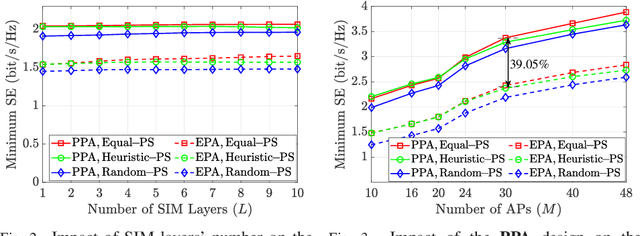
We investigate the integration of stacked intelligent metasurfaces (SIMs) into cell-free massive multiple input multiple output (CF-mMIMO) system to enhance the simultaneous wireless information and power transfer (SWIPT) performance. Closed-form expressions for the spectral efficiency (SE) of the information-decoding receivers (IRs) and the average sum of harvested energy (sum-HE) at the energy-harvesting receivers (ERs) in the novel system model are derived to subsequently formulate a maximum total average sum-HE problem under a minimum SE threshold per each IR. This problem jointly optimizes the SIM phase-shift (PS) configuration and access points' (APs) power allocation, relying on long-term statistical channel state information (CSI). This non-convex problem is then transformed into more tractable forms. Then, efficient algorithms are proposed, including a layer-by-layer heuristic method for SIMs PS configuration that prioritizes sum-HE for the ERs and a successive convex approximation (SCA)-based power allocation scheme to improve the achievable SE for the IRs. Numerical results show that our proposed algorithms achieve an almost 7-fold sum-HE gain as we increase the number of SIM layers, while the proposed power allocation (PPA) scheme often gains up to 40% in terms of the achievable minimum SE, compared to the equal power allocation.
Cell-Free Massive MIMO SWIPT with Beyond Diagonal Reconfigurable Intelligent Surfaces
Feb 01, 2024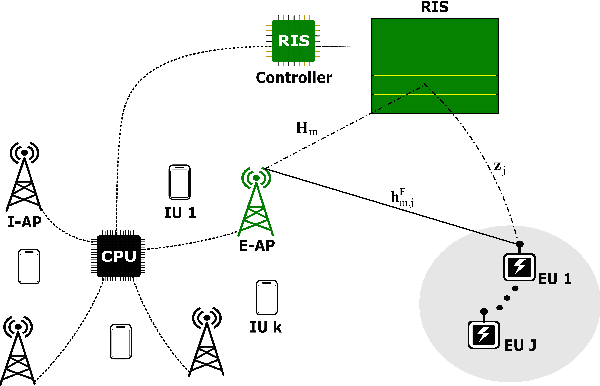
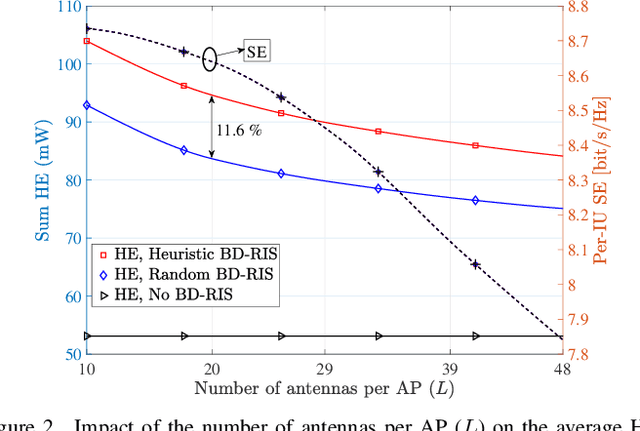
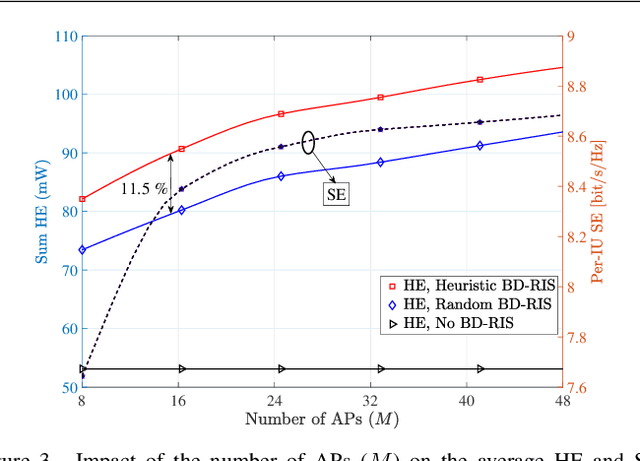
This paper investigates the integration of beyond-diagonal reconfigurable intelligent surfaces (BD-RISs) into cell-free massive multiple-input multiple-output (CF-mMIMO) systems, focusing on applications involving simultaneous wireless information and power transfer (SWIPT). The system supports concurrently two user groups: information users (IUs) and energy users (EUs). A BD-RIS is employed to enhance the wireless power transfer (WPT) directed towards the EUs. To comprehensively evaluate the system's performance, we present an analytical framework for the spectral efficiency (SE) of IUs and the average harvested energy (HE) of EUs in the presence of spatial correlation among the BD-RIS elements and for a non-linear energy harvesting circuit. Our findings offer important insights into the transformative potential of BD-RIS, setting the stage for the development of more efficient and effective SWIPT networks. Finally, incorporating a heuristic scattering matrix design at the BD-RIS results in a substantial improvement compared to the scenario with random scattering matrix design.