 Add to Chrome
 Add to Firefox
 Add to Edge
Conformal Prediction via Transported Beta Laws
May 18, 2026
Split conformal prediction provides finite-sample marginal coverage under exchangeability, but this guarantee averages over the random calibration sample. We study instead the law of the calibration-conditional coverage induced by a realized conformal threshold. In the continuous i.i.d. setting this law is exactly $Beta(k,n+1-k)$, so the usual marginal guarantee corresponds to its mean. We take this beta law as a finite-sample reference object and quantify departures from it using Wasserstein distances on $[0,1]$. The framework yields direct bounds on marginal coverage gaps and on bad-calibration probabilities, and separates different sources of non-i.i.d. behavior according to how they deform the beta reference: test-side shift acts through a transport map on the coverage scale, while calibration dependence changes the order-statistic law itself. We instantiate the framework in scale-shift, clustered, and stationary mixing settings, where the induced deformations can be characterized explicitly or through Berry-Esseen approximations. Simulations on dependent processes confirm that the first-order approximation tracks the empirical Wasserstein distance even at moderate sample sizes.

LOCUS: A Distribution-Free Loss-Quantile Score for Risk-Aware Predictions
Mar 02, 2026Modern machine learning models can be accurate on average yet still make mistakes that dominate deployment cost. We introduce Locus, a distribution-free wrapper that produces a per-input loss-scale reliability score for a fixed prediction function. Rather than quantifying uncertainty about the label, Locus models the realized loss of the prediction function using any engine that outputs a predictive distribution for the loss given an input. A simple split-calibration step turns this function into a distribution-free interpretable score that is comparable across inputs and can be read as an upper loss level. The score is useful on its own for ranking, and it can optionally be thresholded to obtain a transparent flagging rule with distribution-free control of large-loss events. Experiments across 13 regression benchmarks show that Locus yields effective risk ranking and reduces large-loss frequency compared to standard heuristics.
CP4SBI: Local Conformal Calibration of Credible Sets in Simulation-Based Inference
Aug 23, 2025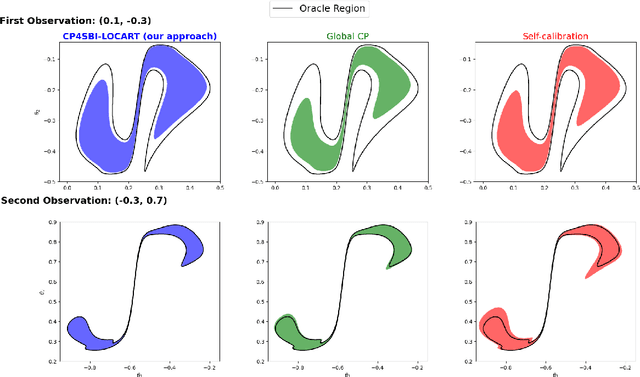
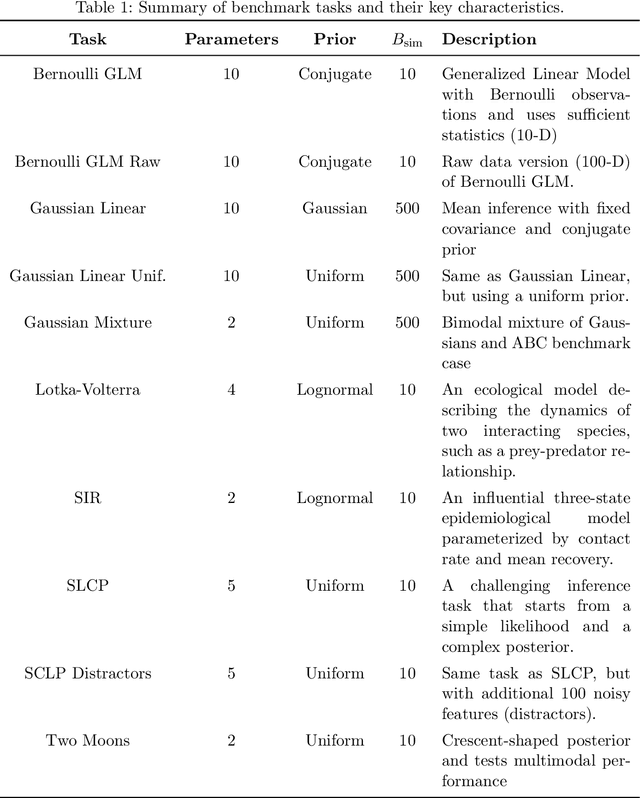
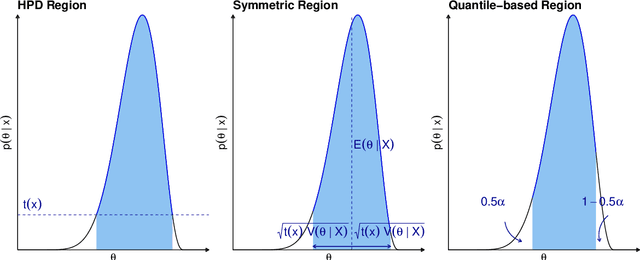
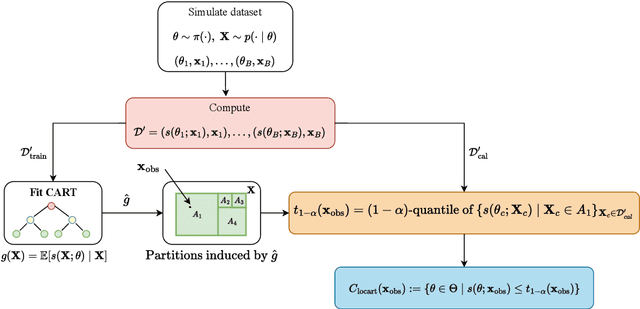
Current experimental scientists have been increasingly relying on simulation-based inference (SBI) to invert complex non-linear models with intractable likelihoods. However, posterior approximations obtained with SBI are often miscalibrated, causing credible regions to undercover true parameters. We develop $\texttt{CP4SBI}$, a model-agnostic conformal calibration framework that constructs credible sets with local Bayesian coverage. Our two proposed variants, namely local calibration via regression trees and CDF-based calibration, enable finite-sample local coverage guarantees for any scoring function, including HPD, symmetric, and quantile-based regions. Experiments on widely used SBI benchmarks demonstrate that our approach improves the quality of uncertainty quantification for neural posterior estimators using both normalizing flows and score-diffusion modeling.
Epistemic Uncertainty in Conformal Scores: A Unified Approach
Feb 10, 2025Conformal prediction methods create prediction bands with distribution-free guarantees but do not explicitly capture epistemic uncertainty, which can lead to overconfident predictions in data-sparse regions. Although recent conformal scores have been developed to address this limitation, they are typically designed for specific tasks, such as regression or quantile regression. Moreover, they rely on particular modeling choices for epistemic uncertainty, restricting their applicability. We introduce $\texttt{EPICSCORE}$, a model-agnostic approach that enhances any conformal score by explicitly integrating epistemic uncertainty. Leveraging Bayesian techniques such as Gaussian Processes, Monte Carlo Dropout, or Bayesian Additive Regression Trees, $\texttt{EPICSCORE}$ adaptively expands predictive intervals in regions with limited data while maintaining compact intervals where data is abundant. As with any conformal method, it preserves finite-sample marginal coverage. Additionally, it also achieves asymptotic conditional coverage. Experiments demonstrate its good performance compared to existing methods. Designed for compatibility with any Bayesian model, but equipped with distribution-free guarantees, $\texttt{EPICSCORE}$ provides a general-purpose framework for uncertainty quantification in prediction problems.
Distribution-Free Calibration of Statistical Confidence Sets
Nov 28, 2024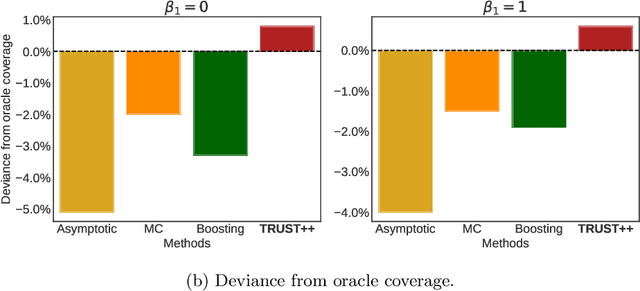
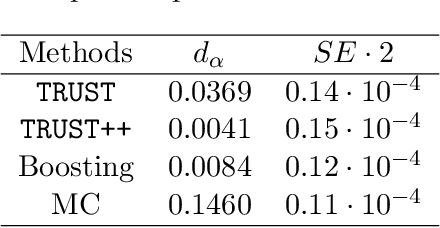
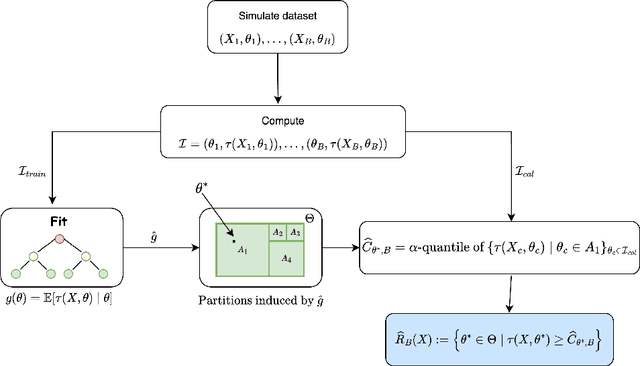
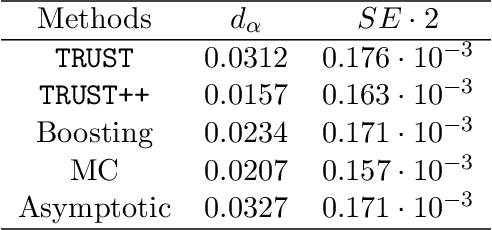
Constructing valid confidence sets is a crucial task in statistical inference, yet traditional methods often face challenges when dealing with complex models or limited observed sample sizes. These challenges are frequently encountered in modern applications, such as Likelihood-Free Inference (LFI). In these settings, confidence sets may fail to maintain a confidence level close to the nominal value. In this paper, we introduce two novel methods, TRUST and TRUST++, for calibrating confidence sets to achieve distribution-free conditional coverage. These methods rely entirely on simulated data from the statistical model to perform calibration. Leveraging insights from conformal prediction techniques adapted to the statistical inference context, our methods ensure both finite-sample local coverage and asymptotic conditional coverage as the number of simulations increases, even if n is small. They effectively handle nuisance parameters and provide computationally efficient uncertainty quantification for the estimated confidence sets. This allows users to assess whether additional simulations are necessary for robust inference. Through theoretical analysis and experiments on models with both tractable and intractable likelihoods, we demonstrate that our methods outperform existing approaches, particularly in small-sample regimes. This work bridges the gap between conformal prediction and statistical inference, offering practical tools for constructing valid confidence sets in complex models.