 Add to Chrome
 Add to Firefox
 Add to Edge
MultiLexNorm++: A Unified Benchmark and a Generative Model for Lexical Normalization for Asian Languages
Jan 23, 2026
Social media data has been of interest to Natural Language Processing (NLP) practitioners for over a decade, because of its richness in information, but also challenges for automatic processing. Since language use is more informal, spontaneous, and adheres to many different sociolects, the performance of NLP models often deteriorates. One solution to this problem is to transform data to a standard variant before processing it, which is also called lexical normalization. There has been a wide variety of benchmarks and models proposed for this task. The MultiLexNorm benchmark proposed to unify these efforts, but it consists almost solely of languages from the Indo-European language family in the Latin script. Hence, we propose an extension to MultiLexNorm, which covers 5 Asian languages from different language families in 4 different scripts. We show that the previous state-of-the-art model performs worse on the new languages and propose a new architecture based on Large Language Models (LLMs), which shows more robust performance. Finally, we analyze remaining errors, revealing future directions for this task.

ViLexNorm: A Lexical Normalization Corpus for Vietnamese Social Media Text
Jan 31, 2024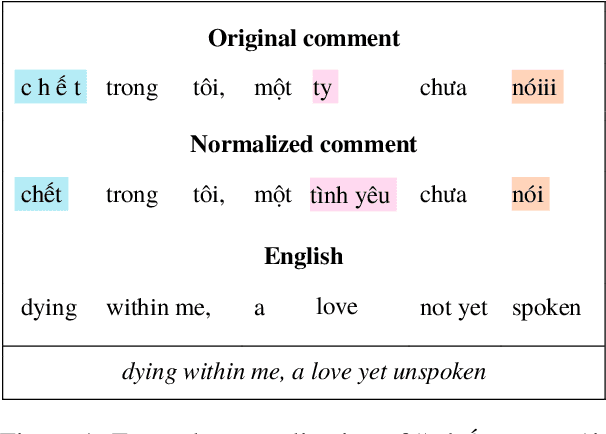
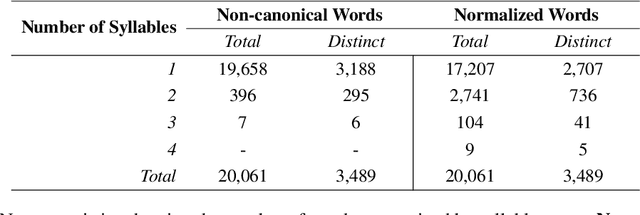
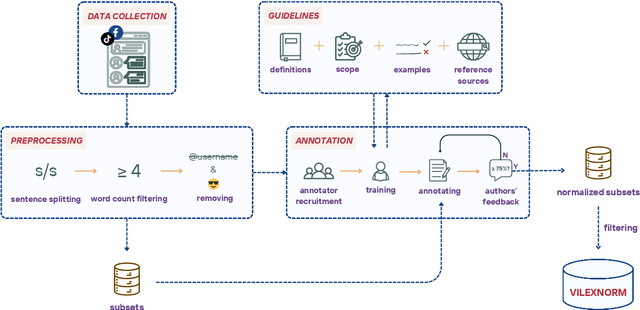
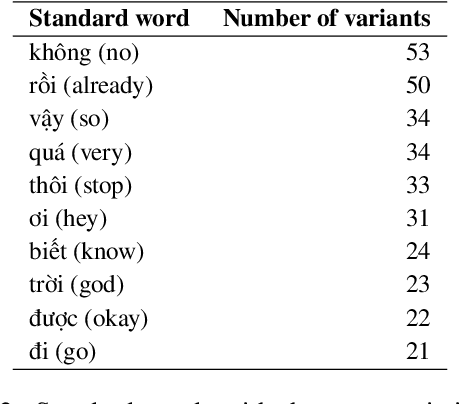
Lexical normalization, a fundamental task in Natural Language Processing (NLP), involves the transformation of words into their canonical forms. This process has been proven to benefit various downstream NLP tasks greatly. In this work, we introduce Vietnamese Lexical Normalization (ViLexNorm), the first-ever corpus developed for the Vietnamese lexical normalization task. The corpus comprises over 10,000 pairs of sentences meticulously annotated by human annotators, sourced from public comments on Vietnam's most popular social media platforms. Various methods were used to evaluate our corpus, and the best-performing system achieved a result of 57.74% using the Error Reduction Rate (ERR) metric (van der Goot, 2019a) with the Leave-As-Is (LAI) baseline. For extrinsic evaluation, employing the model trained on ViLexNorm demonstrates the positive impact of the Vietnamese lexical normalization task on other NLP tasks. Our corpus is publicly available exclusively for research purposes.