 Add to Chrome
 Add to Firefox
 Add to Edge
MVDGC: Joint 3D and 2D Multi-view Pedestrian Detection via Dual Geometric Constraints
Jun 30, 2026
The core challenge in multi-view pedestrian detection (MVPD) lies in effective aggregation of visual features from different viewpoints for robust occlusion reasoning. Recent approaches have addressed this by first projecting image-view features onto a Bird's Eye View (BEV) map, where ground localization is then performed. Despite impressive performance, the perspective transformation induces severe distortion, causing spatial structure break and degrading the quality of object feature extraction. The blurred and ambiguous features hinder accurate BEV point localization, especially in densely populated regions. Moreover, the strong mutual relationship between the BEV ground point and image bounding boxes is not capitalized on. Although multi-view consistency of 2D detections can serve as a powerful constraint in BEV space, these detections are commonly treated as auxiliary signals rather than being jointly optimized with the primary task.In this work, we propose \textbf{MVDGC}, a unified framework that \emph{jointly estimates pedestrian locations on the BEV plane and 2D bounding boxes in image views}. MVDGC employs a \emph{sparse set of 3D cylindrical queries} that embraces geometric context across both BEV and image views, enforcing dual spatial constraints for precise localization. Specifically, the geometric constraints is established by modeling each pedestrian as a vertical cylinder whose center lies on the BEV plane and whose projection casts a rectangular box in the image views. These queries function as shape anchors that directly extract 2D features from the intact image-view features using camera projection, eliminating projection-induced distortions. The 3D cylindrical query enables the unification of BEV and ImV localization into a single task: 3D cylinder position and shape refinement. Code is available at: https://github.com/UARK-AICV/MVDGC

An Analysis of State-of-the-art Activation Functions For Supervised Deep Neural Network
Apr 05, 2021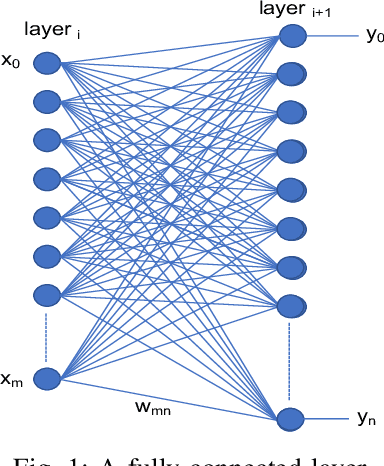
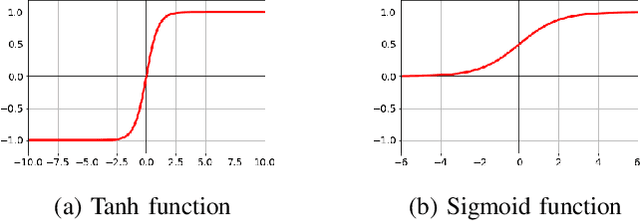
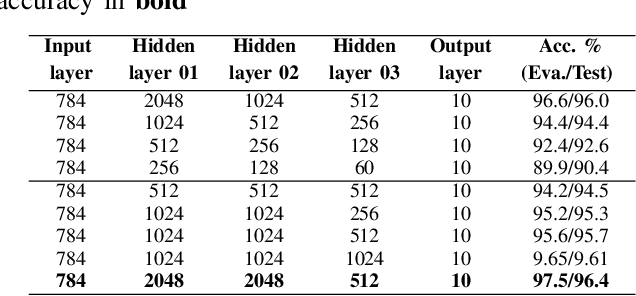
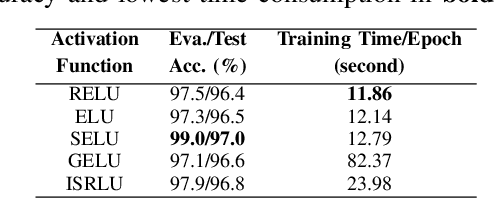
This paper provides an analysis of state-of-the-art activation functions with respect to supervised classification of deep neural network. These activation functions comprise of Rectified Linear Units (ReLU), Exponential Linear Unit (ELU), Scaled Exponential Linear Unit (SELU), Gaussian Error Linear Unit (GELU), and the Inverse Square Root Linear Unit (ISRLU). To evaluate, experiments over two deep learning network architectures integrating these activation functions are conducted. The first model, basing on Multilayer Perceptron (MLP), is evaluated with MNIST dataset to perform these activation functions. Meanwhile, the second model, likely VGGish-based architecture, is applied for Acoustic Scene Classification (ASC) Task 1A in DCASE 2018 challenge, thus evaluate whether these activation functions work well in different datasets as well as different network architectures.
Binomial Tails for Community Analysis
Dec 17, 2020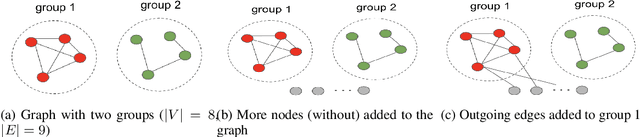
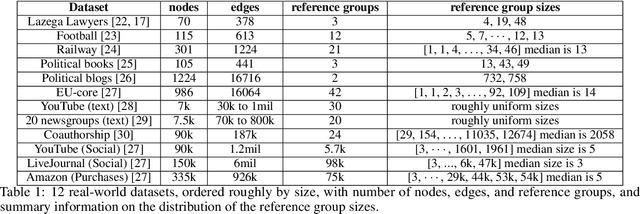

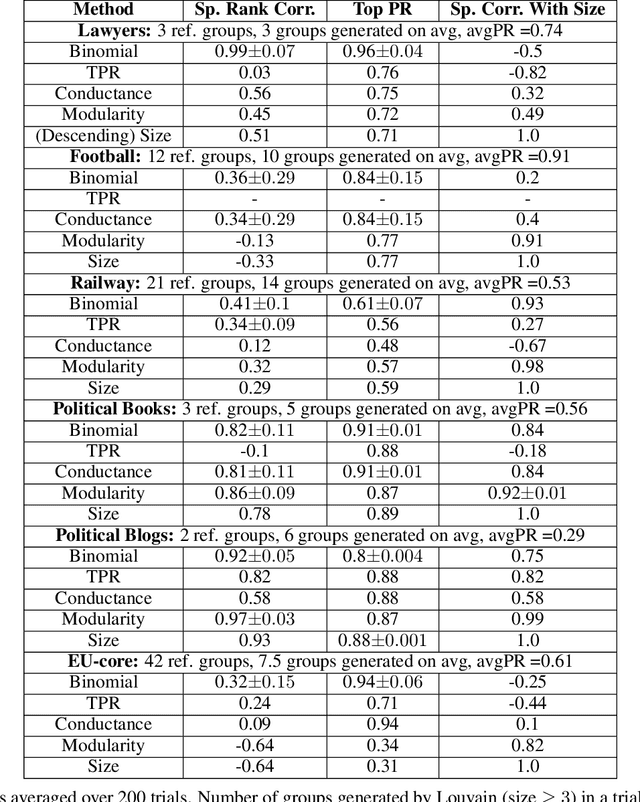
An important task of community discovery in networks is assessing significance of the results and robust ranking of the generated candidate groups. Often in practice, numerous candidate communities are discovered, and focusing the analyst's time on the most salient and promising findings is crucial. We develop simple efficient group scoring functions derived from tail probabilities using binomial models. Experiments on synthetic and numerous real-world data provides evidence that binomial scoring leads to a more robust ranking than other inexpensive scoring functions, such as conductance. Furthermore, we obtain confidence values ($p$-values) that can be used for filtering and labeling the discovered groups. Our analyses shed light on various properties of the approach. The binomial tail is simple and versatile, and we describe two other applications for community analysis: degree of community membership (which in turn yields group-scoring functions), and the discovery of significant edges in the community-induced graph.