 Add to Chrome
 Add to Firefox
 Add to Edge
AirGuard: UAV and Bird Recognition Scheme for Integrated Sensing and Communications System
Mar 13, 2026
In this paper, we propose an unmanned aerial vehicle (UAV) and bird recognition scheme with signal processing and deep learning for integrated sensing and communications (ISAC) system. We first provide the basic scene of low-altitude targets monitoring, and formulate the motion equations and echo signals for UAVs and birds. Next, we extract the centralized micro-Doppler (cmD) spectrum and the high resolution range profile (HRRP) of the low-altitude target from the echo signals. Then we design a dual feature fusion enabled low-altitude target recognition network with convolutional neural network (CNN), which employs both the images of cmD spectrum and HRRP as inputs to jointly distinguish between UAV and bird. Meanwhile, we generate 237600 cmD and HRRP image samples to train, validate, and evaluate the designed low-altitude target recognition network. The proposed scheme is termed as AirGuard, whose effectiveness has been demonstrated by simulation results.

Integrated Sensing and Communications Framework for 6G Networks
May 30, 2024

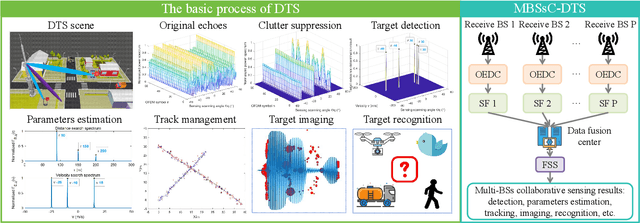

In this paper, we propose a novel integrated sensing and communications (ISAC) framework for the sixth generation (6G) mobile networks, in which we decompose the real physical world into static environment, dynamic targets, and various object materials. The ubiquitous static environment occupies the vast majority of the physical world, for which we design static environment reconstruction (SER) scheme to obtain the layout and point cloud information of static buildings. The dynamic targets floating in static environments create the spatiotemporal transition of the physical world, for which we design comprehensive dynamic target sensing (DTS) scheme to detect, estimate, track, image and recognize the dynamic targets in real-time. The object materials enrich the electromagnetic laws of the physical world, for which we develop object material recognition (OMR) scheme to estimate the electromagnetic coefficient of the objects. Besides, to integrate these sensing functions into existing communications systems, we discuss the interference issues and corresponding solutions for ISAC cellular networks. Furthermore, we develop an ISAC hardware prototype platform that can reconstruct the environmental maps and sense the dynamic targets while maintaining communications services. With all these designs, the proposed ISAC framework can support multifarious emerging applications, such as digital twins, low altitude economy, internet of vehicles, marine management, deformation monitoring, etc.