 Add to Chrome
 Add to Firefox
 Add to Edge
Mitosis Detection in the Wild: Multi-Tumor and Context-Aware Generalization in the MIDOG 2025 Challenge
Jun 05, 2026
Automated mitosis detection is a well-established task in computational pathology. While previous benchmarks focused on scanner-induced domain shift, clinical "real-world" application requires models to be robust across the vast variance to be expected in the histological landscape. The MItosis DOmain Generalization (MIDOG) 2025 challenge was designed to evaluate algorithmic performance across unprecedented biological and contextual diversity. We curated a test dataset of 365 cases, encompassing 12 distinct human, canine and feline tumor types, digitized across multiple scanning platforms. Moving beyond hand-selected hotspots, the challenge required detection also in random tissue areas (representative of the whole slide detection situation) and challenging areas (areas rich in hard negatives). In the second track, we introduced the classification of atypical mitotic figures (AMFs). There were 18 teams submitting to the detection track, with F1 scores ranging up to 0.740. In the AMF detection track, we had 21 submissions with balanced accuracy values up to 0.908. Our analysis reveals that while most models perform reliably in traditional hotspots, significant performance degradation occurs in challenging ROIs, where false positive rates tripled. Furthermore, performance varied significantly across the 12 tumor types, highlighting "blind spots" in current state-of-the-art architectures when encountering rare or highly pleomorphic malignancies. Moreover, we evaluated the effectiveness of ensembling and found a mean increases of 1.5 and 1.3 percentage points in F1 score and balanced accuracy, respectively. In contrast, TTA showed no relevant improvement. MIDOG 2025 demonstrates that "in the wild" mitosis detection remains a significant hurdle. The transition from hotspot-only evaluation to a multi-contextual framework provides a more realistic proxy for clinical reliability.

Seizure-Semiology-Suite (S3): A Clinically Multimodal Dataset, Benchmark, and Models for Seizure Semiology Understanding
May 21, 2026While Multimodal Large Language Models (MLLMs) have demonstrated remarkable proficiency in general video understanding, their capacity to interpret involuntary, and spatio-temporally evolving pathologic motor behaviors such as seizure semiology remains largely untested. To address this gap, we introduce Seizure-Semiology-Suite, a clinically grounded dataset and benchmark for fine-grained, structured seizure semiology understanding. The dataset includes 438 seizure videos annotated with over 35,000 dense labels covering 20 ILAE-defined semiological features. Building on this dataset, we propose a seven-task hierarchical benchmark that systematically evaluates MLLMs from low-level visual perception to temporal sequencing, narrative report generation, and seizure diagnosis. To enable clinically meaningful evaluation of generated reports, we further introduce the Report Quality Index for Seizure Semiology (Seizure-RQI). Extensive baselines across 11 open-weight MLLMs reveal systematic weaknesses in laterality reasoning, temporal localization, symptom sequencing, and clinically faithful reporting. We show that seizure-specific fine-tuning substantially improves performance across tasks, and that a two-stage neuro-symbolic framework achieves an F1 score of 0.96 on epileptic versus non-epileptic seizure classification. Seizure-Semiology-Suite establishes a rigorous benchmark for evaluating multimodal models in safety-critical medical video understanding and guides the development of clinically reliable, domain-adaptive multimodal intelligence.
Z-Stack Scanning can Improve AI Detection of Mitosis: A Case Study of Meningiomas
Jan 27, 2025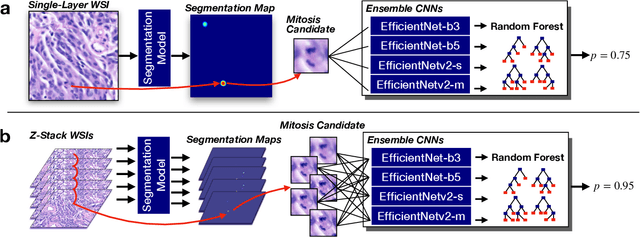
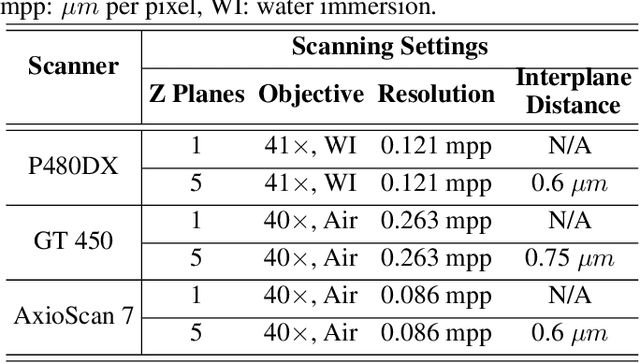
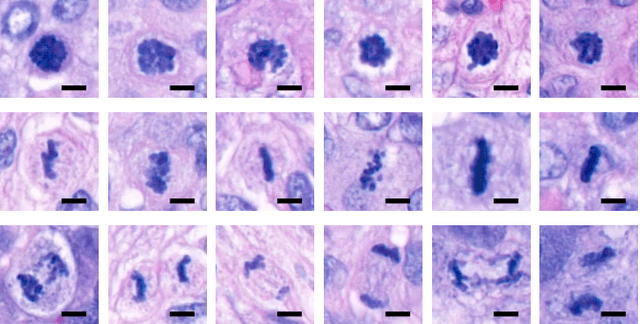
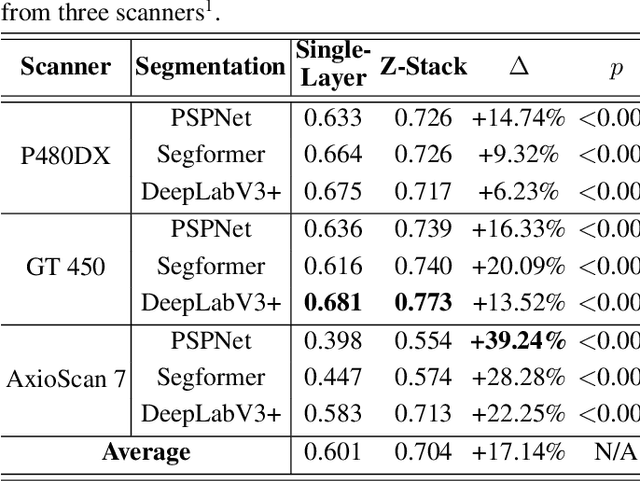
Z-stack scanning is an emerging whole slide imaging technology that captures multiple focal planes alongside the z-axis of a glass slide. Because z-stacking can offer enhanced depth information compared to the single-layer whole slide imaging, this technology can be particularly useful in analyzing small-scaled histopathological patterns. However, its actual clinical impact remains debated with mixed results. To clarify this, we investigate the effect of z-stack scanning on artificial intelligence (AI) mitosis detection of meningiomas. With the same set of 22 Hematoxylin and Eosin meningioma glass slides scanned by three different digital pathology scanners, we tested the performance of three AI pipelines on both single-layer and z-stacked whole slide images (WSIs). Results showed that in all scanner-AI combinations, z-stacked WSIs significantly increased AI's sensitivity (+17.14%) on the mitosis detection with only a marginal impact on precision. Our findings provide quantitative evidence that highlights z-stack scanning as a promising technique for AI mitosis detection, paving the way for more reliable AI-assisted pathology workflows, which can ultimately benefit patient management.