 Add to Chrome
 Add to Firefox
 Add to Edge
GUIDE-US: Grade-Informed Unpaired Distillation of Encoder Knowledge from Histopathology to Micro-UltraSound
Feb 22, 2026
Purpose: Non-invasive grading of prostate cancer (PCa) from micro-ultrasound (micro-US) could expedite triage and guide biopsies toward the most aggressive regions, yet current models struggle to infer tissue micro-structure at coarse imaging resolutions. Methods: We introduce an unpaired histopathology knowledge-distillation strategy that trains a micro-US encoder to emulate the embedding distribution of a pretrained histopathology foundation model, conditioned on International Society of Urological Pathology (ISUP) grades. Training requires no patient-level pairing or image registration, and histopathology inputs are not used at inference. Results: Compared to the current state of the art, our approach increases sensitivity to clinically significant PCa (csPCa) at 60% specificity by 3.5% and improves overall sensitivity at 60% specificity by 1.2%. Conclusion: By enabling earlier and more dependable cancer risk stratification solely from imaging, our method advances clinical feasibility. Source code will be publicly released upon publication.

ProstNFound+: A Prospective Study using Medical Foundation Models for Prostate Cancer Detection
Oct 30, 2025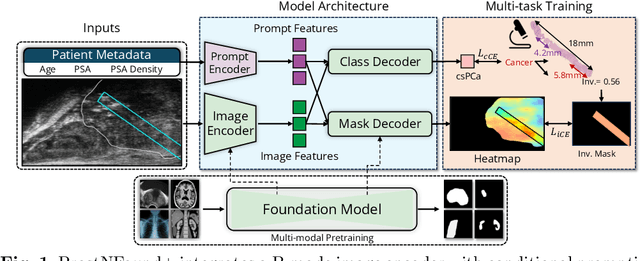
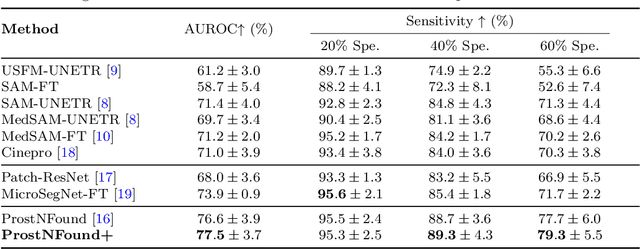
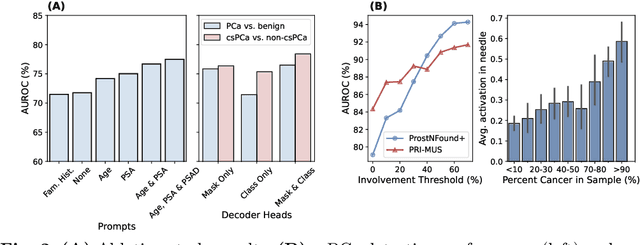
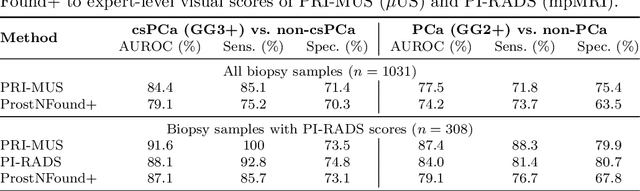
Purpose: Medical foundation models (FMs) offer a path to build high-performance diagnostic systems. However, their application to prostate cancer (PCa) detection from micro-ultrasound ({\mu}US) remains untested in clinical settings. We present ProstNFound+, an adaptation of FMs for PCa detection from {\mu}US, along with its first prospective validation. Methods: ProstNFound+ incorporates a medical FM, adapter tuning, and a custom prompt encoder that embeds PCa-specific clinical biomarkers. The model generates a cancer heatmap and a risk score for clinically significant PCa. Following training on multi-center retrospective data, the model is prospectively evaluated on data acquired five years later from a new clinical site. Model predictions are benchmarked against standard clinical scoring protocols (PRI-MUS and PI-RADS). Results: ProstNFound+ shows strong generalization to the prospective data, with no performance degradation compared to retrospective evaluation. It aligns closely with clinical scores and produces interpretable heatmaps consistent with biopsy-confirmed lesions. Conclusion: The results highlight its potential for clinical deployment, offering a scalable and interpretable alternative to expert-driven protocols.