 Add to Chrome
 Add to Firefox
 Add to Edge
What Does the AI Doctor Value? Auditing Pluralism in the Clinical Ethics of Language Models
May 18, 2026
Medicine is inherently pluralistic. Principles such as autonomy, beneficence, nonmaleficence, and justice routinely conflict, and such ethical dilemmas often sharply divide reasonable physicians. Good clinical practice navigates these tensions in concert with each patient's values rather than imposing a single ethical stance. The ethical values that large language models bring to medical advice, however, have not been systematically examined. We present a framework for auditing value pluralism in medical AI, comprising a benchmark of clinician-verified dilemmas and an attribution method that recovers value priorities directly from decisions. The ecosystem of frontier models spans physician-level value heterogeneity, and models discuss competing values in their reasoning (Overton pluralism) before committing to a decision. However, individual model decisions are near-deterministic across repeated sampling and semantic variations, failing to reproduce the distributional pluralism of the physician panel. Across benchmark cases, these consistent decisions reflect committed, systematic value preferences. While most model priorities fall within the natural range of inter-physician variation, some significantly underweight patient autonomy. A single LLM deployed without regard for its value priorities could amplify those priorities at scale to every patient it serves. Without explicit efforts to balance ethical perspectives with one or multiple models, these tools risk replacing clinical pluralism with a deployment monoculture.

Adversarial attacks on hybrid classical-quantum Deep Learning models for Histopathological Cancer Detection
Sep 08, 2023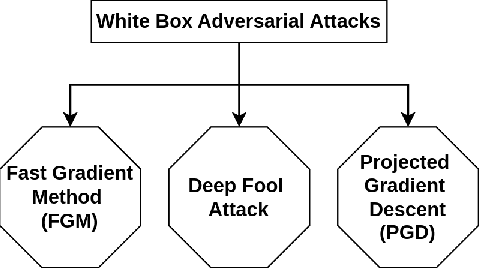
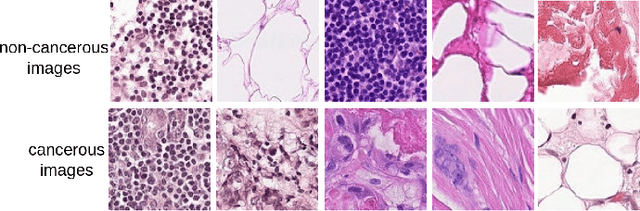
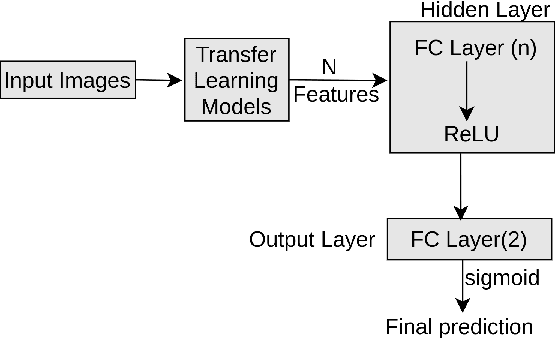
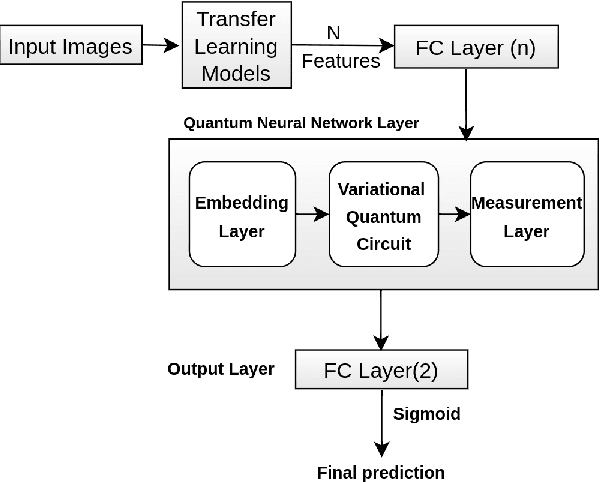
We present an effective application of quantum machine learning in histopathological cancer detection. The study here emphasizes two primary applications of hybrid classical-quantum Deep Learning models. The first application is to build a classification model for histopathological cancer detection using the quantum transfer learning strategy. The second application is to test the performance of this model for various adversarial attacks. Rather than using a single transfer learning model, the hybrid classical-quantum models are tested using multiple transfer learning models, especially ResNet18, VGG-16, Inception-v3, and AlexNet as feature extractors and integrate it with several quantum circuit-based variational quantum circuits (VQC) with high expressibility. As a result, we provide a comparative analysis of classical models and hybrid classical-quantum transfer learning models for histopathological cancer detection under several adversarial attacks. We compared the performance accuracy of the classical model with the hybrid classical-quantum model using pennylane default quantum simulator. We also observed that for histopathological cancer detection under several adversarial attacks, Hybrid Classical-Quantum (HCQ) models provided better accuracy than classical image classification models.
Validation of a Hospital Digital Twin with Machine Learning
Mar 09, 2023Recently there has been a surge of interest in developing Digital Twins of process flows in healthcare to better understand bottlenecks and areas of improvement. A key challenge is in the validation process. We describe a work in progress for a digital twin using an agent based simulation model for determining bed turnaround time for patients in hospitals. We employ a strategy using machine learning for validating the model and implementing sensitivity analysis.
Histopathological Cancer Detection Using Hybrid Quantum Computing
Feb 07, 2023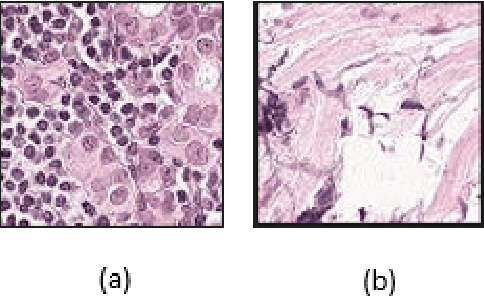
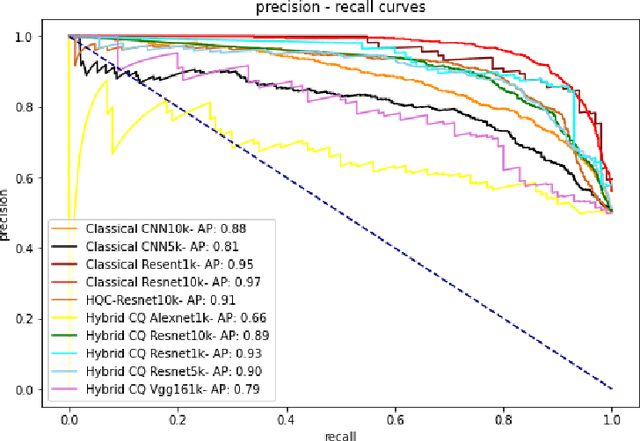
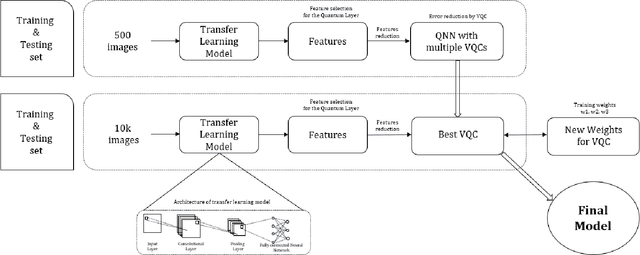
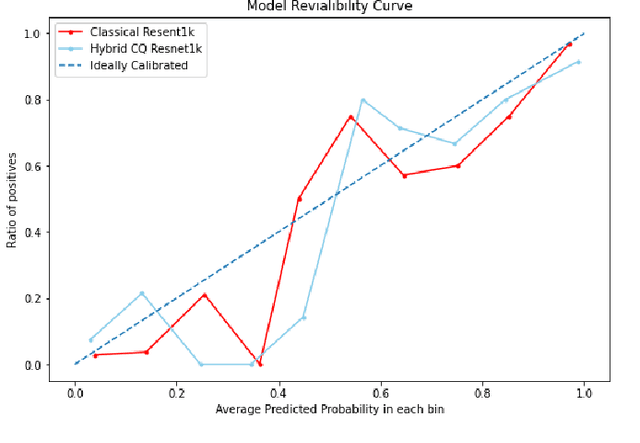
We present an effective application of quantum machine learning in the field of healthcare. The study here emphasizes on a classification problem of a histopathological cancer detection using quantum transfer learning. Rather than using single transfer learning model, the work model presented here consists of multiple transfer learning models especially ResNet18, VGG-16, Inception-v3, AlexNet and several variational quantum circuits (VQC) with high expressibility. As a result, we provide a comparative analysis of the models and the best performing transfer learning model with the prediction AUC of approximately 93 percent for histopathological cancer detection. We also observed that for 1000 images with Resnet18, Hybrid Quantum and Classical (HQC) provided a slightly better accuracy of 88.5 percent than classical of 88.0 percent.