 Add to Chrome
 Add to Firefox
 Add to Edge
SC-Net: Robust Correspondence Learning via Spatial and Cross-Channel Context
Dec 29, 2025
Recent research has focused on using convolutional neural networks (CNNs) as the backbones in two-view correspondence learning, demonstrating significant superiority over methods based on multilayer perceptrons. However, CNN backbones that are not tailored to specific tasks may fail to effectively aggregate global context and oversmooth dense motion fields in scenes with large disparity. To address these problems, we propose a novel network named SC-Net, which effectively integrates bilateral context from both spatial and channel perspectives. Specifically, we design an adaptive focused regularization module (AFR) to enhance the model's position-awareness and robustness against spurious motion samples, thereby facilitating the generation of a more accurate motion field. We then propose a bilateral field adjustment module (BFA) to refine the motion field by simultaneously modeling long-range relationships and facilitating interaction across spatial and channel dimensions. Finally, we recover the motion vectors from the refined field using a position-aware recovery module (PAR) that ensures consistency and precision. Extensive experiments demonstrate that SC-Net outperforms state-of-the-art methods in relative pose estimation and outlier removal tasks on YFCC100M and SUN3D datasets. Source code is available at http://www.linshuyuan.com.

Hypergraph Modelling for Geometric Model Fitting
Jul 11, 2016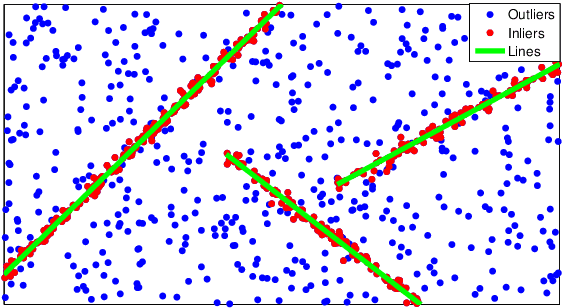
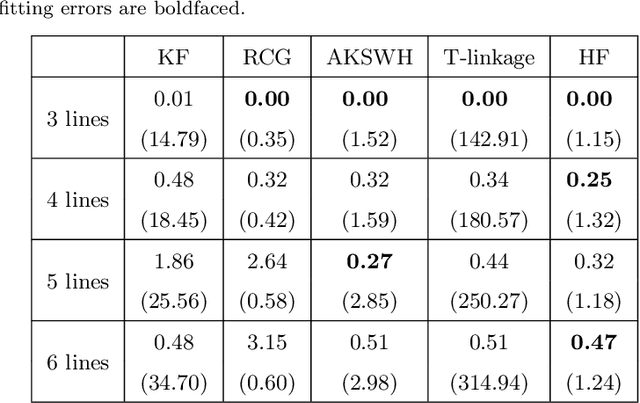
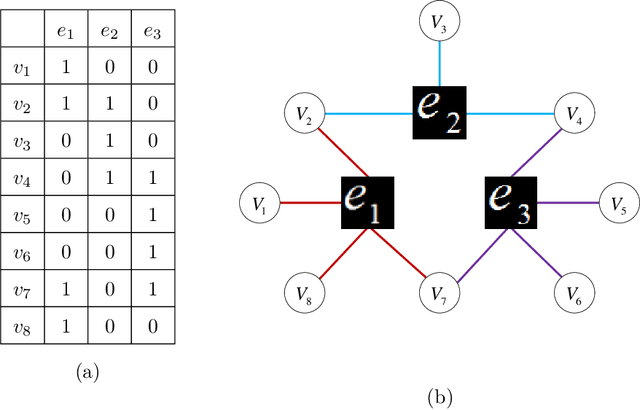
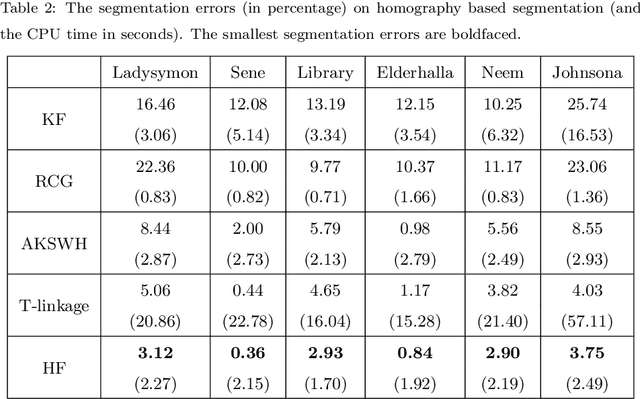
In this paper, we propose a novel hypergraph based method (called HF) to fit and segment multi-structural data. The proposed HF formulates the geometric model fitting problem as a hypergraph partition problem based on a novel hypergraph model. In the hypergraph model, vertices represent data points and hyperedges denote model hypotheses. The hypergraph, with large and "data-determined" degrees of hyperedges, can express the complex relationships between model hypotheses and data points. In addition, we develop a robust hypergraph partition algorithm to detect sub-hypergraphs for model fitting. HF can effectively and efficiently estimate the number of, and the parameters of, model instances in multi-structural data heavily corrupted with outliers simultaneously. Experimental results show the advantages of the proposed method over previous methods on both synthetic data and real images.