 Add to Chrome
 Add to Firefox
 Add to Edge
Tailored Prompts, Targeted Protection: Vulnerability-Specific LLM Analysis for Smart Contracts
May 05, 2026
Smart contracts on blockchains are prone to diverse security vulnerabilities that can lead to significant financial losses due to their immutable nature. Existing detection approaches often lack flexibility across vulnerability types and rely heavily on manually crafted expert rules. In this paper, we present an LLM-based framework for practical smart contract vulnerability detection. We construct and release a large-scale dataset comprising 31,165 professionally annotated vulnerability instances collected from over 3,200 real-world projects across 15 major blockchain platforms. Our approach leverages precise AST-based context extraction and vulnerability-specific prompt design to instantiate customized detectors for 13 prevalent vulnerability categories. Experimental results demonstrate strong effectiveness, achieving an average positive recall of 0.92 and an average negative recall of 0.85, highlighting the potential of carefully engineered contextual prompting for scalable and high-precision smart contract security analysis.

SAFLITE: Fuzzing Autonomous Systems via Large Language Models
Dec 25, 2024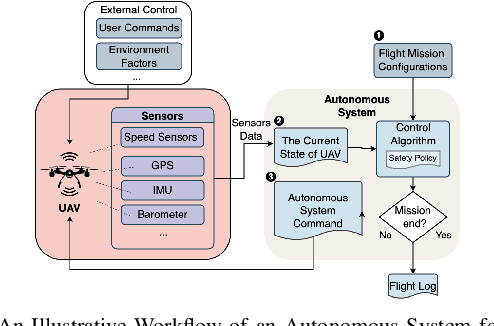
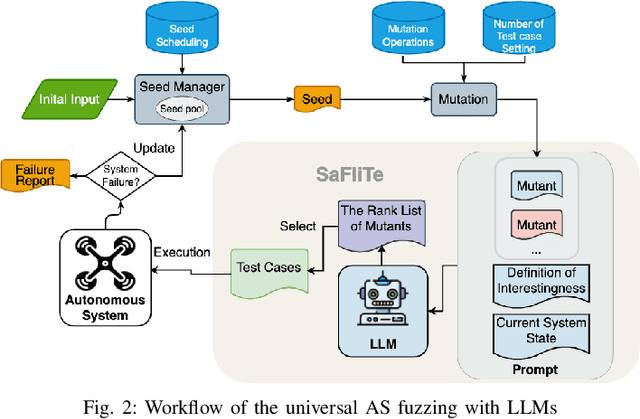
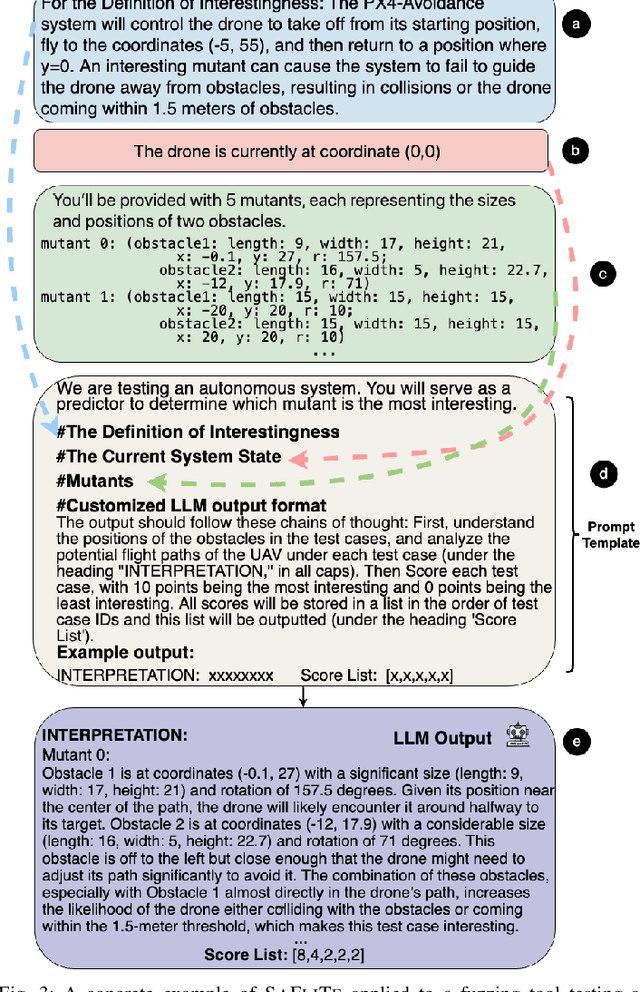
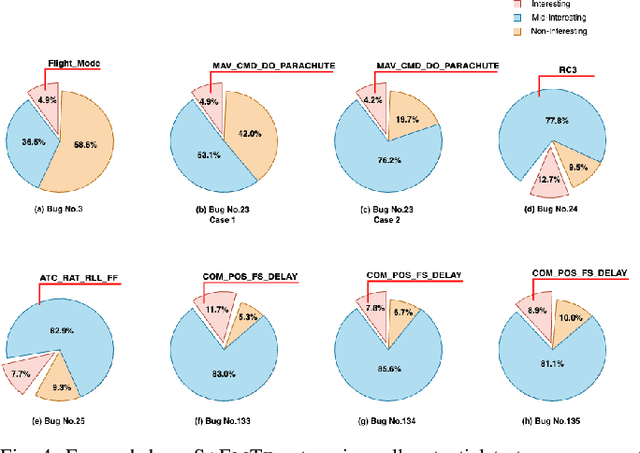
Fuzz testing effectively uncovers software vulnerabilities; however, it faces challenges with Autonomous Systems (AS) due to their vast search spaces and complex state spaces, which reflect the unpredictability and complexity of real-world environments. This paper presents a universal framework aimed at improving the efficiency of fuzz testing for AS. At its core is SaFliTe, a predictive component that evaluates whether a test case meets predefined safety criteria. By leveraging the large language model (LLM) with information about the test objective and the AS state, SaFliTe assesses the relevance of each test case. We evaluated SaFliTe by instantiating it with various LLMs, including GPT-3.5, Mistral-7B, and Llama2-7B, and integrating it into four fuzz testing tools: PGFuzz, DeepHyperion-UAV, CAMBA, and TUMB. These tools are designed specifically for testing autonomous drone control systems, such as ArduPilot, PX4, and PX4-Avoidance. The experimental results demonstrate that, compared to PGFuzz, SaFliTe increased the likelihood of selecting operations that triggered bug occurrences in each fuzzing iteration by an average of 93.1\%. Additionally, after integrating SaFliTe, the ability of DeepHyperion-UAV, CAMBA, and TUMB to generate test cases that caused system violations increased by 234.5\%, 33.3\%, and 17.8\%, respectively. The benchmark for this evaluation was sourced from a UAV Testing Competition.
EAN-MapNet: Efficient Vectorized HD Map Construction with Anchor Neighborhoods
Mar 08, 2024High-definition (HD) map is crucial for autonomous driving systems. Most existing works design map elements detection heads based on the DETR decoder. However, the initial queries lack explicit incorporation of physical positional information, and vanilla self-attention entails high computational complexity. Therefore, we propose EAN-MapNet for Efficiently constructing HD map using Anchor Neighborhoods. Firstly, we design query units based on the anchor neighborhoods, allowing non-neighborhood central anchors to effectively assist in fitting the neighborhood central anchors to the target points representing map elements. Then, we propose grouped local self-attention (GL-SA) by leveraging the relative instance relationship among the queries. This facilitates direct feature interaction among queries of the same instances, while innovatively employing local queries as intermediaries for interaction among queries from different instances. Consequently, GL-SA significantly reduces the computational complexity of self-attention while ensuring ample feature interaction among queries. On the nuScenes dataset, EAN-MapNet achieves a state-of-the-art performance with 63.0 mAP after training for 24 epochs, surpassing MapTR by 12.7 mAP. Furthermore, it considerably reduces memory consumption by 8198M compared to MapTRv2.