 Add to Chrome
 Add to Firefox
 Add to Edge
SkillVetBench: LLM-as-Judge for Multi-Dimensional Security Risk Evaluation in Open-Source LLM Agent Skills
Jun 14, 2026
Open-source LLM agent ecosystems are growing rapidly, yet the security of community-contributed skills - modular tool definitions that extend agent capabilities - remains largely unvetted. The gap we fill: existing scanners operate at the code layer and are structurally blind to instruction-layer and multi-agent risk - natural-language directives that hijack an agent, exfiltrate data through encoded side channels, or chain harm across pipelines - so what is needed is a semantic, multi-dimensional vetting system rather than another signature matcher. We present SKILLVETBENCH, a live public leaderboard on Hugging Face that uses an LLM-as-Judge to vet agent skills. What is new: SARS (Skill Agentic Risk Score), a five-dimensional agentic-risk metric with a principled weighted formula for instruction-following systems. What is integrated: full CVSS v4.0 vector decomposition and a ClawHub dual-view that places our LLM-generated review beside the official marketplace verdict. What is demonstrated: drawing on our companion benchmark paper [ 1], the LLM-as-Judge stage achieves zero false negatives across 78 confirmed-malicious skills and zero false positives across 22 benign controls, while the best static baseline (SKILLSIEVE) still misses 15%; for instruction-layer categories such as Prompt Injection and Memory Poisoning, conventional tools miss between 89% and 100% of threats (e.g., CODEBERT detects none of nine memory-poisoning skills). Detection rates vary from 35% to 95% across four LLM evaluators, motivating ensemble scoring in production deployments.

The Art of the Jailbreak: Formulating Jailbreak Attacks for LLM Security Beyond Binary Scoring
May 09, 2026Jailbreak attacks -- adversarial prompts that bypass LLM alignment through purely linguistic manipulation -- pose a growing operational security threat, yet the field lacks large-scale, reproducible infrastructure for generating, categorizing, and evaluating them systematically. This paper addresses that gap with three contributions. (1) Large-scale compositional jailbreak dataset. We construct 114,000 adversarial prompts by applying 912 composing strategies to 125 harmful seed prompts from JailBreakV-28K. Every prompt is assigned to one of 14 cybersecurity attack categories (e.g., malware, phishing, privilege escalation) via a six-model majority-vote pipeline, and each strategy is ranked by effectiveness per category, enabling principled strategy selection grounded in concrete adversarial objectives. (2) Automated jailbreak generation. We instruction-fine-tune category-aware LLMs on Moderate and Optimal subsets, producing models that synthesize fluent jailbreak prompts from a harmful seed at inference time -- no templates, no gradient search. Our generators achieve perplexity 24-39 versus 40-140 for AutoDAN and AmpleGCG, with safety-filter evasion rates of 0.29-0.51 Mal (LlamaPromptGuard-2-86M), enabling controllable, scalable red-teaming under realistic adversarial conditions. (3) OPTIMUS: a training-free jailbreak evaluator. OPTIMUS is a continuous metric J(S,H) that jointly captures semantic similarity between the harmful seed and the jailbreak (S) and harmfulness probability (H) via calibrated penalty functions. Unlike binary attack success rate (ASR), OPTIMUS requires no task-specific training, generalizes across evolving strategies, and exposes a stealth-optimal regime (S*=0.57, H*=0.43) that ASR misses. Experiments across 114,000 prompts confirm that OPTIMUS separates Weak, Moderate, and Optimal jailbreaks with category-level evidence binary evaluation cannot supply.
Semantic Intent Fragmentation: A Single-Shot Compositional Attack on Multi-Agent AI Pipelines
Apr 08, 2026We introduce Semantic Intent Fragmentation (SIF), an attack class against LLM orchestration systems where a single, legitimately phrased request causes an orchestrator to decompose a task into subtasks that are individually benign but jointly violate security policy. Current safety mechanisms operate at the subtask level, so each step clears existing classifiers -- the violation only emerges at the composed plan. SIF exploits OWASP LLM06:2025 through four mechanisms: bulk scope escalation, silent data exfiltration, embedded trigger deployment, and quasi-identifier aggregation, requiring no injected content, no system modification, and no attacker interaction after the initial request. We construct a three-stage red-teaming pipeline grounded in OWASP, MITRE ATLAS, and NIST frameworks to generate realistic enterprise scenarios. Across 14 scenarios spanning financial reporting, information security, and HR analytics, a GPT-20B orchestrator produces policy-violating plans in 71% of cases (10/14) while every subtask appears benign. Three independent signals validate this: deterministic taint analysis, chain-of-thought evaluation, and a cross-model compliance judge with 0% false positives. Stronger orchestrators increase SIF success rates. Plan-level information-flow tracking combined with compliance evaluation detects all attacks before execution, showing the compositional safety gap is closable.
Agent-Fence: Mapping Security Vulnerabilities Across Deep Research Agents
Feb 07, 2026Large language models are increasingly deployed as *deep agents* that plan, maintain persistent state, and invoke external tools, shifting safety failures from unsafe text to unsafe *trajectories*. We introduce **AgentFence**, an architecture-centric security evaluation that defines 14 trust-boundary attack classes spanning planning, memory, retrieval, tool use, and delegation, and detects failures via *trace-auditable conversation breaks* (unauthorized or unsafe tool use, wrong-principal actions, state/objective integrity violations, and attack-linked deviations). Holding the base model fixed, we evaluate eight agent archetypes under persistent multi-turn interaction and observe substantial architectural variation in mean security break rate (MSBR), ranging from $0.29 \pm 0.04$ (LangGraph) to $0.51 \pm 0.07$ (AutoGPT). The highest-risk classes are operational: Denial-of-Wallet ($0.62 \pm 0.08$), Authorization Confusion ($0.54 \pm 0.10$), Retrieval Poisoning ($0.47 \pm 0.09$), and Planning Manipulation ($0.44 \pm 0.11$), while prompt-centric classes remain below $0.20$ under standard settings. Breaks are dominated by boundary violations (SIV 31%, WPA 27%, UTI+UTA 24%, ATD 18%), and authorization confusion correlates with objective and tool hijacking ($ρ\approx 0.63$ and $ρ\approx 0.58$). AgentFence reframes agent security around what matters operationally: whether an agent stays within its goal and authority envelope over time.
LLM-Guided Dynamic-UMAP for Personalized Federated Graph Learning
Nov 12, 2025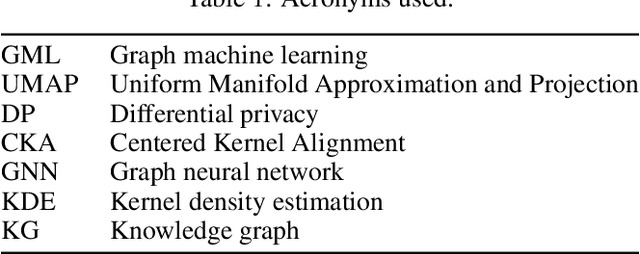

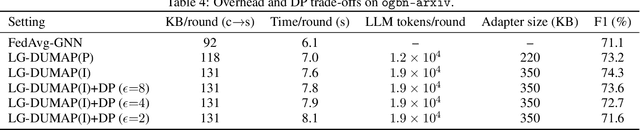
We propose a method that uses large language models to assist graph machine learning under personalization and privacy constraints. The approach combines data augmentation for sparse graphs, prompt and instruction tuning to adapt foundation models to graph tasks, and in-context learning to supply few-shot graph reasoning signals. These signals parameterize a Dynamic UMAP manifold of client-specific graph embeddings inside a Bayesian variational objective for personalized federated learning. The method supports node classification and link prediction in low-resource settings and aligns language model latent representations with graph structure via a cross-modal regularizer. We outline a convergence argument for the variational aggregation procedure, describe a differential privacy threat model based on a moments accountant, and present applications to knowledge graph completion, recommendation-style link prediction, and citation and product graphs. We also discuss evaluation considerations for benchmarking LLM-assisted graph machine learning.