 Add to Chrome
 Add to Firefox
 Add to Edge
LLMs Get Smarter from Targeted Synthetic Multilingual Data
Aug 16, 2026
Language-specific competency (LSC) is the phenomenon of a language model performing better or worse depending on the language of the prompt. In other words, a language model outputs different (and potentially incorrect) responses to the same semantic query when prompted in different languages. Prior work attributes this to an internal misalignment of semantic representation across languages. Currently, there are two main approaches to address LSC in the literature: (1) routing all queries through English, improving performance, but limiting language expressivity to English; or (2) training on language-balanced data, equalizing model performance across languages, but reducing overall performance. In this work, we take a data centric perspective and introduce HOTFIXR: Hardness Optimized Training data For Improving X-Lingual Reasoning. It is a data generation framework that uses models to probe and learn a student model's multilingual weaknesses, and generates data to mitigate them. HOTFIXR can generate multilingual synthetic training data that can improve multilingual performance. We evaluate on three in-distribution tasks, three out-of-distribution tasks, and four out-of-distribution languages. On average, HOTFIXR (1) improves in-distribution performance by 6.2%, (2) reduces catastrophic forgetting (induced by fine-tuning) on OOD tasks by 3.7%, and (3) on OOD languages by 7.1%. Overall, as many real-world applications requires multilingual LLMs, our work contributes to the efforts of making LLMs multilingually proficient. We will release code upon acceptance.

Provenance: A Light-weight Fact-checker for Retrieval Augmented LLM Generation Output
Nov 01, 2024We present a light-weight approach for detecting nonfactual outputs from retrieval-augmented generation (RAG). Given a context and putative output, we compute a factuality score that can be thresholded to yield a binary decision to check the results of LLM-based question-answering, summarization, or other systems. Unlike factuality checkers that themselves rely on LLMs, we use compact, open-source natural language inference (NLI) models that yield a freely accessible solution with low latency and low cost at run-time, and no need for LLM fine-tuning. The approach also enables downstream mitigation and correction of hallucinations, by tracing them back to specific context chunks. Our experiments show high area under the ROC curve (AUC) across a wide range of relevant open source datasets, indicating the effectiveness of our method for fact-checking RAG output.
A multispeaker dataset of raw and reconstructed speech production real-time MRI video and 3D volumetric images
Feb 16, 2021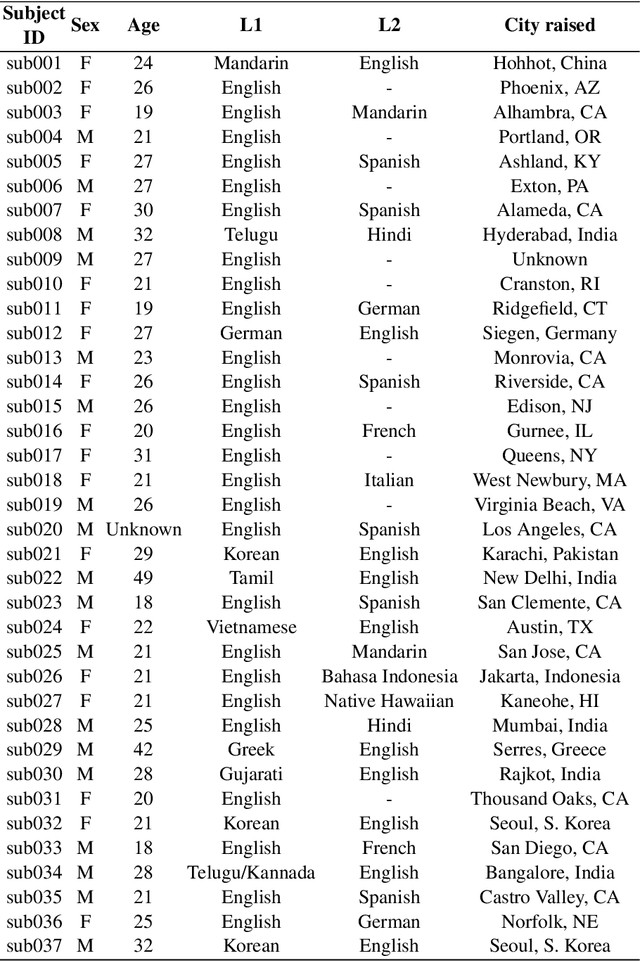
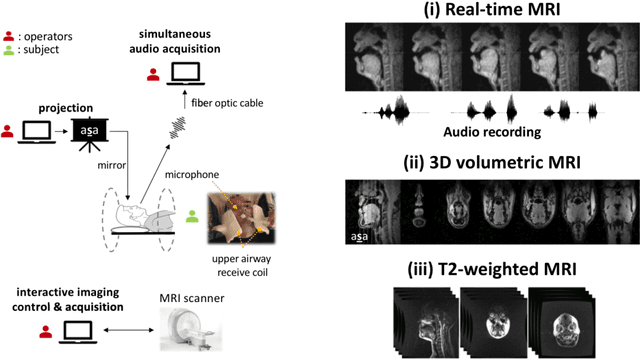
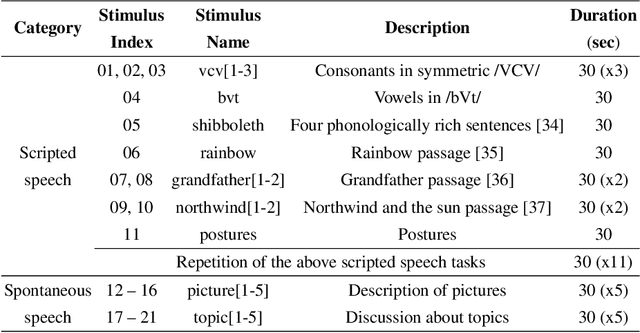
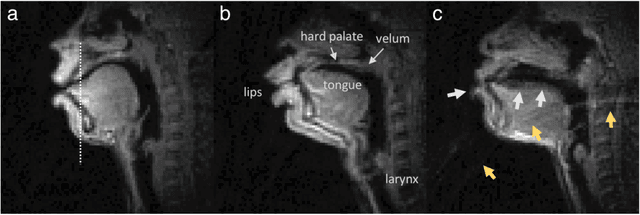
Real-time magnetic resonance imaging (RT-MRI) of human speech production is enabling significant advances in speech science, linguistics, bio-inspired speech technology development, and clinical applications. Easy access to RT-MRI is however limited, and comprehensive datasets with broad access are needed to catalyze research across numerous domains. The imaging of the rapidly moving articulators and dynamic airway shaping during speech demands high spatio-temporal resolution and robust reconstruction methods. Further, while reconstructed images have been published, to-date there is no open dataset providing raw multi-coil RT-MRI data from an optimized speech production experimental setup. Such datasets could enable new and improved methods for dynamic image reconstruction, artifact correction, feature extraction, and direct extraction of linguistically-relevant biomarkers. The present dataset offers a unique corpus of 2D sagittal-view RT-MRI videos along with synchronized audio for 75 subjects performing linguistically motivated speech tasks, alongside the corresponding first-ever public domain raw RT-MRI data. The dataset also includes 3D volumetric vocal tract MRI during sustained speech sounds and high-resolution static anatomical T2-weighted upper airway MRI for each subject.