 Add to Chrome
 Add to Firefox
 Add to Edge
Graph Contextual Reinforcement Learning for Efficient Directed Controller Synthesis
Dec 17, 2025
Controller synthesis is a formal method approach for automatically generating Labeled Transition System (LTS) controllers that satisfy specified properties. The efficiency of the synthesis process, however, is critically dependent on exploration policies. These policies often rely on fixed rules or strategies learned through reinforcement learning (RL) that consider only a limited set of current features. To address this limitation, this paper introduces GCRL, an approach that enhances RL-based methods by integrating Graph Neural Networks (GNNs). GCRL encodes the history of LTS exploration into a graph structure, allowing it to capture a broader, non-current-based context. In a comparative experiment against state-of-the-art methods, GCRL exhibited superior learning efficiency and generalization across four out of five benchmark domains, except one particular domain characterized by high symmetry and strictly local interactions.

Towards Context-aware Support for Color Vision Deficiency: An Approach Integrating LLM and AR
Jul 05, 2024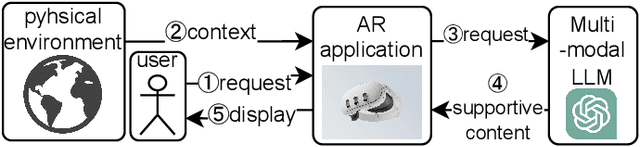
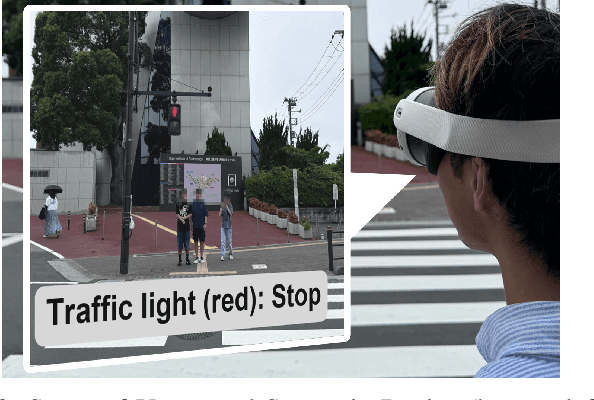
People with color vision deficiency often face challenges in distinguishing colors such as red and green, which can complicate daily tasks and require the use of assistive tools or environmental adjustments. Current support tools mainly focus on presentation-based aids, like the color vision modes found in iPhone accessibility settings. However, offering context-aware support, like indicating the doneness of meat, remains a challenge since task-specific solutions are not cost-effective for all possible scenarios. To address this, our paper proposes an application that provides contextual and autonomous assistance. This application is mainly composed of: (i) an augmented reality interface that efficiently captures context; and (ii) a multi-modal large language model-based reasoner that serves to cognitize the context and then reason about the appropriate support contents. Preliminary user experiments with two color vision deficient users across five different scenarios have demonstrated the effectiveness and universality of our application.