 Add to Chrome
 Add to Firefox
 Add to Edge
A Machine Learning-based Non-precipitating Clouds Estimation for THz Dual-Frequency Radar
Aug 01, 2026
Accurate measurement of non-precipitable clouds is important for early prediction of heavy rainfall disasters caused by extreme weather events. However, microwave cloud radar cannot observe the early stages of cloud development from non-precipitation clouds (cumulus) to cumulonimbus. In this paper, we propose a terahertz dual-frequency cloud radar using 150 GHz and 95 GHz bands to detect cloud particles in cumulus smaller than 10 μm. Using a dataset generated by the ITU-R radio propagation model, we estimate the liquid water content of non-precipitation clouds and water vapor content in atmospheric gases, respectively, by using a machine learning-based approach. The effectiveness of using the dual wavelength ratio as an explanatory variable is examined.

Experimental Verification on LoS-MIMO Transmission in 300-GHz Band
Aug 01, 2026In this study, we conducted Line-of-Sight (LoS) 2x2 multiple-input multiple-output (MIMO) orthogonal frequencydivision multiplexing (OFDM) transmission experiments in the 300-GHz band to investigate the potential for channel capacity enhancement. A circularly polarized patch antenna, supporting both crossand co-polarization, and a 2x2 MIMO transceiver equipped with a Pre-Correction scheme were developed. Experimental evaluation was carried out under conditions of a stream spacing of 0.3 m and a transmission distance of 1.9 m. As a result, in both coand cross-polarized antenna configurations, the off-diagonal components were suppressed below -20 dB, and 2-stream transmission with 16-QAM modulation achieved a throughput of 13.1 Gbit/s and a spectral efficiency of 6.55 bit/s/Hz. Furthermore, future research directions toward advanced spatial multiplexing based on channel correlation analysis are discussed. These results demonstrate the feasibility of highcapacity fixed wireless links and provide practical design insights for long-distance transmission.
Secure Artificial Intelligence of Things for Implicit Group Recommendations
Apr 23, 2021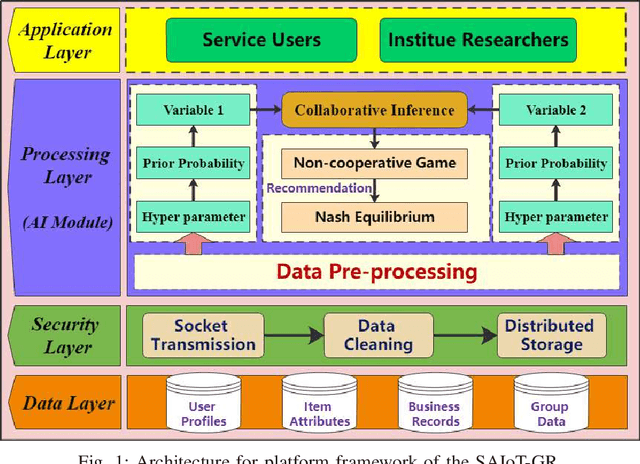
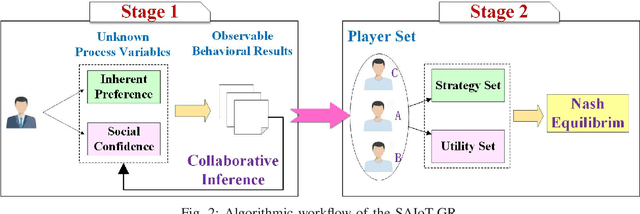
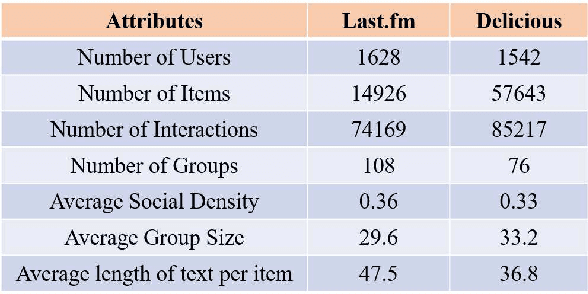
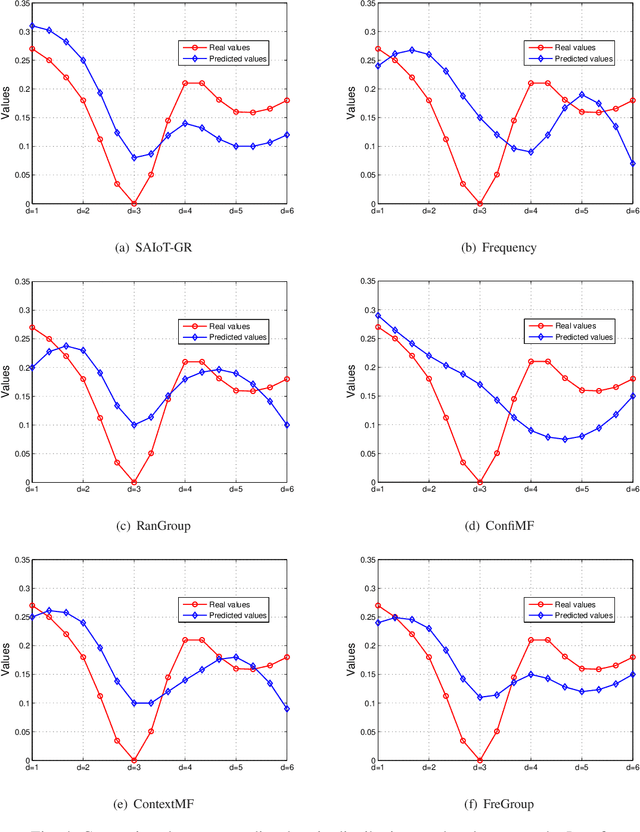
The emergence of Artificial Intelligence of Things (AIoT) has provided novel insights for many social computing applications such as group recommender systems. As distance among people has been greatly shortened, it has been a more general demand to provide personalized services to groups instead of individuals. In order to capture group-level preference features from individuals, existing methods were mostly established via aggregation and face two aspects of challenges: secure data management workflow is absent, and implicit preference feedbacks is ignored. To tackle current difficulties, this paper proposes secure Artificial Intelligence of Things for implicit Group Recommendations (SAIoT-GR). As for hardware module, a secure IoT structure is developed as the bottom support platform. As for software module, collaborative Bayesian network model and non-cooperative game are can be introduced as algorithms. Such a secure AIoT architecture is able to maximize the advantages of the two modules. In addition, a large number of experiments are carried out to evaluate the performance of the SAIoT-GR in terms of efficiency and robustness.