 Add to Chrome
 Add to Firefox
 Add to Edge
MoWorld: A Flash World Model
Jul 07, 2026
The future of World Models depends not only on scaling model capability, but also on scaling practicality and inference efficiency. High-frame-rate inference enables responsive perception, planning, and control in real-world autonomous systems. To this end, we present MoWorld, a cost-effective yet high-performance Flash World Model with an end-to-end framework spanning data generation, pre-training, distillation, and efficient inference, enabling up to 50 FPS real-time interaction with cinematic visual quality without the need of high-end GPUs. To enable large-scale real-world deployment, MoWorld jointly optimizes model capability and cost throughout the entire development pipeline. Specifically, unlike existing approaches that primarily rely on large-scale video corpora, MoWorld is built upon a scalable 3D-native data engine accumulated from our large-scale 3D vision and generative modeling pipeline, enabling the efficient construction of geometrically consistent training data across diverse real-world and synthetic environments. Based on this foundation, a curriculum cross-frame pre-training strategy for stable and scalable World Model learning, an efficient denoising-step distillation algorithm to reduce diffusion training cost, and a mixed-precision parallel inference framework for low-cost real-time deployment. MoWorld is the first real-time interactive World Model built on the Neural Processing Unit (NPU) and can achieves up to 50 FPS in such the devices, enabling practical and efficient deployment at scale. Comprehensive evaluations demonstrate that MoWorld achieves leading performance; notably, its average inference cost is only 30\%-50\% of that of existing World Models, providing a practical foundation for large-scale real-world applications of World Models. We also demonstrate diverse applications of MoWorld.

Claw AI Lab: An Autonomous Multi-Agent Research Team
May 21, 2026We present Claw AI Lab, a lab-native autonomous research platform that advances automated research from a hidden prompt-to-paper pipeline into an interactive AI laboratory. Rather than centering the system around a single agent or a fixed serial workflow, we allow users to instantiate a full research team from one prompt, with customizable roles, collaborative workflows, real-time monitoring, artifact inspection, and rollback/resume control through a unified dashboard. The platform also supports distinct research modes for exploration, multi-agent discussion, and reproduction, making autonomous research substantially more steerable and laboratory-like in practice. A key practical contribution of Claw AI Lab lies in its Claw-Code Harness, which connects local codebases, datasets, and checkpoints to runnable experiments and feeds execution artifacts back into the research loop. As a result, the harness improves not only execution integration, but also experimental completion and result integrity: experiments are easier to inspect, iterate on, and faithfully transfer into final papers, reducing common failure modes such as partial runs and malformed result reporting. In our internal evaluation on five AI research case studies, using AutoResearchClaw as the baseline, Claw AI Lab is consistently preferred by AI expert judges on idea novelty, experiment completeness, and paper presentation quality. We view Claw AI Lab as an early step toward a new paradigm: autonomous research as usable, interactive, and reliability-aware scientific infrastructure.
Coverage Path Planning for Autonomous Sailboats in Inhomogeneous and Time-Varying Oceans: A Spatiotemporal Optimization Approach
Feb 13, 2026Autonomous sailboats are well suited for long-duration ocean observation due to their wind-driven endurance. However, their performance is highly anisotropic and strongly influenced by inhomogeneous and time-varying wind and current fields, limiting the effectiveness of existing coverage methods such as boustrophedon sweeping. Planning under these environmental and maneuvering constraints remains underexplored. This paper presents a spatiotemporal coverage path planning framework tailored to autonomous sailboats, combining (1) topology-based morphological constraints in the spatial domain to promote compact and continuous coverage, and (2) forecast-aware look-ahead planning in the temporal domain to anticipate environmental evolution and enable foresighted decision-making. Simulations conducted under stochastic inhomogeneous and time-varying ocean environments, including scenarios with partial directional accessibility, demonstrate that the proposed method generates efficient and feasible coverage paths where traditional strategies often fail. To the best of our knowledge, this study provides the first dedicated solution to the coverage path planning problem for autonomous sailboats operating in inhomogeneous and time-varying ocean environments, establishing a foundation for future cooperative multi-sailboat coverage.
Wound Tissue Segmentation in Diabetic Foot Ulcer Images Using Deep Learning: A Pilot Study
Jun 23, 2024Identifying individual tissues, so-called tissue segmentation, in diabetic foot ulcer (DFU) images is a challenging task and little work has been published, largely due to the limited availability of a clinical image dataset. To address this gap, we have created a DFUTissue dataset for the research community to evaluate wound tissue segmentation algorithms. The dataset contains 110 images with tissues labeled by wound experts and 600 unlabeled images. Additionally, we conducted a pilot study on segmenting wound characteristics including fibrin, granulation, and callus using deep learning. Due to the limited amount of annotated data, our framework consists of both supervised learning (SL) and semi-supervised learning (SSL) phases. In the SL phase, we propose a hybrid model featuring a Mix Transformer (MiT-b3) in the encoder and a CNN in the decoder, enhanced by the integration of a parallel spatial and channel squeeze-and-excitation (P-scSE) module known for its efficacy in improving boundary accuracy. The SSL phase employs a pseudo-labeling-based approach, iteratively identifying and incorporating valuable unlabeled images to enhance overall segmentation performance. Comparative evaluations with state-of-the-art methods are conducted for both SL and SSL phases. The SL achieves a Dice Similarity Coefficient (DSC) of 84.89%, which has been improved to 87.64% in the SSL phase. Furthermore, the results are benchmarked against two widely used SSL approaches: Generative Adversarial Networks and Cross-Consistency Training. Additionally, our hybrid model outperforms the state-of-the-art methods with a 92.99% DSC in performing binary segmentation of DFU wound areas when tested on the Chronic Wound dataset. Codes and data are available at https://github.com/uwm-bigdata/DFUTissueSegNet.
Integrated Image and Location Analysis for Wound Classification: A Deep Learning Approach
Aug 24, 2023The global burden of acute and chronic wounds presents a compelling case for enhancing wound classification methods, a vital step in diagnosing and determining optimal treatments. Recognizing this need, we introduce an innovative multi-modal network based on a deep convolutional neural network for categorizing wounds into four categories: diabetic, pressure, surgical, and venous ulcers. Our multi-modal network uses wound images and their corresponding body locations for more precise classification. A unique aspect of our methodology is incorporating a body map system that facilitates accurate wound location tagging, improving upon traditional wound image classification techniques. A distinctive feature of our approach is the integration of models such as VGG16, ResNet152, and EfficientNet within a novel architecture. This architecture includes elements like spatial and channel-wise Squeeze-and-Excitation modules, Axial Attention, and an Adaptive Gated Multi-Layer Perceptron, providing a robust foundation for classification. Our multi-modal network was trained and evaluated on two distinct datasets comprising relevant images and corresponding location information. Notably, our proposed network outperformed traditional methods, reaching an accuracy range of 74.79% to 100% for Region of Interest (ROI) without location classifications, 73.98% to 100% for ROI with location classifications, and 78.10% to 100% for whole image classifications. This marks a significant enhancement over previously reported performance metrics in the literature. Our results indicate the potential of our multi-modal network as an effective decision-support tool for wound image classification, paving the way for its application in various clinical contexts.
FUSegNet: A Deep Convolutional Neural Network for Foot Ulcer Segmentation
May 04, 2023
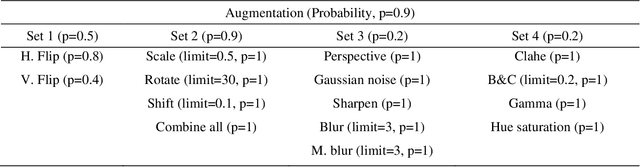
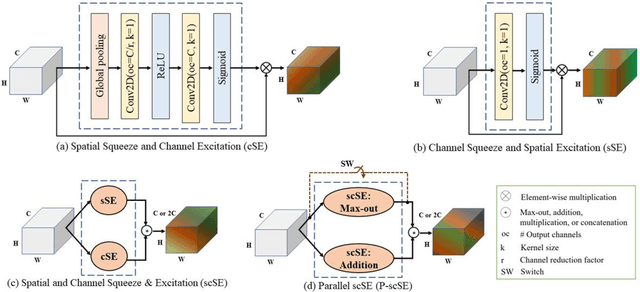
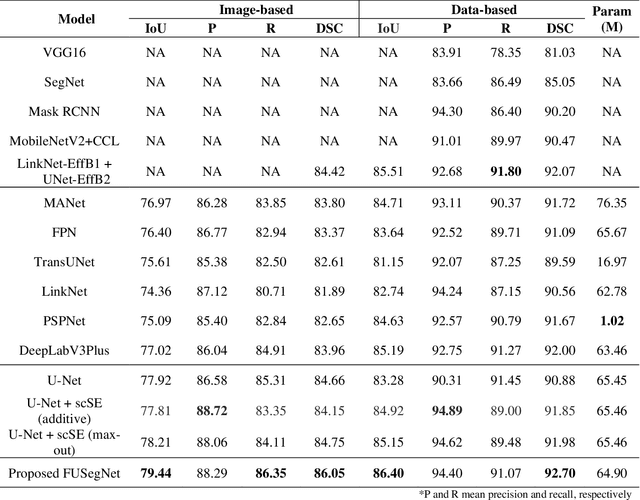
This paper presents FUSegNet, a new model for foot ulcer segmentation in diabetes patients, which uses the pre-trained EfficientNet-b7 as a backbone to address the issue of limited training samples. A modified spatial and channel squeeze-and-excitation (scSE) module called parallel scSE or P-scSE is proposed that combines additive and max-out scSE. A new arrangement is introduced for the module by fusing it in the middle of each decoder stage. As the top decoder stage carries a limited number of feature maps, max-out scSE is bypassed there to form a shorted P-scSE. A set of augmentations, comprising geometric, morphological, and intensity-based augmentations, is applied before feeding the data into the network. The proposed model is first evaluated on a publicly available chronic wound dataset where it achieves a data-based dice score of 92.70%, which is the highest score among the reported approaches. The model outperforms other scSE-based UNet models in terms of Pratt's figure of merits (PFOM) scores in most categories, which evaluates the accuracy of edge localization. The model is then tested in the MICCAI 2021 FUSeg challenge, where a variation of FUSegNet called x-FUSegNet is submitted. The x-FUSegNet model, which takes the average of outputs obtained by FUSegNet using 5-fold cross-validation, achieves a dice score of 89.23%, placing it at the top of the FUSeg Challenge leaderboard. The source code for the model is available on https://github.com/mrinal054/FUSegNet.