 Add to Chrome
 Add to Firefox
 Add to Edge
Spectral Property-Driven Data Augmentation for Hyperspectral Single-Source Domain Generalization
Mar 17, 2026
While hyperspectral images (HSI) benefit from numerous spectral channels that provide rich information for classification, the increased dimensionality and sensor variability make them more sensitive to distributional discrepancies across domains, which in turn can affect classification performance. To tackle this issue, hyperspectral single-source domain generalization (SDG) typically employs data augmentation to simulate potential domain shifts and enhance model robustness under the condition of single-source domain training data availability. However, blind augmentation may produce samples misaligned with real-world scenarios, while excessive emphasis on realism can suppress diversity, highlighting a tradeoff between realism and diversity that limits generalization to target domains. To address this challenge, we propose a spectral property-driven data augmentation (SPDDA) that explicitly accounts for the inherent properties of HSI, namely the device-dependent variation in the number of spectral channels and the mixing of adjacent channels. Specifically, SPDDA employs a spectral diversity module that resamples data from the source domain along the spectral dimension to generate samples with varying spectral channels, and constructs a channel-wise adaptive spectral mixer by modeling inter-channel similarity, thereby avoiding fixed augmentation patterns. To further enhance the realism of the augmented samples, we propose a spatial-spectral co-optimization mechanism, which jointly optimizes a spatial fidelity constraint and a spectral continuity self-constraint. Moreover, the weight of the spectral self-constraint is adaptively adjusted based on the spatial counterpart, thus preventing over-smoothing in the spectral dimension and preserving spatial structure. Extensive experiments conducted on three remote sensing benchmarks demonstrate that SPDDA outperforms state-of-the-art methods.

RadioDUN: A Physics-Inspired Deep Unfolding Network for Radio Map Estimation
Jun 10, 2025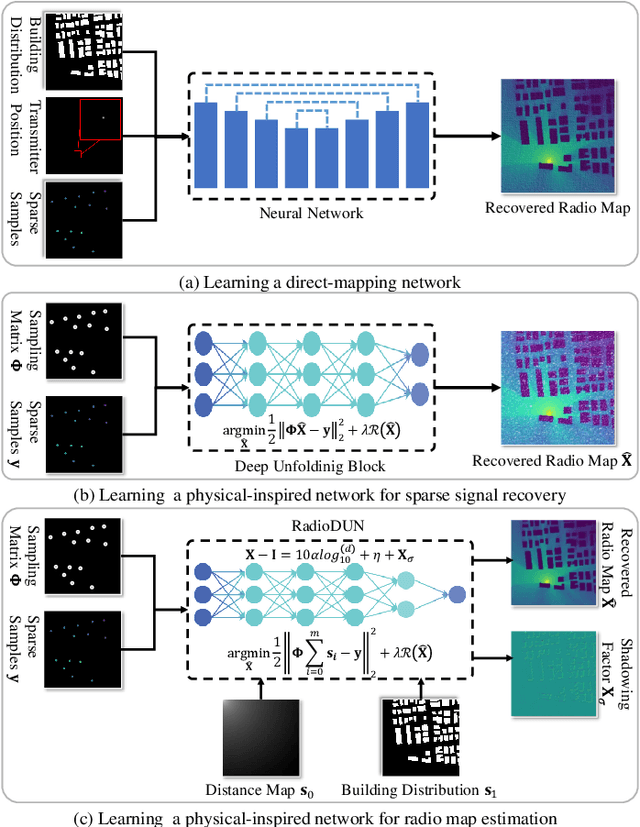

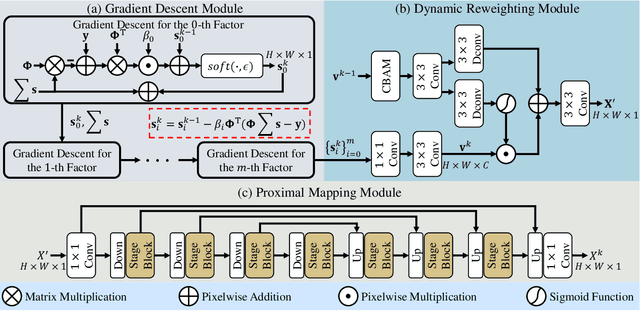
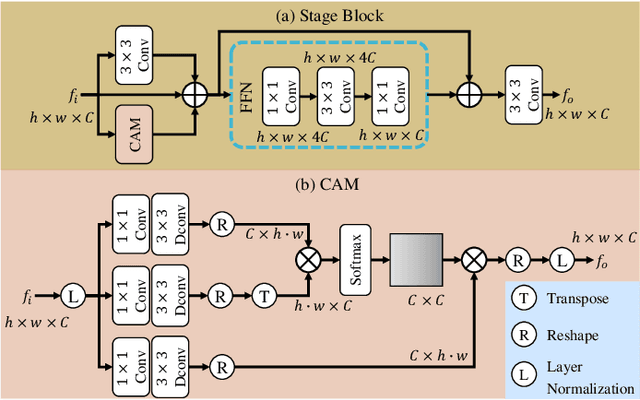
The radio map represents the spatial distribution of spectrum resources within a region, supporting efficient resource allocation and interference mitigation. However, it is difficult to construct a dense radio map as a limited number of samples can be measured in practical scenarios. While existing works have used deep learning to estimate dense radio maps from sparse samples, they are hard to integrate with the physical characteristics of the radio map. To address this challenge, we cast radio map estimation as the sparse signal recovery problem. A physical propagation model is further incorporated to decompose the problem into multiple factor optimization sub-problems, thereby reducing recovery complexity. Inspired by the existing compressive sensing methods, we propose the Radio Deep Unfolding Network (RadioDUN) to unfold the optimization process, achieving adaptive parameter adjusting and prior fitting in a learnable manner. To account for the radio propagation characteristics, we develop a dynamic reweighting module (DRM) to adaptively model the importance of each factor for the radio map. Inspired by the shadowing factor in the physical propagation model, we integrate obstacle-related factors to express the obstacle-induced signal stochastic decay. The shadowing loss is further designed to constrain the factor prediction and act as a supplementary supervised objective, which enhances the performance of RadioDUN. Extensive experiments have been conducted to demonstrate that the proposed method outperforms the state-of-the-art methods. Our code will be made publicly available upon publication.