 Add to Chrome
 Add to Firefox
 Add to Edge
Benchmarking Uncertainty Quantification of Plug-and-Play Diffusion Priors for Inverse Problems Solving
Feb 04, 2026
Plug-and-play diffusion priors (PnPDP) have become a powerful paradigm for solving inverse problems in scientific and engineering domains. Yet, current evaluations of reconstruction quality emphasize point-estimate accuracy metrics on a single sample, which do not reflect the stochastic nature of PnPDP solvers and the intrinsic uncertainty of inverse problems, critical for scientific tasks. This creates a fundamental mismatch: in inverse problems, the desired output is typically a posterior distribution and most PnPDP solvers induce a distribution over reconstructions, but existing benchmarks only evaluate a single reconstruction, ignoring distributional characterization such as uncertainty. To address this gap, we conduct a systematic study to benchmark the uncertainty quantification (UQ) of existing diffusion inverse solvers. Specifically, we design a rigorous toy model simulation to evaluate the uncertainty behavior of various PnPDP solvers, and propose a UQ-driven categorization. Through extensive experiments on toy simulations and diverse real-world scientific inverse problems, we observe uncertainty behaviors consistent with our taxonomy and theoretical justification, providing new insights for evaluating and understanding the uncertainty for PnPDPs.

Local Patches Meet Global Context: Scalable 3D Diffusion Priors for Computed Tomography Reconstruction
Dec 20, 2025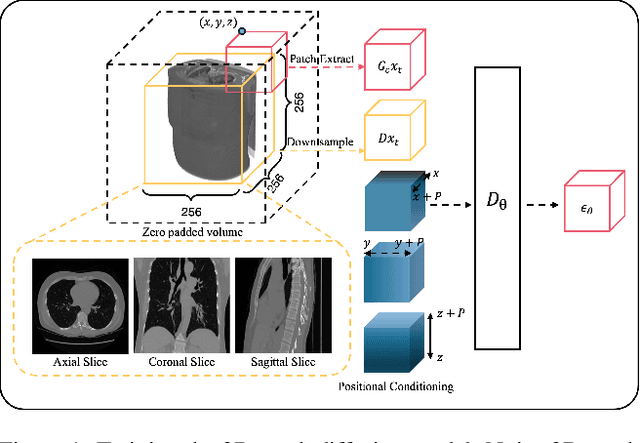
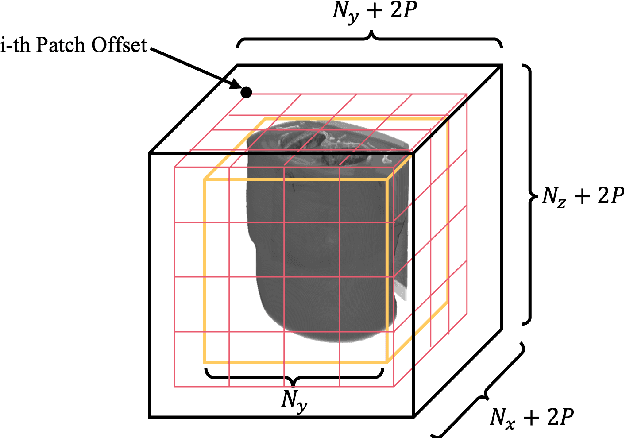
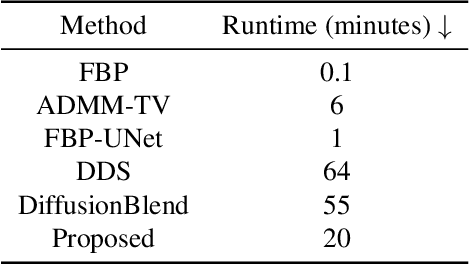

Diffusion models learn strong image priors that can be leveraged to solve inverse problems like medical image reconstruction. However, for real-world applications such as 3D Computed Tomography (CT) imaging, directly training diffusion models on 3D data presents significant challenges due to the high computational demands of extensive GPU resources and large-scale datasets. Existing works mostly reuse 2D diffusion priors to address 3D inverse problems, but fail to fully realize and leverage the generative capacity of diffusion models for high-dimensional data. In this study, we propose a novel 3D patch-based diffusion model that can learn a fully 3D diffusion prior from limited data, enabling scalable generation of high-resolution 3D images. Our core idea is to learn the prior of 3D patches to achieve scalable efficiency, while coupling local and global information to guarantee high-quality 3D image generation, by modeling the joint distribution of position-aware 3D local patches and downsampled 3D volume as global context. Our approach not only enables high-quality 3D generation, but also offers an unprecedentedly efficient and accurate solution to high-resolution 3D inverse problems. Experiments on 3D CT reconstruction across multiple datasets show that our method outperforms state-of-the-art methods in both performance and efficiency, notably achieving high-resolution 3D reconstruction of $512 \times 512 \times 256$ ($\sim$20 mins).