 Add to Chrome
 Add to Firefox
 Add to Edge
To Go Far, Go Together: Diverse Preferences Induce a Curriculum for Reward Optimization
Aug 19, 2026
Learning a reward model from human feedback and optimizing a policy against it is one approach to aligning AI systems with individual users. From a fairness perspective, existing work improves such alignment by developing data-efficient and accurate reward models that capture minority preferences despite scarce data. We push this line of inquiry one step further and argue that data-efficient and accurate per-user reward models are not sufficient: users whose reward models are difficult to \textit{optimize} at the policy level can become a new underserved group. We start from the observation that one user's reward model can be easy to optimize from the initial policy while another's is not. We argue that, given a sufficiently diverse user population, a curriculum naturally emerges between easy- and hard-to-optimize reward models. Building on this insight, we propose CurriPO, which grows a tree-structured curriculum to accommodate diverse user-specific objectives, covering the population in a single traversal. Specifically, CurriPO automatically constructs a curriculum over diverse user reward models, allowing it to branch from the existing curriculum and reuse reward models previously incorporated into the curriculum. To the best of our knowledge, this is the first work to explicitly exploit multi-user structure to address optimization in AI alignment. Extensive experiments on personalized continuous control in a simulated environment show that CurriPO achieves $1.2$--$2.1\times$ the population satisfaction of the strongest baseline while substantially reducing training time. Additional analysis attributes much of this improvement to the users left underserved by conventional optimization.

Deployable Human Preference Alignment in Robotics: Learning Representative Rewards from Diverse Human Preferences
Jul 14, 2026Aligning robot policies with human preferences is essential for deployment to diverse end users. In per-user alignment approach, preference feedback is often sparse, so learning becomes unstable and vulnerable to human preference noise, and a growing number of individualized policies makes validation difficult before deployment. A single shared policy approach to user alignment avoids this cost but fails to capture heterogeneous preferences and often neglects minority preferences. To address these challenges, we introduce Preference-based REward Clustering (PREC), a novel framework that learns a compact set of policies from binary preference labels provided by diverse users. From a dataset of user trajectories and their preference labels, PREC first sets the labels aside and aggregates trajectories across users to learn a population-level shared trajectory encoder, alleviating limited per-user coverage and avoiding label noise during representation learning. Using this representation, PREC jointly assigns users to preference-coherent clusters and learns a representative reward model per cluster using preference labels, from which a policy is optimized for each cluster. Clustering similar users compensates for the limited number of labels available from each user and mitigates the effect of label noise. At the same time, maintaining a manageable number of reward models reduces the validation burden at deployment. Experiments across diverse simulated locomotion environments show that PREC groups users who label different trajectory subsets into preference-coherent clusters more accurately than baseline methods. Under sparse and noisy feedback, policies trained with PREC improve all three social welfare metrics over an existing single shared-policy user-alignment approach and even outperform per-user alignment approaches.
Wave-Encoded Model-based Deep Learning for Highly Accelerated Imaging with Joint Reconstruction
Feb 06, 2022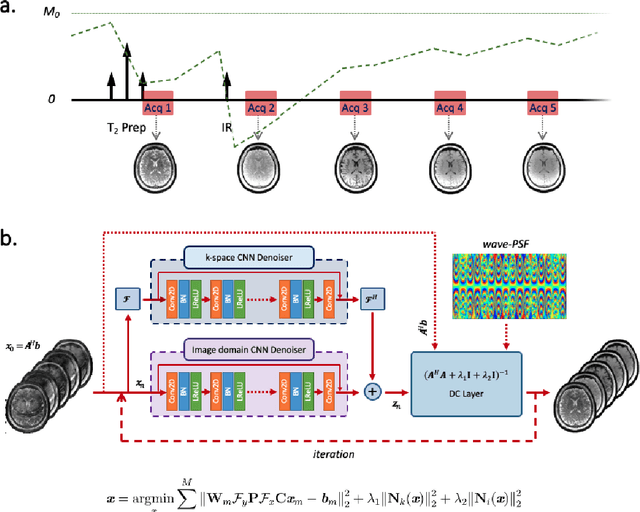
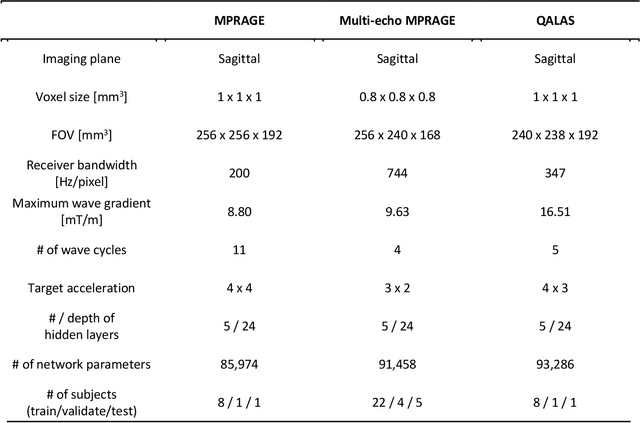
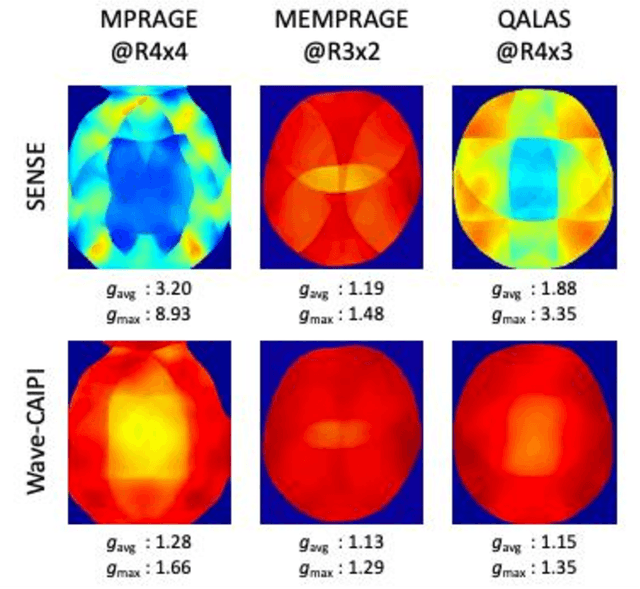
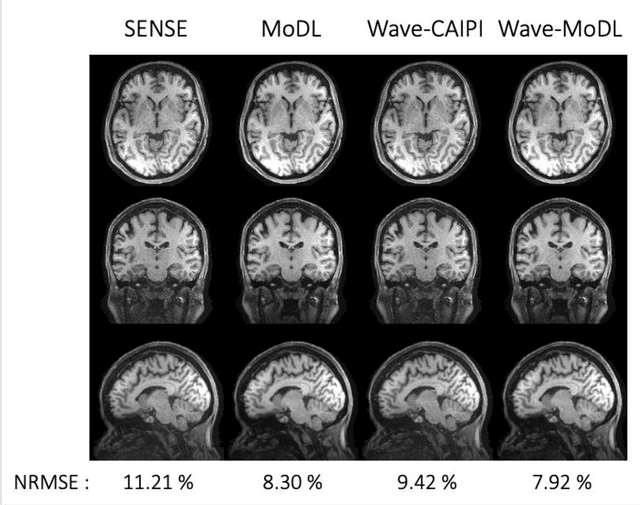
Purpose: To propose a wave-encoded model-based deep learning (wave-MoDL) strategy for highly accelerated 3D imaging and joint multi-contrast image reconstruction, and further extend this to enable rapid quantitative imaging using an interleaved look-locker acquisition sequence with T2 preparation pulse (3D-QALAS). Method: Recently introduced MoDL technique successfully incorporates convolutional neural network (CNN)-based regularizers into physics-based parallel imaging reconstruction using a small number of network parameters. Wave-CAIPI is an emerging parallel imaging method that accelerates the imaging speed by employing sinusoidal gradients in the phase- and slice-encoding directions during the readout to take better advantage of 3D coil sensitivity profiles. In wave-MoDL, we propose to combine the wave-encoding strategy with unrolled network constraints to accelerate the acquisition speed while enforcing wave-encoded data consistency. We further extend wave-MoDL to reconstruct multi-contrast data with controlled aliasing in parallel imaging (CAIPI) sampling patterns to leverage similarity between multiple images to improve the reconstruction quality. Result: Wave-MoDL enables a 47-second MPRAGE acquisition at 1 mm resolution at 16-fold acceleration. For quantitative imaging, wave-MoDL permits a 2-minute acquisition for T1, T2, and proton density mapping at 1 mm resolution at 12-fold acceleration, from which contrast weighted images can be synthesized as well. Conclusion: Wave-MoDL allows rapid MR acquisition and high-fidelity image reconstruction and may facilitate clinical and neuroscientific applications by incorporating unrolled neural networks into wave-CAIPI reconstruction.