 Add to Chrome
 Add to Firefox
 Add to Edge
Solar Open 2 Technical Report
Jul 24, 2026
We present Solar Open 2, a 250B-A15B Mixture-of-Experts language model built for long-horizon agentic tasks, scaled up from Solar Open 1 (Solar Open 100B). To hold entire agent trajectories in a single context, Solar Open 2 reaches a 1M-token window through a hybrid attention stack that interleaves one softmax layer among every three linear-attention layers, using no positional encoding and a gated delta rule extended to negative eigenvalues. To train at this scale under a fixed compute budget, we make training efficient in two ways: a stronger starting point, and higher-value data. For the starting point, we initialize Solar Open 2 from Solar Open 1, transferring the 5.69B-parameter shared skeleton that survives the architectural change and learning everything else through full pre-training. For the data, we curate for value per token: quality- and rarity-aware data curation and mixture-ratio optimization refine a 20T pool into a 10T mixture that, at equal token budget, outperforms the Solar Open 1 recipe. To build its agent skills, we train twelve domain specialists across purpose-built scenarios, then consolidate them into a single model by Multi-teacher On-Policy Distillation (MOPD). Against comparably sized open-weight models on English benchmarks, Solar Open 2 leads on MMLU-Pro, LiveCodeBench, and the APEX-Agents agentic suite, and stays competitive with the strongest (DeepSeek-V4-Flash and MiMo-V2.5) elsewhere. On Korean benchmarks, Solar Open 2 records the highest average of any model compared, including fast-tier closed APIs, and on Ko-GDPval, an in-house Korean officework-agent benchmark, it is competitive with DeepSeek-V4-Pro (1.6T) at less than a sixth of its size.

Kanana: Compute-efficient Bilingual Language Models
Feb 26, 2025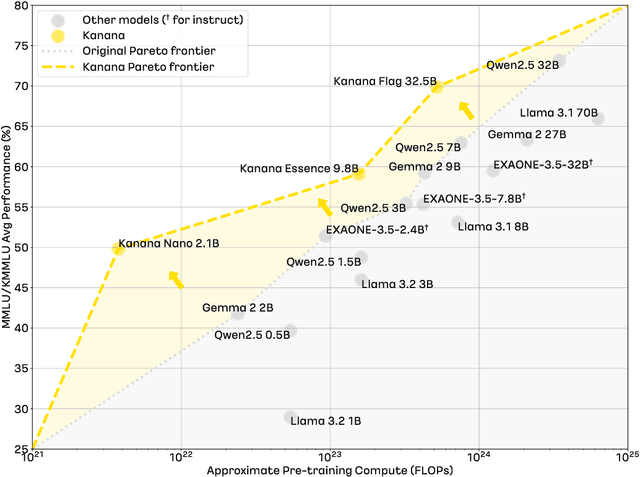
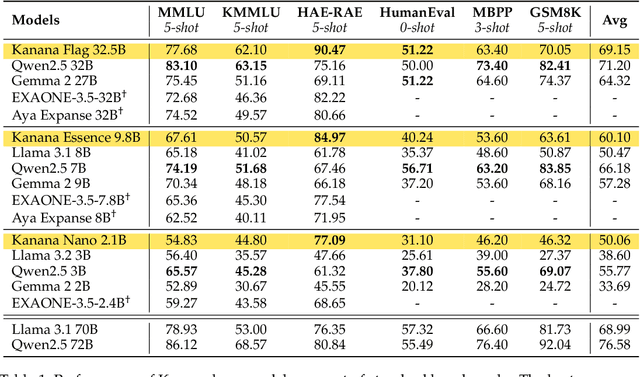
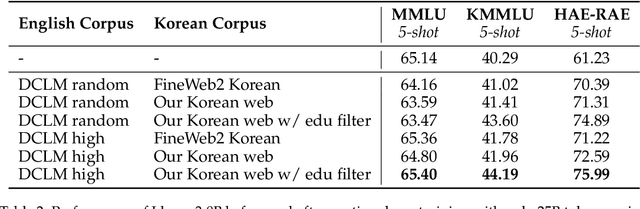
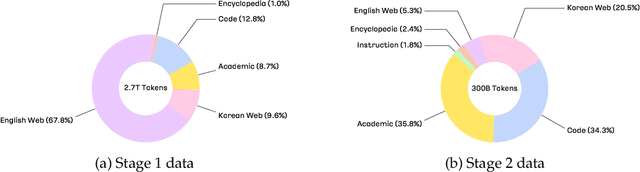
We introduce Kanana, a series of bilingual language models that demonstrate exceeding performance in Korean and competitive performance in English. The computational cost of Kanana is significantly lower than that of state-of-the-art models of similar size. The report details the techniques employed during pre-training to achieve compute-efficient yet competitive models, including high quality data filtering, staged pre-training, depth up-scaling, and pruning and distillation. Furthermore, the report outlines the methodologies utilized during the post-training of the Kanana models, encompassing supervised fine-tuning and preference optimization, aimed at enhancing their capability for seamless interaction with users. Lastly, the report elaborates on plausible approaches used for language model adaptation to specific scenarios, such as embedding, retrieval augmented generation, and function calling. The Kanana model series spans from 2.1B to 32.5B parameters with 2.1B models (base, instruct, embedding) publicly released to promote research on Korean language models.