 Add to Chrome
 Add to Firefox
 Add to Edge
Let's Scale Step by Step: Compute-Efficient Hyperparameter Transfer for Large-Scale Mixture-of-Experts
Aug 20, 2026
Mixture-of-Experts (MoE) architectures significantly expand model capacity without a proportional increase in computational cost. However, optimizing their hyperparameters---particularly the learning rate---at extreme scales of both model size and token budget via sweeping remains computationally prohibitive. In this paper, we propose a compute-efficient, two-step hyperparameter transfer framework that estimates optimal learning rates for training large MoE models by transferring them across scaling model widths, and subsequently extrapolating to trillion-token horizons. First, we formulate a Maximal Update Parameterization ($μ$P) adaptation for MoE architectures utilizing Multi-head Latent Attention (MLA) and the Muon optimizer, demonstrating that optimal learning rates transfer consistently across width-scaled models. Second, we extend this transferability along the token dimension by establishing a predictive scaling law. By applying linear regression to the optimal values derived from small proxy models on limited budgets, we successfully extrapolate the ideal learning rate to massive training horizons (e.g., 10 trillion tokens) with high fidelity ($R^2=0.95$). Consequently, this indicates that proxy training on small models is sufficient to determine the optimal learning rate for the extensive training of large-scale MoEs. We apply the proposed methodology to pretrain our foundation model (155B total, 17B active parameters) from scratch, and the stable training and evaluation results validate that optimal configurations for full-scale target models can be accurately predicted with minimal ablation costs.

Kanana: Compute-efficient Bilingual Language Models
Feb 26, 2025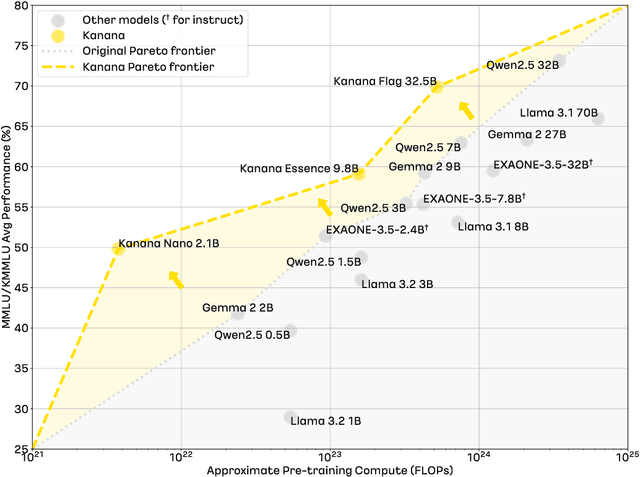
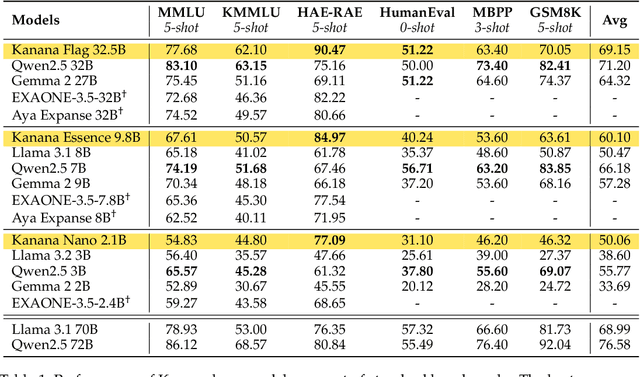
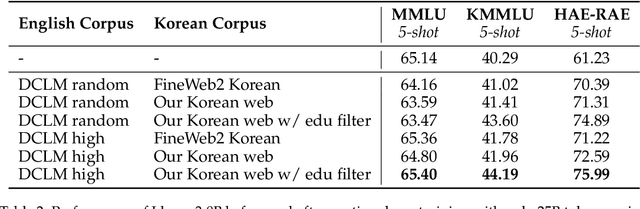
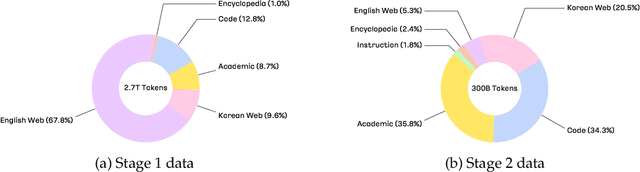
We introduce Kanana, a series of bilingual language models that demonstrate exceeding performance in Korean and competitive performance in English. The computational cost of Kanana is significantly lower than that of state-of-the-art models of similar size. The report details the techniques employed during pre-training to achieve compute-efficient yet competitive models, including high quality data filtering, staged pre-training, depth up-scaling, and pruning and distillation. Furthermore, the report outlines the methodologies utilized during the post-training of the Kanana models, encompassing supervised fine-tuning and preference optimization, aimed at enhancing their capability for seamless interaction with users. Lastly, the report elaborates on plausible approaches used for language model adaptation to specific scenarios, such as embedding, retrieval augmented generation, and function calling. The Kanana model series spans from 2.1B to 32.5B parameters with 2.1B models (base, instruct, embedding) publicly released to promote research on Korean language models.